
Local SEO in 2026 requires more than just a Google Business Profile. This guide covers 13 proven strategies — from GBP optimisation and Core Web Vitals to AI-powered search and review management — to help your business rank in the local pack and win more customers in your city.
Key takeaway: Businesses that combine GBP optimisation + consistent NAP + active review management see an average 3× increase in local pack visibility within 90 days.
Why Local SEO Matters More Than Ever in 2026
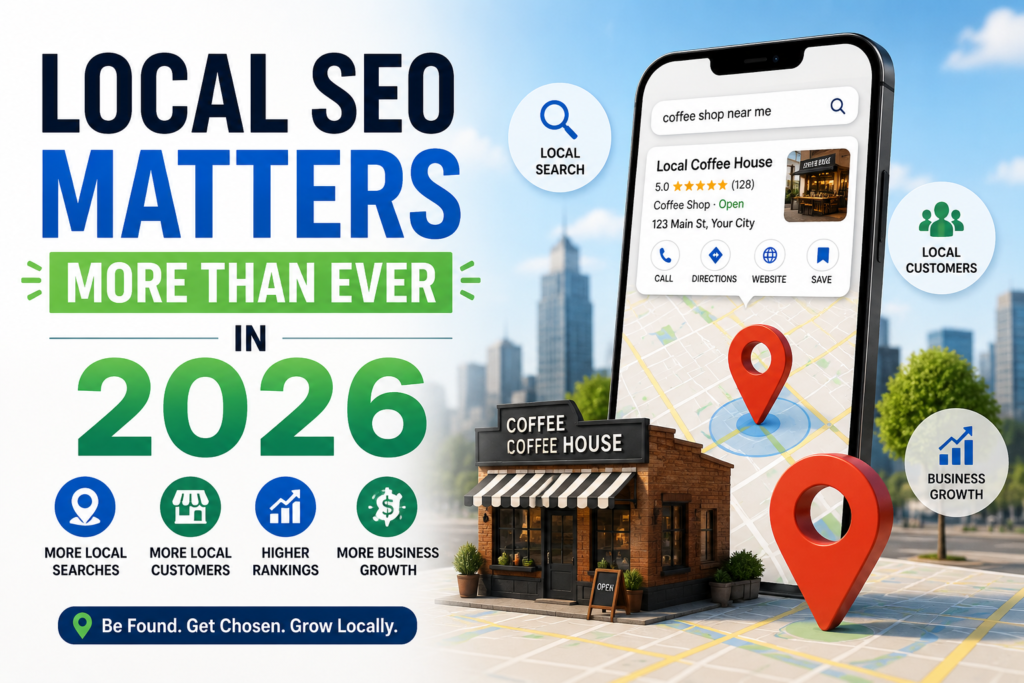
Google’s search landscape has changed dramatically. AI Overviews now appear above organic results. Voice search is mainstream. And ‘near me’ searches have grown by over 500% in recent years according to Google’s own data. Yet the businesses winning these searches aren’t necessarily the biggest — they’re the ones that have done the work to optimise their local presence.
Local SEO (Search Engine Optimisation) is the practice of improving your business’s visibility in location-based search results — the map pack, Google Business Profile listings, and local organic results. For small businesses, local service providers, and brick-and-mortar shops, local SEO is not optional. It is the single most cost-effective digital marketing channel available.
Consider this: 76% of people who search for something nearby visit a business within a day (Google Consumer Insights). And 28% of those searches result in a purchase. If your business isn’t showing up when locals search for your service, you’re handing customers directly to your competitors.
| 📚 Also Read — Learn More About SEO→ 10 Reasons Why SEO is Important for Your Business→ Local SEO Ranking Factors: What Actually Moves the Needle→ The Importance of Local SEO for Small Businesses |
What is Local SEO? (2026 Definition)
Local SEO is the process of optimising your online presence so that your business appears prominently in geographically-relevant searches. Unlike traditional SEO, which targets national or global audiences, local SEO focuses on attracting customers in your specific city, neighbourhood, or service area.
There are three primary places where local SEO visibility shows up on Google:
- The Local Pack (Map Pack) — the 3 business listings shown with a map at the top of local search results
- The Knowledge Panel — the information box on the right side showing your business details
- Local Organic Results — standard blue links that show up below the map pack
Google uses three core factors to determine local rankings:
| Factor | What It Means | How to Influence It |
|---|---|---|
| Relevance | How well your profile matches the search query | Complete GBP profile, keyword-rich descriptions, right categories |
| Distance | How close your business is to the searcher | Accurate address, service area settings in GBP |
| Prominence | How well-known and trusted your business is | Reviews, backlinks, citations, online mentions |
1. Fully Optimise Your Google Business Profile (GBP)
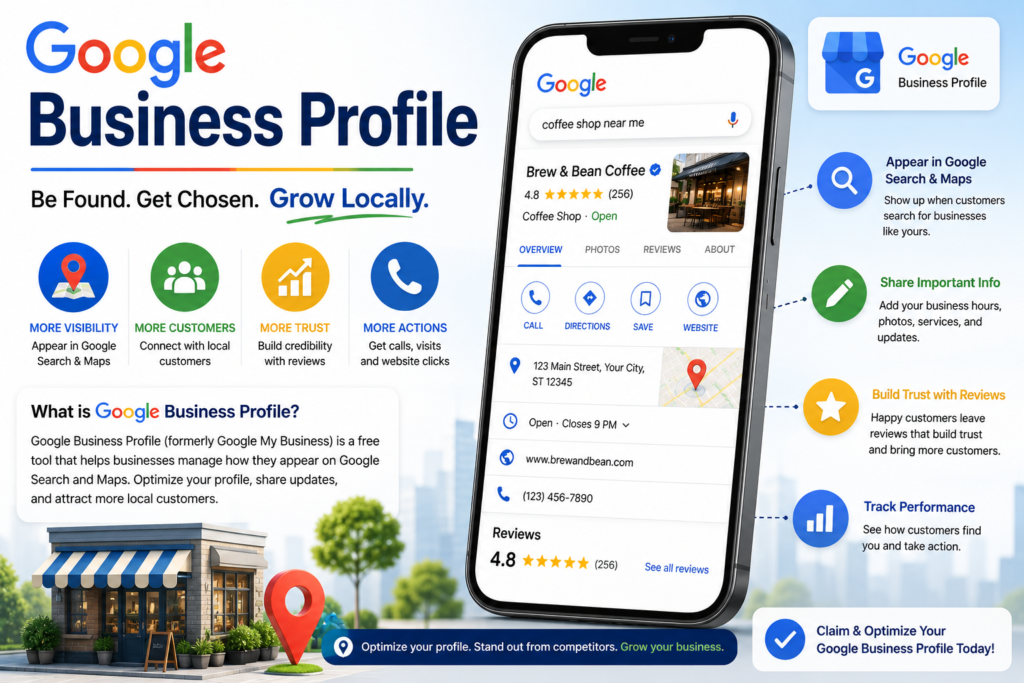
Google Business Profile (formerly Google My Business, rebranded in 2021) is the single most important tool for local SEO. A fully optimised GBP directly influences your ranking in the local pack. According to BrightLocal’s Local Consumer Review Survey 2024, businesses with complete GBP profiles are 2.7× more likely to be considered reputable by consumers.
Here’s how to optimise your GBP for 2026:
- Business Name, Category & Description: Use your exact registered business name. Select the most specific primary category and add secondary categories. Write a keyword-rich description (750 characters max) that naturally includes your city and service.
- Google Posts: Publish weekly updates — offers, events, product announcements. Posts expire after 7 days so freshness signals matter. Example: A Jaipur restaurant posting daily specials saw a 35% increase in profile views within 60 days.
- Photos & Videos: Businesses with more than 100 photos on GBP receive 520% more calls than those with fewer photos (Google data). Upload team photos, interior/exterior shots, products, and short video walkthroughs.
- Q&A Management: Pre-populate your own Q&A section with frequently asked questions. This controls the narrative and adds keyword-rich content to your profile.
- Service/Product Catalogue: List every service with descriptions and pricing ranges. This helps GBP understand your offerings for relevant queries.
- GBP Messaging: Enable direct messaging. Profiles that respond quickly earn a ‘Responds quickly’ badge that boosts conversion rates.
A dental clinic in Jaipur added 150+ photos, responded to all reviews within 24 hours, and published weekly posts about dental tips. Within 3 months, their GBP direction requests increased by 40% and phone calls from Google Search doubled.
2. Optimise On-Page SEO with Local Signals
Your website’s on-page elements must clearly communicate your location and services to search engines. In 2026, this goes well beyond basic title tags — it includes structured data, semantic HTML, and location-specific content signals.
- Title Tags: Follow the format: “Primary Service in City | Business Name” — e.g., “Best Digital Marketing Agency in Jaipur | G2S Technology”
- Meta Descriptions: Include your city and a clear call to action — e.g., “Looking for SEO services in Jaipur? G2S Technology helps local businesses rank higher on Google. Call us today.”
- Header Tags (H1–H3): Your H1 should contain your primary keyword + location. Use H2s for sub-services and locations.
- Local Business Schema Markup: This is now essential, not optional. Add JSON-LD Local Business schema to every page:
| 💻 Code Example — LocalBusiness JSON-LD Schema{ “@context”: “https://schema.org“, “@type”: “LocalBusiness”, “@id”: “https://g2stechnology.com/#business“, “name”: “G2S Technology”, “url”: “https://g2stechnology.com“, “telephone”: “+91-7976373846”, “address”: { “@type”: “PostalAddress”, “streetAddress”: “Orbit Mall, B37, Shanti Nagar, Civil Lines”, “addressLocality”: “Jaipur”, “addressRegion”: “Rajasthan”, “postalCode”: “302006”, “addressCountry”: “IN” }, “openingHoursSpecification”: [ { “@type”: “OpeningHoursSpecification”, “dayOfWeek”: [ “Monday”, “Tuesday”, “Wednesday”, “Thursday”, “Friday”, “Saturday” ], “opens”: “09:00”, “closes”: “18:00” } ], “areaServed”: { “@type”: “City”, “name”: “Jaipur” } } |
- FAQ Schema: Add FAQ schema to blog posts and service pages. This helps your content appear in Google’s AI Overviews and voice search results.
- Internal Linking: Link service pages to relevant blog posts and vice versa to build topical authority and help Google crawl your site’s local relevance.
| 📚 Also Read→ 10 Essential On-Page SEO Factors You Need to Know→ On-Page SEO Cheat Sheet to Rank on the First Page→ How to Increase SERP Visibility Using Local Business Schema |
3. Create Dedicated, Unique Location Pages
If your business serves multiple cities or areas, you need a dedicated page for each one. Generic pages that just swap out the city name will be penalised by Google as ‘doorway pages’. Each location page must provide genuinely unique, valuable content.
Each location page should include:
- Unique written content (500+ words): Describe what makes your service in that specific location different. Mention local landmarks, neighbourhoods, and client results from that area.
- LocalBusiness Schema with exact address: Each page should have schema specific to that location.
- Embedded Google Map: Embed the Google Map for that specific office or service area.
- Local reviews: Feature testimonials from customers in that specific city.
- Location-specific FAQs: Address questions unique to customers in that area — pricing, travel time, local regulations relevant to your service.
AVOID thin doorway pages — pages that are nearly identical except for the city name. Google actively demotes these. If you can’t write at least 500 words of genuinely unique content for a location, combine multiple nearby areas onto one page instead.
| 📚 Read More→ 10 Ways to Optimise Your Website for Local SEO→ Finding Your Way in Local Searches — A Comprehensive Guide for Small Businesses |
4. Build Topical Authority with Local Content
Google rewards websites that demonstrate deep expertise on a topic. For local businesses, this means creating a structured content ecosystem — not just random blog posts, but a strategic hub-and-spoke model built around your service area and niche.
The hub-and-spoke content model for local SEO works like this:
- Hub Page: Create a comprehensive, cornerstone page — e.g., “Complete Guide to Digital Marketing in Jaipur” — that covers the broad topic.
- Spoke Pages: Create supporting blog posts that link back to the hub — e.g., “Social Media Marketing Tips for Jaipur Businesses”, “How to Run Google Ads in Jaipur”, “Local SEO for Jaipur Restaurants”.
- Local Event & News Content: Write about local events, industry news in your city, or community initiatives. This signals geographic relevance to Google.
- Optimise for AI Overviews: Structure answers clearly. Google’s AI Overviews pull from well-organised, concise content. Answer questions in the format “What is X? / How does X work? / Why does X matter?” directly in your content.
Publish at least 2 locally-relevant blog posts per month. Focus on: (1) answering FAQs your customers ask you in person, (2) local industry news, (3) how-to guides specific to your service in your city. Consistency builds topical authority over time.
| 📚 Also Read→ Tips to Write SEO-Friendly Content→ Local SEO Content Types That Drive Real Results→ The Ultimate Guide to Content Marketing |
5. Achieve Core Web Vitals & Mobile Excellence
‘Mobile-friendly’ was table stakes in 2020. In 2026, Google holds your site to a much higher standard: Core Web Vitals are confirmed ranking signals that measure real-world user experience.
| Core Web Vital | What It Measures | Target Score |
|---|---|---|
| LCP (Largest Contentful Paint) | How fast the main content loads | Under 2.5 seconds |
| INP (Interaction to Next Paint) | How quickly the page responds to user input (replaced FID in 2024) | Under 200ms |
| CLS (Cumulative Layout Shift) | How stable the layout is (no jumping elements) | Under 0.1 |
Beyond Core Web Vitals, local mobile optimisation requires:
- Click-to-call buttons: Prominently placed phone numbers that dial directly. Mobile local searchers are in action mode — make it frictionless.
- Click-for-directions links: Link directly to Google Maps with your address pre-filled.
- Fast-loading images: Use WebP format and lazy loading. Images are the #1 cause of slow LCP scores.
- No intrusive pop-ups: Google penalises mobile sites with pop-ups that cover content immediately on load.
Use Google PageSpeed Insights and Google Search Console’s Core Web Vitals Report to monitor your scores monthly.
| 📚 Read More→ How Page Speed Affects SEO & Google Rankings→ Mobile SEO: Complete Optimisation Guide→ Optimise Website for Mobile Devices |
6. Maintain Consistent NAP Across All Platforms
NAP stands for Name, Address, and Phone number. Google cross-references your business information across dozens of online sources. Inconsistencies — even minor ones like ‘St.’ vs ‘Street’ — create trust signals that can suppress your local ranking.
How to ensure NAP consistency in 2026:
- Audit with tools: Use BrightLocal, Whitespark, or Moz Local to scan your NAP across 50+ directories and identify discrepancies.
- Priority platforms: Ensure NAP is 100% correct on Google Business Profile, your website (all pages), Bing Places, Apple Maps, and JustDial first — these have the most authority.
- Add structured data: Use Schema.org LocalBusiness markup on every page of your website — not just the contact page.
- Update everywhere simultaneously: If you move location or change phone numbers, update GBP, your website, and all directories within the same week. Stale citations confuse Google.
A Jaipur law firm had ‘Shanti Nagar’ listed on Google but ‘Shantinaagar’ (typo) on JustDial and three other directories. After correcting all citations using BrightLocal, their local pack ranking improved from position 7 to position 2 within 45 days.
7. Build Citations on India-Relevant Directories
Citations are online mentions of your business — with or without a link. They signal to Google that your business is established and trustworthy. The key in 2026 is quality and consistency, not volume.
High-priority citation sources for Indian businesses:
| Directory | Best For | Priority |
|---|---|---|
| JustDial | All business types — India’s largest directory | ⭐ Essential |
| Sulekha | Service businesses, home services, professionals | ⭐ Essential |
| IndiaMart | B2B, manufacturing, wholesale | ⭐ Essential |
| Urban Company (UrbanClap) | Home services, beauty, wellness | ⭐ High |
| Practo | Healthcare, doctors, clinics | ⭐ High |
| MagicBricks / 99acres | Real estate businesses | ⭐ High |
| Google Business Profile | All business types | ⭐ Critical |
| Bing Places for Business | All business types | ⭐ Essential |
| Apple Maps Connect | All business types | ⭐ High |
For global citations, Foursquare is particularly important as it powers hundreds of apps and aggregators that feed location data across the web.
| 📚 Read More→ Google Business Profile vs Other Local Listing Platforms→ Google Maps Ranking Check Tools |
8. Build High-Quality Local Backlinks
According to Moz’s Local Search Ranking Factors report, link signals consistently rank among the top 3 factors for local ranking. But in 2026, quality matters far more than quantity. One link from a respected local news site is worth more than 50 links from low-quality directories.
Modern local link building strategies that work in 2026:
- Local PR & News Coverage: Pitch stories to local publications — Times of India, Rajasthan Patrika, local business journals. A feature or quote earns a powerful, high-authority link.
- Sponsor Local Events: Sponsor marathons, school events, community festivals. Event organisers typically link to sponsors from their websites.
- Chamber of Commerce Membership: Join your local chamber of commerce and industry associations. These provide high-authority, locally-relevant links.
- ‘Best of [City]’ Roundups: Reach out to bloggers and content creators who publish ‘Best Digital Marketing Agencies in Jaipur’ style posts. Request inclusion.
- Unlinked Brand Mention Reclamation: Set up Google Alerts for your business name. When you find mentions that don’t include a link, reach out and politely request one.
- Guest Blogging: Write high-value articles for local industry blogs, trade publications, and news sites. Include a contextual link back to your relevant service page — not just your homepage.
| 📚 Also Read→ 7 New Ways for Local Businesses to Get Links→ Mastering Link Building: A Comprehensive Guide→ Biggest SEO Link Building Mistakes to Avoid in 2026 |
9. Master Local Keyword Research
Local keyword research in 2026 is about understanding search intent, not just search volume. A keyword with 50 monthly searches and high purchase intent is far more valuable than one with 5,000 searches from people who will never become customers.
The four types of local keyword intent you should target:
| Intent Type | Example Keywords | Where to Target |
|---|---|---|
| Navigational | “G2S Technology Jaipur address”, “G2S Technology contact” | Homepage, Contact page |
| Informational | “how to improve local SEO in Jaipur”, “what is Google Business Profile” | Blog posts, FAQ pages |
| Transactional | “hire SEO agency Jaipur”, “digital marketing company near me” | Service pages, Landing pages |
| “Near Me” / Implicit Local | “restaurants near me”, “plumber open now” | GBP profile, NAP + schema |
Best tools for local keyword research:
- Google Keyword Planner: Free and shows location-based search volumes. Filter by India or specific states.
- Semrush Local: Track local keyword rankings and audit your GBP performance.
- Ahrefs Keywords Explorer: Find keyword gaps and competitive opportunities in your local market.
- Answer The Public: Discover the exact questions people are typing about your service in your city.
In 2026, ChatGPT Search, Perplexity, and Google AI Overviews are now significant traffic sources. These AI tools prefer content that directly answers specific questions. For every service page, add a clear FAQ section that answers 5–8 questions your customers commonly ask. Use natural, conversational language.
10. Optimise for Voice Search & AI-Powered Search
The way people search has fundamentally changed. Smart speakers, mobile voice assistants (Google Assistant, Siri, Alexa), and AI chat interfaces (ChatGPT, Gemini, Perplexity) are now common entry points to local discovery. Optimising for these channels requires a different content approach.
Voice and AI search optimisation strategies:
- Conversational FAQ content: Create content that answers complete questions. Instead of “SEO Jaipur”, optimise for “Which is the best SEO agency in Jaipur for small businesses?”
- Featured Snippet optimisation: Voice assistants read Featured Snippets aloud. Structure your content with a direct 40–60 word answer immediately after each H2 or H3 heading.
- ‘Near me’ and ‘Open now’ signals: Keep your GBP hours up-to-date and mark special hours for holidays. Google uses this to serve ‘open now’ queries.
- Local business FAQ schema: Mark up your FAQ content with FAQ Schema so Google can pull it directly into AI Overviews and voice results.
- Zero-click optimisation: Many local searches resolve without a click — the searcher gets their answer from the Knowledge Panel or Map Pack. Claim your Knowledge Panel and ensure your GBP is the authoritative source.
| 📚 Also Read→ Digital Marketing Trends 2026 and Beyond→ Boost Your Local SEO Ranking — Advanced Strategies |
11. Actively Manage Reviews — Your Most Powerful Trust Signal
Reviews are the #1 factor for local pack rankings according to Whitespark’s Local Search Ranking Factors 2023. More importantly, 93% of consumers say online reviews influence their purchase decisions (BrightLocal). Reviews are not just a ranking factor — they are your most visible sales tool.
A complete review management strategy for 2026:
- Request reviews systematically: After every completed service, send a direct Google review link via WhatsApp, SMS, or email. Use a QR code at your reception or on invoices. The easier you make it, the more reviews you’ll get.
- Respond to every review: Google confirmed that responding to reviews helps local ranking. For positive reviews, thank the customer and mention a specific service or product. For negative reviews, acknowledge the issue, apologise, and offer a resolution — never argue publicly.
- Review velocity matters: A steady stream of new reviews is better than a burst followed by silence. Aim for at least 4–5 new reviews per month.
- Include keywords naturally in responses: When responding, you can naturally include relevant keywords — e.g., “Thank you for trusting us with your website design project in Jaipur.”
- Monitor review platforms: Don’t just watch Google. Monitor JustDial, Sulekha, Facebook, and industry-specific platforms like Practo (healthcare) or 99acres (real estate).
A retail clothing store in Jaipur went from 12 Google reviews (3.8 stars) to 187 reviews (4.6 stars) in 6 months by placing a review request QR code on every purchase receipt. Their Google Maps ranking improved from outside the top 10 to a consistent position 2 for their primary keywords. Foot traffic increased by 28%
12. Leverage Social Signals & Hyperlocal Engagement
While social media is not a direct Google ranking factor, the brand authority, local mentions, and inbound traffic that come from strong social presence do influence local SEO outcomes indirectly.
Key social strategies for local businesses in 2026:
- Instagram geo-tagging: Tag your city and specific locations in every post. Build a local audience that drives branded searches — and branded searches are a strong local ranking signal.
- Facebook Local Groups: Participate genuinely in local community Facebook groups relevant to your industry. Answer questions, offer value, and occasionally reference your services when appropriate.
- Social proof on your website: Embed your Google reviews and social testimonials on service pages. Social proof improves conversion rates and time-on-page, both of which send positive engagement signals to Google.
- YouTube local content: Create short video guides relevant to your city — “How to choose an SEO agency in Jaipur”, “Top 5 website mistakes Jaipur businesses make”. YouTube videos rank in Google Search and build brand authority.
| 📚 Also Read→ 5 Creative Ways to Promote Your Product on Social Media→ Benefits of Social Media Marketing for Local Businesses→ How to Boost Your Website Traffic with Social Media |
13. Run Regular Local SEO Audits
Local SEO is not a one-time project — it’s an ongoing process. Google’s algorithm updates, competitor activity, and changes to your own business all require regular attention. A systematic monthly audit keeps your local rankings protected and growing.
Your monthly local SEO audit checklist:
- GBP Health Check: Verify all information is accurate, check for Google-suggested edits (sometimes Google auto-changes your listing based on user suggestions), review insights for calls, views, and direction requests.
- Core Web Vitals: Check Google Search Console for any pages that fail Core Web Vitals thresholds. Fix failing pages within 30 days.
- Citation Audit: Use BrightLocal or Whitespark to check for new NAP inconsistencies and new citation opportunities.
- Review Monitoring: Check all platforms for new reviews. Respond within 24 hours. Track your average rating trend over time.
- Keyword Rank Tracking: Monitor your local pack and organic rankings for your 10–15 primary keywords. Semrush Local or BrightLocal make this easy.
- Competitor Analysis: Check what your top 3 local competitors are doing — new pages, new reviews, new links. Identify gaps.
- Backlink Monitoring: Use Google Search Console or Ahrefs to watch for lost links and new link opportunities.
| 📚 Read More→ Complete SEO Audit Guide for 2025–26→ Regular SEO Audits Are Crucial for Website Health→ Common SEO Audit Mistakes That Hurt Rankings |
E-E-A-T: The Framework Behind Everything
Google’s E-E-A-T (Experience, Expertise, Authoritativeness, Trustworthiness) framework underpins how the algorithm evaluates local business content. Every strategy in this guide contributes to one or more E-E-A-T signals. Here’s how to explicitly demonstrate E-E-A-T on your local website:
| E-E-A-T Signal | How to Demonstrate It | Priority |
|---|---|---|
| Experience | Show real case studies, before/after results, years in business, client testimonials with specific outcomes | High |
| Expertise | Named author bios with credentials, certifications displayed (e.g. Google Partner badge), detailed how-to content | High |
| Authoritativeness | Press mentions, industry awards, backlinks from authoritative local sites, chamber memberships displayed | Medium |
| Trustworthiness | SSL certificate, clear privacy policy, physical address, phone number, HTTPS throughout, genuine reviews | Critical |
Frequently Asked Questions About Local SEO
How long does local SEO take to show results?
Most businesses see meaningful improvement in local pack rankings within 3–6 months of consistent optimisation. Quick wins like GBP optimisation and review management can show results in 4–8 weeks. Building domain authority through links takes 6–12 months.
Is Google Business Profile free?
Yes, Google Business Profile is completely free to create and manage. There is no paid version. You can run Google Ads separately to appear above organic local results, but the organic GBP listing costs nothing.
How many Google reviews do I need to rank in the local pack?
There is no minimum number. What matters more is recency (reviews in the last 90 days), rating (4.0+ average), and your review count relative to competitors. In competitive markets, the top-ranked businesses often have 100+ reviews. In low-competition niches, 20 reviews may be enough.
Does social media affect local SEO rankings?
Social media is not a direct ranking factor. However, strong social presence drives branded searches, local mentions, and website traffic — all of which are indirect local SEO signals. More importantly, social media is where potential customers discover and vet local businesses before visiting.
What’s the difference between local SEO and regular SEO?
Regular (national/global) SEO targets broad keywords without geographic intent. Local SEO specifically targets location-based queries and optimises for the Map Pack and local organic results. Local SEO involves GBP optimisation, citation building, and review management — elements that don’t exist in national SEO.
Conclusion: Your Local SEO Action Plan for 2026
Local SEO in 2026 is a multi-channel discipline that requires sustained effort across your Google Business Profile, website, citation network, review platforms, and content strategy. The good news? Most of your local competitors aren’t doing all of this — which means the opportunity is significant.
Start here — your priority order for the first 30 days:
- Fully complete and optimise your Google Business Profile
- Fix all NAP inconsistencies across your top 10 directories
- Add LocalBusiness Schema to your website
- Set up a systematic review request process
- Create or update your core service pages with location signals
If you want expert help implementing these strategies, G2S Technology’s Local SEO Services specialise in helping Jaipur and India-based businesses dominate their local markets. We’ve helped businesses across healthcare, retail, legal, real estate, and hospitality sectors achieve top-3 local pack rankings.