
68% of all online experiences begin with a search engine — and if your business isn’t showing up on page one, you’re handing those clicks to a competitor.
After running 100+ SEO campaigns for B2B brands, ecommerce stores, and local service businesses across India and abroad, our team has seen one truth repeat itself: SEO is no longer optional. It is the single most cost-effective channel for compounding traffic, leads, and revenue.
In this guide, you’ll learn exactly why SEO is important for your business in 2026, what real returns it delivers, and how it stacks up against paid ads. Let’s get into it.
What Is SEO? A Quick Definition
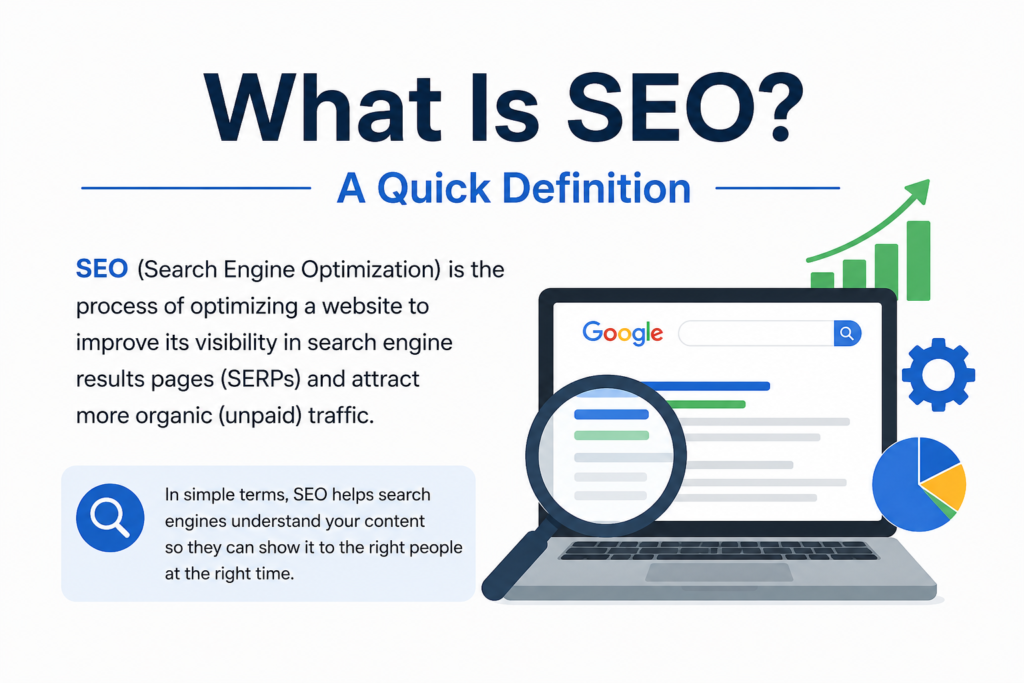
Search Engine Optimization (SEO) is the practice of improving a website’s visibility in unpaid search engine results on platforms like Google, Bing, and Yahoo. It combines technical setup, content quality, user experience, and backlinks to help search engines understand and rank your pages.
In simpler words, SEO is how you get found online without paying Google for ad placement. The higher you rank, the more free, qualified traffic you earn.
Want a deeper breakdown of how search engines rank pages? Google’s own Search Quality Evaluator Guidelines is the most authoritative reference available.
Why SEO Matters More Than Ever in 2026
Search behavior has changed. People now use Google, voice assistants, and AI tools like ChatGPT, Gemini, and Perplexity to research before buying. If your website isn’t optimized, you’re invisible across all of these surfaces.
Here are a few numbers worth keeping in mind:
- 53% of all website traffic comes from organic search, far ahead of paid, social, or referral.
- 75% of users never scroll past the first page of Google results.
- Local searches drive action — 76% of people who search for something nearby on their phone visit a business within 24 hours.
- SEO leads have a 14.6% close rate, compared to just 1.7% for outbound channels like cold calls and direct mail.
In short: skipping SEO in 2026 is like opening a shop with no signboard on the busiest street in town.
10 Reasons Why SEO Is Important for Your Business
We’ve grouped these into three themes — growth, trust, and ROI — based on what we’ve seen actually move the needle for clients.
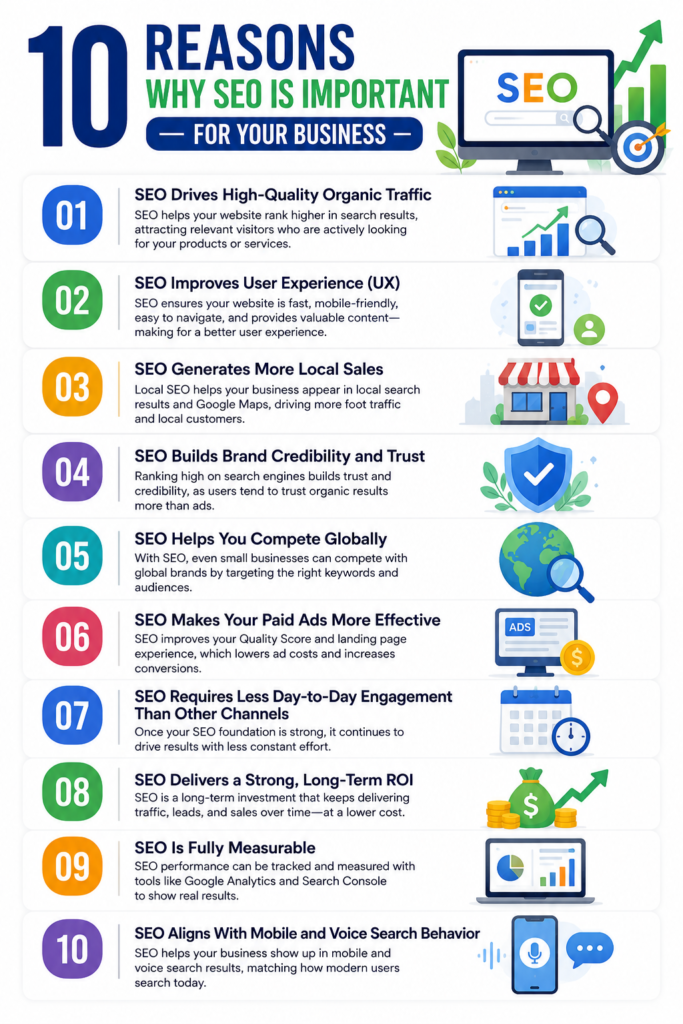
1. SEO Drives High-Quality Organic Traffic
Organic search is the most consistent traffic channel on the internet. People who type a query are actively looking for a solution — they’re not interrupted, they’re searching.
According to BrightEdge research, organic search delivers more than half of all trackable website traffic — significantly more than paid search and social combined. That’s traffic you don’t pay for every time someone clicks.
2. SEO Improves User Experience (UX)
Google ranks websites based on how useful and usable they are. That means fast loading speed, clean structure, mobile responsiveness, secure HTTPS, and clear navigation — all of which directly improve UX.
So when you optimize for search engines, you’re really optimizing for humans. Better UX leads to longer sessions, lower bounce rates, and more conversions.
3. SEO Generates More Local Sales
Local SEO helps your business show up in Google Maps, the local 3-pack, and ‘near me’ searches. For brick-and-mortar stores, clinics, salons, restaurants, and service businesses, this is gold.
In our work with local brands across Jaipur, Delhi, and Mumbai, optimized Google Business Profiles consistently bring 3–5x more inbound calls than paid ads — at zero ad cost.
4. SEO Builds Brand Credibility and Trust
People trust Google. When your business ranks on page one, users assume you’re a legitimate, established player in your space. That perception alone increases click-through and conversion rates.
Google’s E-E-A-T framework (Experience, Expertise, Authoritativeness, Trustworthiness) rewards sites that demonstrate real-world knowledge and credible sources — a long-term moat against fly-by-night competitors.
5. SEO Helps You Compete Globally
With the right international SEO setup — country-specific TLDs, hreflang tags, and localized content — your business can rank in multiple countries simultaneously.
This means a small agency in Jaipur can attract clients from London, Dubai, or Toronto without spending a rupee on international ads. We’ve seen this work for SaaS clients and ecommerce stores in our portfolio.
6. SEO Makes Your Paid Ads More Effective
SEO and PPC aren’t rivals — they amplify each other. A well-optimized landing page improves your Google Ads Quality Score, which lowers your cost per click and increases ad position.
Brands running both SEO and paid campaigns typically see a 25–30% lift in overall conversion rates compared to running paid ads alone.
7. SEO Requires Less Day-to-Day Engagement Than Other Channels
Social media demands daily posts. Paid ads need constant budget management and creative refreshes. SEO, by contrast, is a slow burn that pays compounding dividends.
Once a piece of well-optimized content ranks, it can keep pulling traffic for months or years with only periodic updates — what we call ‘evergreen earning assets.’
8. SEO Delivers a Strong, Long-Term ROI
Yes, SEO costs money upfront — for audits, content, technical fixes, and link building. But unlike ads, you don’t pay for every click.
Most of our clients break even on SEO investment within 6–9 months and continue earning traffic worth 5–10x the original spend over the next two years. That’s a return paid media simply can’t match.
9. SEO Is Fully Measurable
Every aspect of SEO is trackable: rankings, organic clicks, impressions, conversions, time-on-site, and revenue per page.
Free tools like Google Search Console and Google Analytics give you a complete view of which keywords, pages, and campaigns drive results — so you can double down on what works.
10. SEO Aligns With Mobile and Voice Search Behavior
More than 60% of Google searches now happen on mobile devices, and voice search is rising fast thanks to smart speakers and AI assistants.
A mobile-first SEO strategy — fast pages, conversational keywords, structured data, and FAQ-style content — keeps your business visible across every screen and every search format, including AI-powered answer engines.
Common SEO Mistakes Businesses Still Make in 2026
Across the 100+ audits our team has run this year, the same problems keep showing up. Avoid these and you’re already ahead of most competitors:
- Keyword stuffing instead of writing for humans first.
- Ignoring page speed and Core Web Vitals.
- Skipping local SEO when 80% of customers are nearby.
- Building backlinks from low-quality, irrelevant sites.
- Treating SEO as a one-time project instead of an ongoing strategy.
If any of these sound familiar, it’s worth getting a fresh pair of eyes on your site.
How to Start Implementing SEO for Your Business
You don’t need to overhaul everything overnight. Start with these five steps:
- Run a technical SEO audit to identify crawl, speed, and indexing issues.
- Research keywords your customers actually use — not industry jargon.
- Optimize your highest-traffic pages first for clicks and conversions.
- Publish helpful, original content that answers real customer questions.
- Build credibility with quality backlinks and consistent local citations.
If you’d rather skip the trial and error, our team at G2S Technology specializes in SEO audits and growth strategies tailored to Indian and global businesses.
For a deeper dive into on-page best practices, check out our On-Page SEO Cheat Sheet 2026 And if local visibility is your priority, our Hyper-Local SEO Strategy guide walks you through dominating neighborhood search results.
Final Thoughts: SEO Is a Business Investment, Not an Expense
If you’re still on the fence, here’s the bottom line: SEO is the only marketing channel where the asset you build today keeps earning tomorrow.
Paid ads stop the moment you stop paying. Social posts disappear in 48 hours. But a page that ranks #1 on Google can drive leads for years.
The businesses winning in 2026 aren’t necessarily the biggest — they’re the ones who started taking SEO seriously two years ago. The next best time to start? Today.
FAQ Section
Why is SEO important for small businesses?
SEO is important for small businesses because it levels the playing field with larger competitors. With strong local and on-page SEO, even a small brand can rank above national chains for relevant searches — and capture customers without expensive ad budgets.
How long does SEO take to show results?
Most businesses begin seeing meaningful SEO results within 3 to 6 months, depending on competition, website age, and content quality. Significant ROI typically kicks in between 6 and 12 months. SEO is a long-term investment, not a quick fix.
Is SEO better than paid advertising?
SEO and paid ads serve different goals. Paid ads deliver instant traffic but stop the moment you pause spending. SEO builds compounding, long-term traffic at a lower cost per lead. Most successful businesses use both together for the best results.
How much does SEO cost in India?
SEO costs in India typically range from ₹15,000 to ₹1,50,000 per month, depending on scope, competition, and goals. Local small business SEO sits at the lower end, while ecommerce or competitive national campaigns require higher investment.
Can I do SEO myself?
Yes, basic SEO — like keyword research, on-page optimization, and Google Business Profile setup — can be done yourself with free tools. However, technical SEO, link building, and competitive content strategy usually deliver better ROI when handled by experienced professionals.
What is the difference between SEO and digital marketing?
Digital marketing is the umbrella term covering all online marketing channels, including paid ads, email, and social media. SEO is one specific channel within digital marketing focused on earning organic visibility on search engines like Google and Bing.
Does SEO still work in the age of AI search?
Yes, SEO is more important than ever. AI-powered search engines like ChatGPT, Gemini, and Perplexity pull answers from authoritative websites — often the same ones that rank well on Google. Strong SEO now also means strong visibility inside AI-generated answers.