
When someone searches for “best dentist near Malviya Nagar” or “AC repair in Vaishali Nagar,” they are not looking for a city-wide list — they want a business in their exact neighborhood, right now. That is the power of hyper-local SEO, and businesses that understand this are quietly stealing customers from those still targeting entire cities.
If you have been running a local SEO strategy that targets broad city-level keywords, you might be leaving a huge chunk of high-intent traffic on the table. This guide will walk you through everything you need to know about hyper-local SEO — what it is, why it works better, and exactly how to implement it to dominate your neighborhood search results in 2025 and beyond.
What Is Hyper-Local SEO and Why Does It Matter?
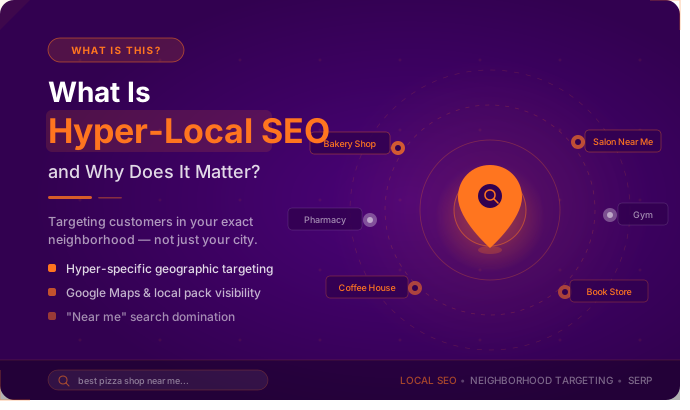
Most businesses know about local SEO — the practice of optimizing your online presence to show up in location-based searches. But hyper-local SEO takes that concept several levels deeper. Instead of targeting a whole city like “Jaipur” or “Mumbai,” hyper-local SEO focuses on specific neighborhoods, districts, localities, or even landmarks — think “Bani Park,” “Sector 18 Noida,” or “near Phoenix Mall.”
This shift matters because search behavior has become dramatically more precise. According to Google’s internal data, “near me” searches have grown by over 500% in recent years, and a significant portion of those searches carry strong purchase intent. People searching at the neighborhood level are much closer to making a decision than someone casually browsing city-level results.
📖 Also Read: Local SEO Ranking Factors: What Really Matters in 2025
City-Level SEO vs. Hyper-Local SEO: What’s the Real Difference?
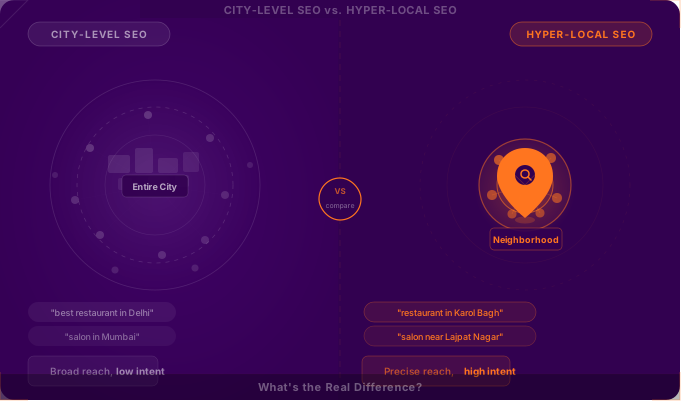
Many business owners assume that ranking for a city keyword like “plumber in Jaipur” is the ultimate goal. But here is the truth — that keyword is highly competitive, expensive to rank for, and often attracts users who are still in the research phase rather than ready to call.
Hyper-local keywords like “plumber in C-Scheme Jaipur” or “plumber near Raja Park” attract far fewer searches, but the people who type those queries are almost always ready to act. The competition is lower, the conversion rate is higher, and the cost of ranking is much smaller. This is the core advantage of hyper-local SEO — precision over volume.
Think of it this way: would you rather have 1,000 visitors to your website with a 1% conversion rate, or 200 visitors with a 15% conversion rate? For most small and medium businesses, the second option wins every time.
📖 Also Read: Top 10 Ways to Improve Your Local SEO Right Now
How Google Decides Who Ranks in Neighborhood-Level Searches
Understanding how Google ranks local results is the foundation of any solid hyper-local strategy. Google uses three core signals to determine which businesses appear in the local pack and map results — relevance, distance, and prominence.
Relevance means how well your business matches what the user is searching for. Distance is exactly what it sounds like — how physically close your business is to the searcher’s location. Prominence reflects how well-known and trusted your business is online, based on reviews, backlinks, and overall digital presence.
At the neighborhood level, distance becomes an even more dominant factor. If your Google Business Profile accurately represents your location and service areas, and your website has strong neighborhood-specific signals, Google will favor you in hyper-local results. This is precisely why businesses that invest in neighborhood-focused content and on-page optimization tend to outperform larger competitors who rely only on broad city-level SEO.
📖 Also Read: 10 Ways to Optimize Your Website for Local SEO
Keyword Research for Hyper-Local SEO: Think Smaller, Win Bigger
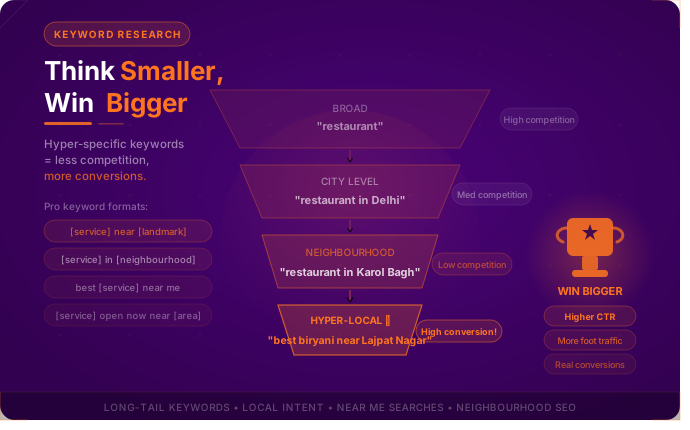
The foundation of any successful SEO strategy is keyword research, and hyper-local SEO is no different. The key here is to go beyond the obvious city-level terms and dig into neighborhood-specific language that your ideal customers are actually using.
Start by listing every neighborhood, locality, sector, colony, or landmark within your service area. Then combine those location modifiers with your core service or product keywords. Tools like Google Keyword Planner, BrightLocal, and Ahrefs can help you discover what people are actually searching for in specific areas. Also pay close attention to Google’s “People Also Search For” and autocomplete suggestions — these are goldmines of hyper-local keyword ideas straight from real user behavior.
Another smart tactic is to include local landmarks, popular streets, schools, hospitals, and shopping centers in your keyword mix. Someone might search “gym near City Mall” or “accountant near DAV School” — these landmark-based queries have very low competition and very high buying intent.
📖 Also Read: 10 Essential On-Page SEO Factors You Need to Know
Creating Neighborhood Landing Pages That Actually Rank
One of the most powerful — and most underused — hyper-local SEO tactics is creating dedicated landing pages for each neighborhood you serve. These are not just generic “we also serve this area” pages. They need to be genuinely useful, locally relevant pages that demonstrate real knowledge of that specific neighborhood.
A strong neighborhood landing page should include a unique H1 tag with the neighborhood name, original content that references local landmarks and community details, embedded Google Maps, neighborhood-specific customer testimonials or case studies, local schema markup, and clear calls to action. Avoid the common mistake of creating copy-paste location pages where you just swap out the neighborhood name — Google will identify this as thin content and it will hurt rather than help your rankings.
For example, if you run a pest control company in Jaipur, instead of one generic page targeting “pest control Jaipur,” create individual pages for Malviya Nagar, Vaishali Nagar, Bani Park, Civil Lines, Mansarovar, and so on. Each page should speak to that specific neighborhood’s context — building types, seasonal pest issues, local references — making it genuinely valuable for someone in that area.
📖 Also Read: On-Page SEO Cheat Sheet to Rank on the First Page
Optimizing Your Google Business Profile for Hyper-Local Dominance
Your Google Business Profile (GBP) is arguably the single most important asset for hyper-local SEO. It is what powers your appearance in Google Maps, the local pack (the 3-pack of business results that appears at the top of local searches), and Google’s Knowledge Panel for your business.
To maximize your hyper-local presence, go beyond the basics of just filling in your address and phone number. Use the “Service Areas” section to specifically list the neighborhoods and localities you serve — this signals to Google exactly which micro-areas your business is relevant for. Upload photos that show your business within the local context — street views, community events, local landmarks nearby. Regularly publish GBP posts that reference neighborhood-specific content, seasonal offers, or local events. And make sure your NAP (Name, Address, Phone number) information is 100% consistent across your GBP and every other platform where your business appears online.
According to Moz’s Local Search Ranking Factors report, GBP signals are among the top ranking factors for local pack results, making it critical to treat your profile as a living, active digital asset rather than a one-time setup.
📖 Also Read: 7 New Ways for Local Businesses to Get Links
Building Hyper-Local Content That Establishes Real Authority
Content is the backbone of your hyper-local SEO strategy, and the businesses that win at the neighborhood level are those that genuinely sound like they belong in the community. Google’s E-E-A-T framework — which stands for Experience, Expertise, Authoritativeness, and Trustworthiness — rewards content that demonstrates real, first-hand local knowledge.
There are several content formats that work exceptionally well for hyper-local SEO. Neighborhood guides like “The Best Home Services in Vaishali Nagar” or “Everything You Need to Know About Living in C-Scheme” attract local readers and build topical authority. Blog posts about local events, community initiatives, or area-specific challenges show that your business is genuinely embedded in the neighborhood. Customer success stories and case studies from specific localities add a layer of social proof while reinforcing your geographic relevance.
The key is to write content that could only have been written by someone with genuine local knowledge. Mention actual street names, known landmarks, community issues, or seasonal patterns specific to that neighborhood. This kind of authentic, experience-driven content is exactly what Google — and your potential customers — are looking for.
📖 Also Read: Tips to Write SEO-Friendly Content That Ranks
Local Link Building: Earning Neighborhood-Level Authority
Backlinks remain one of the strongest ranking signals in SEO, and for hyper-local strategies, the quality and local relevance of those links matters far more than sheer volume. A single backlink from a well-known neighborhood blog, a local news website, or a community organization can outperform dozens of generic directory links.
Start by identifying the digital ecosystem of your target neighborhoods. Look for local news portals, community Facebook groups with associated websites, resident welfare associations (RWAs), local school or hospital websites, neighbourhood business associations, and local event organizers. Earning links from these sources — through sponsorships, guest articles, community participation, or resource creation — sends powerful local authority signals to Google.
Additionally, make sure your business is listed accurately in top local citation directories like JustDial, Sulekha, IndiaMart, Google Maps, and niche directories relevant to your industry. Consistent NAP information across all these platforms reinforces your local presence and builds the trust signals that influence neighborhood-level rankings.
📖 Also Read: Mastering Link Building: A Comprehensive Guide to Boost Your SEO Strategy
Reviews and Reputation Management: The Trust Signal Google Loves
Online reviews are not just a social proof tool — they are a direct ranking signal for local and hyper-local search results. Businesses with a higher volume of recent, relevant, and positive reviews consistently outperform competitors in local pack rankings. For hyper-local SEO, the neighborhood context of your reviews matters too.
When asking customers for reviews, encourage them to naturally mention their neighborhood in the review. A review that says “I’m from Bani Park and this was the best AC repair service I’ve ever used” is far more powerful for hyper-local rankings than a generic five-star rating. Respond to every review — positive and negative — professionally and with local references where appropriate. This ongoing engagement signals to Google that your business is active, responsive, and genuinely connected to the local community.
Beyond Google Reviews, explore platforms like Justdial, Sulekha, and industry-specific review sites. Each review platform where your business has a strong presence adds another layer of local authority and trustworthiness that Google factors into your rankings.
Technical SEO Essentials for Hyper-Local Websites
Even the most compelling neighborhood content will struggle to rank if your website has technical SEO issues holding it back. For hyper-local SEO, a few technical elements deserve particular attention.
Schema markup — specifically the LocalBusiness schema — is essential. It tells search engines your exact business type, service areas, operating hours, address, and contact details in a structured format they can easily interpret. Implementing proper LocalBusiness schema on your neighborhood landing pages can significantly improve your visibility in rich results and local knowledge panels. Google’s Structured Data documentation provides a complete guide for implementing this correctly.
Mobile optimization is non-negotiable for hyper-local SEO because the majority of neighborhood searches happen on smartphones, often while the person is already out and about. Your website must load fast, look great on mobile screens, and make it effortless for users to call, get directions, or book your service with a single tap. Page speed is also directly tied to rankings — read more about how page speed affects your SEO and Google rankings.
Tracking Your Hyper-Local SEO Performance
You cannot improve what you do not measure. Tracking the right metrics is what separates businesses that grow their local presence systematically from those that guess and hope for the best.
Google Search Console’s Performance report lets you filter by queries that include neighborhood names, giving you a clear picture of which local terms are driving impressions and clicks. Google Analytics 4 (GA4) provides detailed location data showing exactly where your website visitors are coming from geographically. BrightLocal’s rank tracker allows you to monitor your rankings for specific neighborhood keywords over time, so you can see what’s working and what needs adjustment.
Key metrics to track include: local pack appearances for neighborhood keywords, organic traffic from location-specific pages, click-to-call actions from your GBP, direction requests on Google Maps, and review velocity (how quickly new reviews are coming in). Review these metrics at least monthly and adjust your strategy based on what the data tells you.
📖 Also Read: Complete SEO Audit Guide for 2025–26
Common Hyper-Local SEO Mistakes to Avoid
Even well-intentioned local SEO efforts can backfire if certain pitfalls are not avoided. The most common mistake businesses make is creating thin, duplicate location pages — essentially the same content repeated across multiple neighborhood pages with only the location name changed. Google identifies this as low-quality content and may penalize or simply ignore these pages entirely.
Another frequent error is inconsistent NAP (Name, Address, Phone) information across different platforms. If your address appears differently on your website, GBP, JustDial, and other directories, it creates confusion for search engines and erodes your local trust signals. Do a thorough citation audit periodically to ensure complete consistency everywhere your business is listed online.
Neglecting mobile optimization is another major mistake, as is failing to update your GBP regularly. A stale, inactive profile signals to Google that your business may no longer be active or engaged, which can drop your local rankings even if your website is otherwise well-optimized.
📖 Also Read: SEO Link Building Mistakes to Avoid in 2026
The Future of Hyper-Local SEO: What’s Coming Next
The trajectory of search technology is making hyper-local SEO more important, not less. Google’s AI-powered search features — including the Search Generative Experience (SGE) — are increasingly surfacing highly specific, contextually relevant local results. Businesses with strong neighborhood signals, rich local content, and consistent review profiles are the ones that will thrive in this new AI-driven search landscape.
Voice search is another trend accelerating the demand for hyper-local optimization. When someone asks their phone “where’s the nearest electrician in Mansarovar?” they expect a precise, local answer — not a list of options across an entire city. Optimizing for conversational, voice-friendly queries with neighborhood-specific intent is becoming a key differentiator for local businesses.
The businesses that start investing in hyper-local SEO today are building a moat that will become increasingly difficult for competitors to overcome as search continues to evolve toward greater personalization and location precision.
📖 Also Read: Digital Marketing Trends You Need to Know
Conclusion: Think Smaller. Win Bigger.
The core insight behind hyper-local SEO is beautifully simple: when you try to reach everyone, you reach no one effectively. But when you focus your efforts on the specific neighborhoods where your best customers live and work, you become the obvious, trusted choice for that community.
Hyper-local SEO is not just a tactic for small businesses — it is a smart, scalable strategy for any business that wants to compete and win in today’s increasingly local and intent-driven search landscape. By combining neighborhood-specific keyword research, dedicated landing pages, an optimized Google Business Profile, authentic local content, and community-level link building, you can build a dominant local presence that continuously drives high-quality, high-converting traffic to your business.
Ready to dominate your neighborhood search results? Contact G2S Technology today for a free hyper-local SEO audit and let our experts build a customized strategy that puts your business on the map — literally.
Frequently Asked Questions (FAQs)
What is hyper-local SEO? Hyper-local SEO is the practice of optimizing your online presence to rank in search results for very specific geographic areas — such as neighborhoods, districts, or streets — rather than targeting an entire city or region.
How is hyper-local SEO different from regular local SEO? Regular local SEO typically targets a city or broad region. Hyper-local SEO goes deeper, focusing on specific neighborhoods or localities to capture high-intent searches from users who are very close to making a purchase decision.
How long does it take to see results from hyper-local SEO? In most cases, you can start seeing improvements in neighborhood-level rankings within 3 to 6 months of consistent implementation, though results vary based on competition level and the strength of your existing online presence.
Can small businesses compete with big brands using hyper-local SEO? Absolutely. In fact, hyper-local SEO is one of the most effective ways for small businesses to outperform large brands, because big companies often focus on broad, high-volume keywords and cannot replicate the authentic neighborhood presence a local business can establish.
How many neighborhood pages should I create? Create a dedicated page for every neighborhood or locality within your actual service area. Quality always beats quantity — a few well-written, genuinely useful neighborhood pages will outperform dozens of thin, duplicate ones.
Do I need a physical address in every neighborhood I target? No. You can target multiple neighborhoods through your Google Business Profile’s service area settings and through neighborhood-specific content on your website, even without a physical address in each area.