
Why Most Local Businesses Stay Invisible on Google (And How to Fix It) Here’s a fact most agencies won’t tell you: 46% of all Google searches have local intent, yet fewer than 1 in 5 small businesses actively optimize for them.
If your business doesn’t show up in the Google Map Pack — those top three local results with the map — you’re handing customers straight to your competitors.
After working with 100+ local businesses across India, our team at G2S Technology has Narrowed the noise down to 8 ranking factors that actually move the needle. This guide walks you through each one with what it is, why it matters, and exactly how to act on it.
What Is Local SEO?
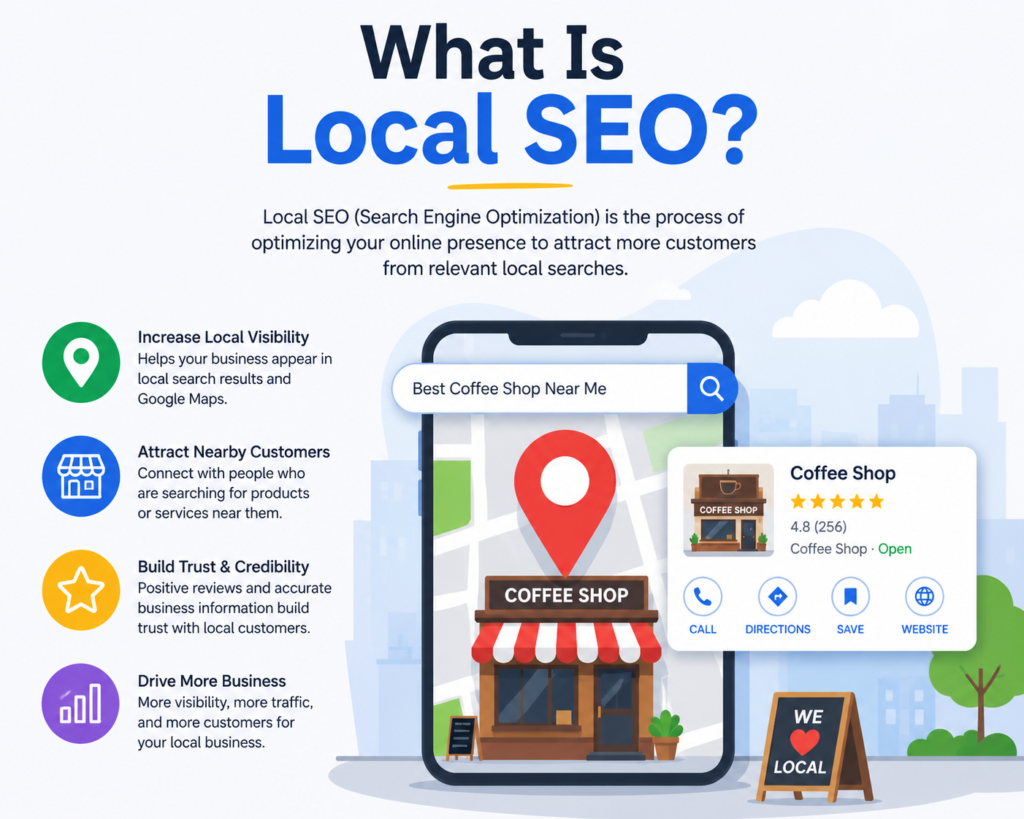
Local SEO is the process of optimizing a website and online presence so a business appears in geographically relevant search results — like “plumber near me” or “best dentist in Jaipur.”
Unlike traditional SEO, local SEO focuses on three core signals: relevance, distance, and prominence. Google uses these to decide which businesses appear in the Map Pack and local organic results.
In simple terms: traditional SEO helps you rank globally; local SEO helps you rank in your city, neighborhood, or service area.
Why Local SEO Matters in 2026
Local search has stopped being optional. According to a study referenced by Think with Google, 76% of people who search for something nearby on their smartphone visit a related business within a day, and 28% of those searches result in a purchase.
That’s not traffic — that’s revenue. And here’s what we’ve seen first-hand:
- Local searches convert 3–5x higher than generic searches
- Map Pack listings get roughly 44% of clicks on local SERPs
- “Near me” searches have grown over 500% in the past few years
If you run a service business — a clinic, café, agency, repair shop, or boutique — local SEO is no longer a marketing channel. It is the marketing channel.
The 8 Local SEO Ranking Factors That Actually Drive Traffic
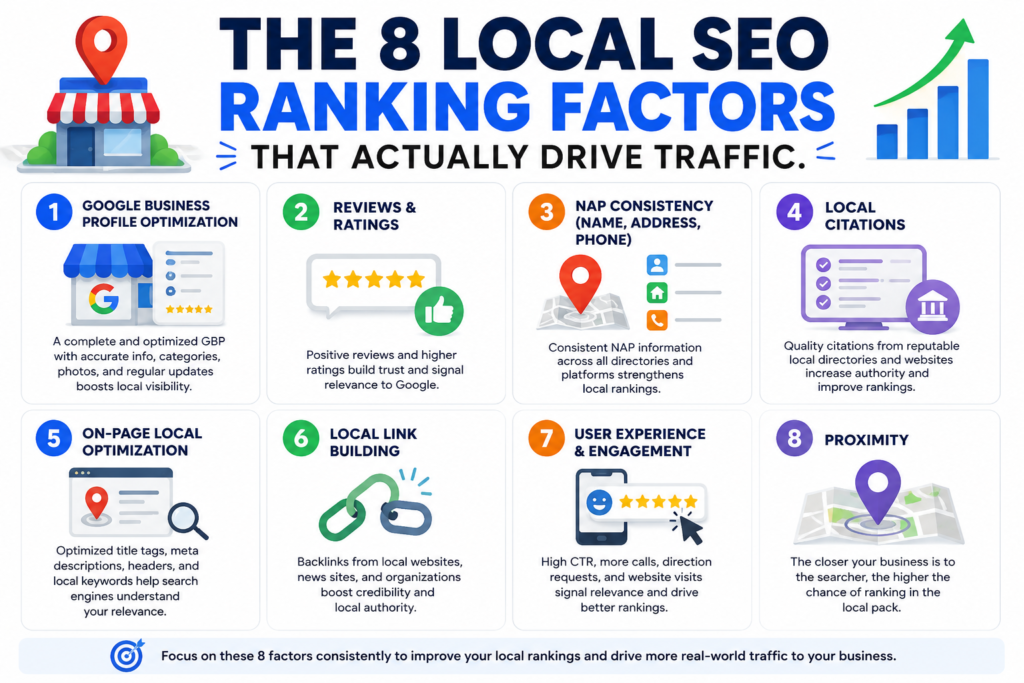
Industry research from Moz’s Local Search Ranking Factors survey consistently identifies a tight cluster of signals that determine local rankings. Based on the latest weighting and our own client data, here’s how the eight biggest factors break down.
| Ranking Factor | Approximate Weight |
| Google Business Profile signals | ~25% |
| Link signals | ~17% |
| Review signals | ~15% |
| On-page signals | ~14% |
| Citation signals | ~11% |
| Behavioral signals | ~10% |
| Personalization | ~6% |
| Social signals | ~3% |
Source: Moz Local Search Ranking Factors — weights are directional, not absolute, and shift slightly each year.
1. Google Business Profile (GBP) — The Foundation
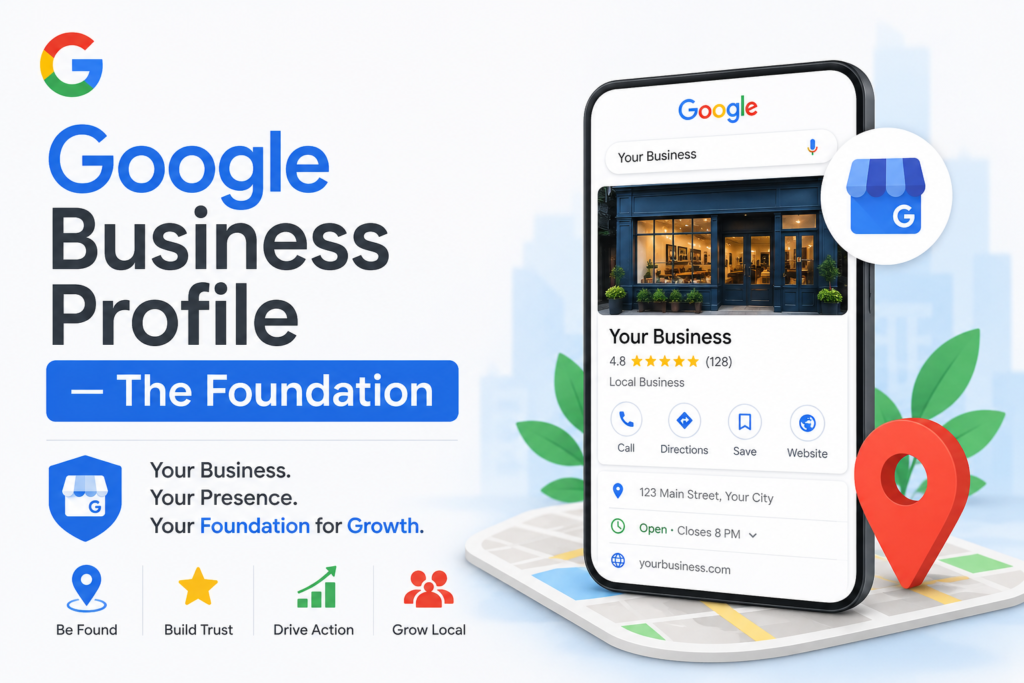
What it is: Google Business Profile (formerly Google My Business) is the free listing that powers your appearance in Google Maps and the local Map Pack.
Why it matters: It carries roughly a quarter of the weight in local rankings. No other single asset comes close.
How to optimize it:
- Claim and verify your profile through the official Google Business Profile manager
- Choose the most specific primary category (e.g., “Italian Restaurant” beats “Restaurant”)
- Fill out 100% of your profile — services, hours, attributes, products, and Q&A
- Upload high-quality, geo-tagged photos every month
- Post weekly updates, offers, and event announcements
In our experience, businesses that post on GBP at least once a week see meaningfully higher direction requests and profile calls within 60 days.
2. On-Page Signals — The Silent Multiplier
What it is: On-page signals are the SEO elements on your actual website — titles, headings, NAP (Name, Address, Phone), schema markup, and content relevance.
Why it matters: Google needs to confirm that your website matches the location and service it sees on your GBP. Mismatched on-page signals weaken your entire local presence.
Quick wins:
- Add city + service keywords to your homepage title tag
- Place your full NAP in the footer of every page
- Add LocalBusiness schema markup use Schema.org’s LocalBusiness reference.
- Make sure the site loads under 3 seconds on mobile
- Build dedicated location pages if you serve multiple cities
Also Read:- On-Page SEO Cheat Sheet 2026: Complete Guide
3. Online Reviews — Your Trust Currency
What it is: Reviews on Google, industry directories, and social platforms — including their quantity, quality, recency, and how you respond.
Why it matters: Customers and Google read reviews together. A business with 80+ reviews and a 4.6 star average will almost always outrank one with 12 reviews and a 5.0.
How to act on it:
- Send a review request within 24 hours of every transaction
- Use a short, branded review link (Google provides one in your dashboard)
- Respond to every review — yes, even the bad ones — within 48 hours
- Naturally include service or product keywords in your replies
One client we worked with — a dental clinic in Jaipur — went from 17 reviews to 142 reviews in six months. Their Map Pack visibility roughly doubled in the same window.
4. Backlink Profile — Local Authority Builder
What it is: Backlinks are inbound links from other websites pointing to yours. For local SEO, links from local, relevant, and trusted sources matter most.
Why it matters: Google still treats links as one of the strongest authority signals. For local rankings, a single link from a city newspaper or local chamber of commerce can outweigh dozens of generic ones.
Where to earn local links:
- Local newspapers and online magazines
- Chamber of commerce and trade association websites
- Sponsorships of local events, sports teams, or charities
- Guest posts on regional industry blogs
- Educational institution partnerships (.edu links carry weight)
For a complete framework, see our deep-dive on link-building for local businesses.
5. Online Citations — Consistency Wins
What it is: A citation is any online mention of your business name, address, and phone number — whether linked or not.
Why it matters: Google cross-checks your details across the web. Inconsistent NAP information (e.g., “Suite 12” on one site, “#12” on another) erodes trust and rankings.
Top citation sources to claim:
- Google Business Profile
- Bing Places
- Apple Business Connect
- Justdial, Sulekha, IndiaMART (for Indian businesses)
- Industry-specific directories (e.g., Practo for healthcare, Zomato for restaurants)
Run an audit twice a year to catch outdated entries — especially after office moves or rebrands.
6. Behavioral Signals — How Searchers React
What it is: Behavioral signals are user actions that tell Google your listing is the right answer — clicks, calls, direction requests, and dwell time.
Why it matters: If users consistently click your result, call, and stay — Google reads that as a vote of confidence and rewards you with better placement.
How to nudge them positively:
- Use a clear, benefit-driven business description
- Add a strong primary photo (people, not stock images)
- Keep response time on messaging under an hour
- Update your offers and posts so the listing always feels active
7. Personalization — Why Two Searchers See Different Results
What it is: Personalization is Google’s adjustment of results based on a user’s location, search history, and device.
Why it matters: You can’t directly control personalization, but you can rank well across more user contexts by serving content that resonates locally.
Practical actions:
- Publish content using neighborhood and area-specific terminology
- Build separate landing pages for each city you operate in
- Embed a Google Map of your location on the contact page
8. Social Signals — Underrated, Not Useless
What it is: Engagement on social media platforms — Facebook, Instagram, LinkedIn, YouTube — that ties back to your business.
Why it matters: While the direct ranking weight is small (around 3%), social platforms drive branded searches, citations, and referral traffic — all of which feed back into local SEO.
Choose by business type:
- B2C local: Instagram + Facebook
- B2B local: LinkedIn + Google Posts
- Visual or video-first: YouTube + Instagram Reels
Bonus Factor: Local Content That Earns Attention
Hyper-local content — blogs, neighborhood guides, event recaps, and customer stories — quietly fuels every other factor on this list.
It earns links, sparks shares, builds citations, and gives your GBP fresh material to post. It also shows Google that you are an active, contributing voice in your local market.
For ideas on what to write, check out hyper-local SEO content strategy.
How to Prioritize Your Local SEO in the Next 90 Days
Don’t try to fix everything at once. Across our client engagements, here’s the order that consistently delivers the fastest results:
- Days 1–30: Lock down GBP — claim, verify, fully complete every field, post weekly
- Days 31–60: Fix on-page basics — NAP, schema, title tags, location pages
- Days 61–90: Launch a structured review-generation workflow and start citation cleanup
After 90 days, layer in link-building and local content as ongoing programs.
Common Local SEO Mistakes That Quietly Kill Rankings
From auditing dozens of small business sites this year, these are the patterns we see again and again:
- Keyword-stuffing the GBP business name — it triggers a Google penalty and suspends listings
- Inconsistent NAP across directories — one wrong digit costs trust
- Buying or incentivizing reviews — Google’s spam filters now catch these in days
- Ignoring negative reviews — silence is read as guilt by both customers and the algorithm
- Building only generic backlinks — local relevance beats raw domain authority for local rankings
Final Thoughts
Local SEO isn’t about gaming the system. It’s about giving Google clear, consistent, trustworthy signals — and giving your customers a reason to choose you over the next listing.
The eight factors above account for the overwhelming majority of what determines who shows up in the Map Pack. Get them right, audit them quarterly, and you’ll build a local search advantage that compounds month after month.
If you’d rather skip the trial and error, our team at G2S Technology has helped 100+ businesses translate this exact framework into measurable Map Pack growth. We’d be happy to talk about your local goals — no pitch, just a conversation.
FAQ Section
What is the most important local SEO ranking factor in 2026?
Google Business Profile signals remain the single most important local SEO ranking factor, accounting for roughly 25% of total weight. A complete, verified, and actively maintained profile is the foundation of every Map Pack ranking.
How long does local SEO take to show results?
Most local businesses begin seeing measurable improvements in 60–90 days, with significant Map Pack movement typically arriving within 4–6 months. Highly competitive niches and metros may take longer.
Do online reviews really affect local search rankings?
Yes. Reviews account for around 15% of local ranking weight. Google evaluates the quantity, quality, recency, and diversity of your reviews, plus how consistently you respond to them. They influence both rankings and click-through rates.
What is NAP consistency and why does it matter?
NAP stands for Name, Address, and Phone number. NAP consistency means these details appear identically across every online directory, social profile, and your website. Inconsistencies confuse Google and weaken your local authority.
Is local SEO worth it for small businesses?
For any business serving a defined geographic area, local SEO delivers one of the highest returns in digital marketing. With nearly half of all Google searches being local, ignoring it means handing customers directly to competitors.
How is local SEO different from regular SEO?
Regular SEO targets broad, location-independent search rankings. Local SEO focuses on geographic relevance, the Google Map Pack, and platforms like Google Business Profile. The two overlap on technical fundamentals but use different signals and strategies.
How often should I update my Google Business Profile?
At minimum, post a new update, photo, or offer once a week. Refresh your business hours seasonally, respond to reviews within 48 hours, and audit your profile information every 90 days for accuracy.