
Let’s be honest — link building has a bit of a complicated reputation in India’s SEO community. Some people swear by it. Others have been burned badly by it. And a whole lot of business owners are somewhere in the middle, quietly buying a few links here and there and hoping Google doesn’t notice.
Here’s the thing: done right, professional link building is still one of the most powerful levers you can pull to improve your Google rankings. It signals to search engines that other credible websites trust your content enough to point their readers towards you. That trust translates directly into authority, and authority translates into rankings.
But done wrong? It can get your website penalised, tank your traffic overnight, and undo months of hard work.
At G2S Technology, Jaipur, we’ve audited hundreds of websites across India — from small local businesses to large e-commerce brands — and we see the same link building mistakes coming up again and again. This post covers all of them, explains why they’re harmful, and tells you exactly what to do instead.
Who is this for? Business owners, marketing managers, and in-house SEO teams who are doing link building themselves or managing an agency doing it on their behalf. If you’ve ever wondered “wait, is this link building strategy actually safe?” — this one’s for you.
Read This Also:- Complete SEO Audit Guide For 2025–26
What is Link Building and Why Does It Still Matter?
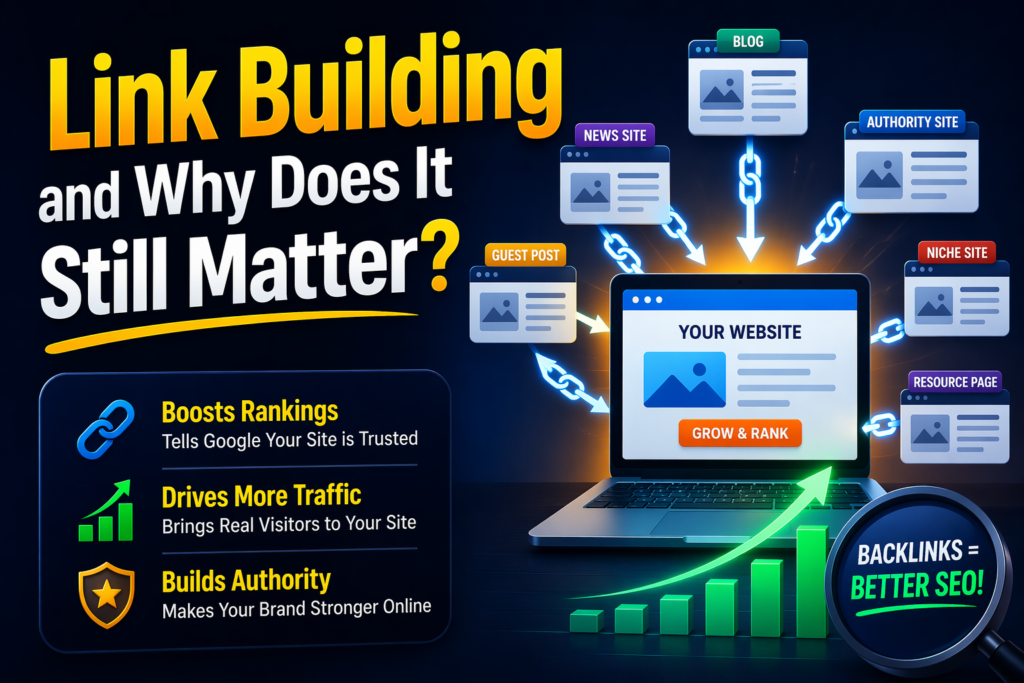
A backlink is simply a link from one website to another. When Website A links to your page, it’s essentially giving you a vote of confidence — telling Google, “this content is worth reading.” The more of these votes you collect from trusted, relevant sources, the more Google trusts your website too.
This has been true since the early days of Google’s PageRank algorithm, and despite all the updates and changes over the years, it remains true in 2026. According to consistent industry research, backlinks remain one of the top three ranking factors Google uses to evaluate pages.
What has changed is how Google evaluates link quality. The old game of building as many links as possible from anywhere and everywhere — that stopped working around 2012 with Google’s Penguin update. Today, one link from a genuinely relevant, authoritative website is worth more than 500 links from random directories or spammy blogs.
“Link building is not dead. Bad link building is. The businesses winning on Google in 2026 are the ones doing it the right way — patiently, strategically, and with a focus on earning links rather than manufacturing them”
Read this also: Mastering Link Building: A Comprehensive Guide To Boost Your SEO Strategy
The 12 Biggest Link Building Mistakes (and How to Fix Them)
Mistake 01 : Buying Links — The Shortcut That Can End Your Website’s Rankings
This is probably the most common mistake we see in India. You’ll find vendors on Fiverr, Upwork, and even WhatsApp groups offering “500 high DA backlinks for ₹2,000.” It’s tempting, especially when you’re impatient to see results. But buying links is a direct violation of Google’s Webmaster Guidelines.
Google has an entire team — and sophisticated algorithms — dedicated to detecting paid link schemes. When they catch it (and they do catch it), the consequences range from a significant rankings drop to a full manual penalty that can take months to recover from. We’ve seen Indian e-commerce websites lose 60–70% of their organic traffic in a single day because of a link buying spree that went wrong.
The Fix: Invest that budget into creating genuinely useful content that naturally earns links — detailed guides, original research, free tools, or data studies relevant to your industry. If you want faster results, spend on legitimate digital PR outreach instead.
Mistake 02: Chasing Quantity Over Quality
A lot of people still operate with the mindset that more links = better rankings. So they focus on getting as many backlinks as possible, regardless of where they come from. This leads to a backlink profile full of low-quality, irrelevant websites that do almost nothing for your rankings — and in the worst case, actively harm them.
Think of it this way: would you rather have a recommendation from the top industry expert in your field, or from 500 random people you’ve never heard of? Google thinks the same way.
The Fix: Set a quality threshold for every link you pursue. At minimum, target websites with a Domain Rating (DR) of 30+ in Ahrefs or a Domain Authority (DA) of 30+ in Moz. Prioritise links from websites that are relevant to your industry, have real traffic, and have real editorial standards.
Mistake 03: Ignoring Link Relevance
Getting a backlink from a high-authority website sounds great — until that website has absolutely nothing to do with your industry. A link to your Jaipur restaurant from a cryptocurrency blog, or a link to your healthcare website from a gaming forum, sends confusing signals to Google about what your website is actually about.
Topical relevance has become an increasingly important signal. Google now uses advanced machine learning to understand the relationship between linking and linked pages, and irrelevant links carry far less weight than they used to.
The Fix: Build your target link list around websites in your niche or closely related niches. For a digital marketing agency in Jaipur, you’d want links from business publications, tech blogs, marketing websites, and local business directories — not from food blogs or travel sites.
Mistake 04: Over-Optimising Anchor Text
Anchor text is the clickable text in a hyperlink. If every single link pointing to your website uses the exact same keyword phrase as anchor text — say, “best digital marketing agency in Jaipur” — Google reads this as an unnatural, manipulated link profile. This is called anchor text over-optimisation, and it’s a classic red flag.
A natural link profile has a healthy mix: brand name anchors, generic anchors like “click here” or “read more”, partial-match anchors, URL-only anchors, and some exact-match keyword anchors. When the ratio is heavily skewed towards exact-match keywords, it looks like someone is gaming the system.
The Fix: Aim for this rough distribution in your backlink profile: 40–50% branded anchors (your company name, website URL), 30–35% generic or partial-match anchors, and no more than 10–15% exact-match keyword anchors. Use Ahrefs or SEMrush to audit your current anchor text distribution.
| Anchor Text Type | Example | Target % |
|---|---|---|
| Branded | “G2S Technology” | 40–50% |
| URL / Naked | “g2stechnology.com” | 10–15% |
| Generic | “click here”, “read more” | 10–15% |
| Partial match | “SEO services for businesses” | 15–20% |
| Exact match keyword | “SEO company in Jaipur” | 5–10% max |
Mistake 05: Submitting to Low-Quality Directories in Bulk
Back in 2010, submitting your website to hundreds of online directories was a legitimate link building strategy. Those days are long gone. Google has completely devalued links from generic, low-quality web directories that exist purely to sell listings.
We still see Indian businesses paying for bulk directory submissions — sometimes thousands of them at once. Not only is this a waste of money, it’s actively dangerous if those directories are flagged as spammy.
The Fix: Only submit to directories that are genuinely relevant and well-moderated. For Indian businesses, this means platforms like Justdial, IndiaMART, Sulekha, and industry-specific associations. For local businesses, your Google Business Profile and Bing Places listing matter far more than any generic directory.
Mistake 06: Ignoring Internal Links Completely
Most people think link building is only about getting links from other websites. But internal links — links from one page on your site to another — are equally important and often completely overlooked.
Internal links distribute “link equity” (the ranking power passed from one page to another) across your website. If your homepage earns strong backlinks but your service pages have no internal links pointing to them, all that authority stays on the homepage and never reaches the pages you actually want to rank.
The Fix: Audit your internal linking with Screaming Frog. Look for “orphan pages” — pages with zero internal links pointing to them. Then, whenever you publish a new blog post, link to 2–3 relevant service pages or other blog posts using descriptive anchor text. This is free, takes five minutes, and has a measurable impact on rankings.
Mistake 07: Building All Your Links to the Homepage
When most people think about link building, they focus on getting links to their homepage — the main URL of their website. And while homepage links do help build overall domain authority, they’re not targeted enough to move the needle for specific pages or keywords.
If you want your “social media marketing service” page to rank for “social media marketing company in Jaipur”, you need links pointing directly to that page — not just to your homepage.
The Fix: Map your link building efforts to your actual ranking goals. Identify which pages you want to rank for which keywords, then build links specifically to those pages. A good rule of thumb: about 60–70% of your link building should target deep pages (services, products, blog posts) and only 30–40% should go to the homepage.
Mistake 08: Guest Posting on Any Website That Will Have You
Guest posting — writing articles for other websites in exchange for a backlink — is still a perfectly legitimate strategy when done properly. The problem is when businesses treat it as a numbers game and write for any website that will accept their article, regardless of quality.
Google has specifically warned against “large-scale article campaigns with keyword-rich anchor text links” as a link scheme. If you’re using a vendor that’s placing your guest posts on the same 50 spammy blogs for everyone, you’re in dangerous territory.
The Fix: Only guest post on websites that you would genuinely recommend to your own customers. Check that the site has: real traffic (use Ahrefs’ traffic estimate), original editorial content, an engaged readership, and a DR/DA of at least 40. Quality over quantity — two guest posts on strong websites per month will outperform twenty posts on weak ones.
Mistake 09: Not Cleaning Up Toxic Links
Over time, every website accumulates some bad backlinks — from spammy websites, link farms, or negative SEO attacks by competitors. Many businesses don’t even know these links exist, let alone that they could be dragging rankings down.
If you’ve done any kind of aggressive link building in the past (or hired an agency that did), there’s a good chance your backlink profile has some toxic links sitting in it right now.
The Fix: Run a full backlink audit in Ahrefs or SEMrush every 3–6 months. Look for links from websites with very low DR, irrelevant topics, or that appear on known spam lists. First, try to get them removed by contacting the site owners. For links you cannot remove, use Google’s Disavow Tool — but use it carefully. Disavowing good links by mistake can hurt your rankings just as much as the bad ones.
Mistake 10: Expecting Results in 2–3 Weeks
This one is more of a mindset mistake than a technical one, but it leads to all the other mistakes on this list. When business owners expect link building to produce results in a matter of weeks, they start cutting corners — buying links, submitting to spammy directories, taking whatever shortcuts are available.
The reality is that link building is a slow burn. In most cases, new backlinks take 3–6 months to meaningfully impact your rankings. The businesses that win at link building are the ones that play the long game consistently — building a few quality links every month, month after month, year after year.
The Fix: Set realistic expectations with your team and leadership. Plan your link building in quarterly cycles. Track your Domain Rating and organic traffic trends over 6-month periods, not week-by-week. And remember — the links you build today are an investment in where your website will be 12 months from now.
Mistake 11: Missing the Broken Link Building Opportunity
Broken link building is one of the most underutilised and genuinely white-hat link building tactics available — especially in India, where most competitors aren’t doing it at all.
The strategy is simple: find pages on authoritative websites that link to content that no longer exists (a 404 page). Then reach out to the website owner, flag the broken link, and offer your own relevant content as a replacement. You’re helping them fix a problem — so the response rate is much higher than cold outreach.
The Fix: Use Ahrefs’ “Broken Links” report on competitor websites to find broken external links. Create or identify content on your website that would serve as a relevant replacement. Then send a polite, personalised email to the site owner. Even a 5–10% response rate from this method can land you some genuinely strong links.
Mistake 12: Not Tracking Your Backlink Profile Regularly
A surprising number of businesses — including ones that are spending serious money on SEO — have never looked at their backlink profile in detail. They don’t know how many backlinks they have, where they’re coming from, whether new ones are being built, or whether old ones are disappearing.
Links are not permanent. Websites get redesigned, content gets deleted, and links vanish. If you’re not monitoring your profile, you could be silently losing the links driving your best rankings.
The Fix: Set up a monthly backlink audit routine. Use Google Search Console (free) to see links Google has found, and Ahrefs or SEMrush for a more complete picture. Track: total referring domains, new vs. lost links each month, your Domain Rating trend, and your top linked pages. Set up email alerts in Ahrefs for new and lost backlinks so you’re notified in real time.
Read this also: Common Mistakes To Avoid When Outsourcing Off-Page SEO Services
What Good Link Building Actually Looks Like in 2026
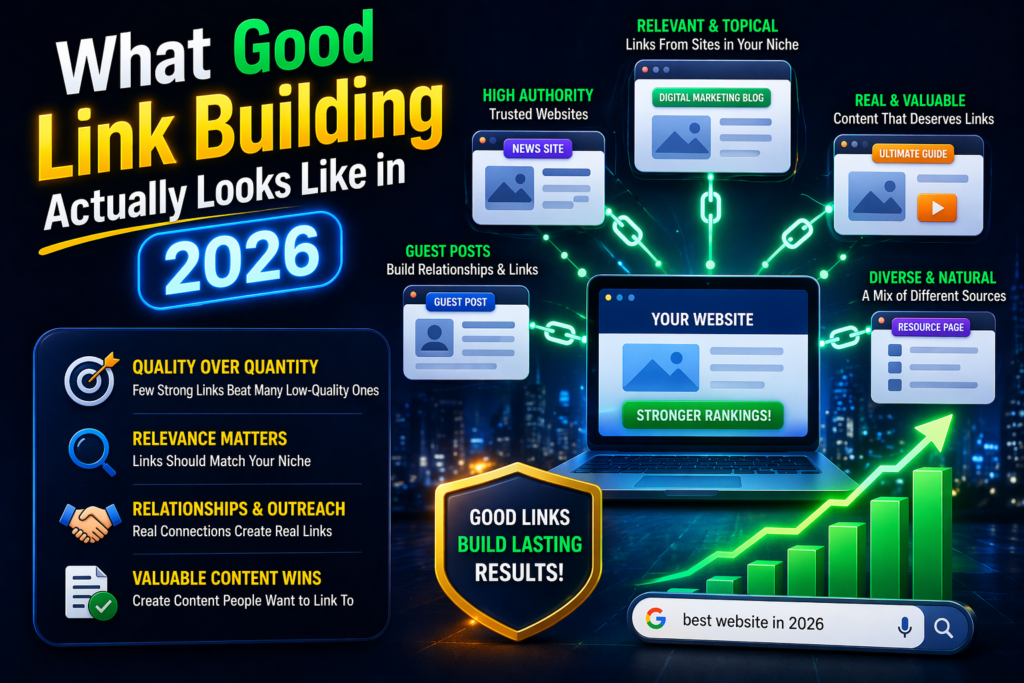
Now that we’ve covered what not to do, here’s a quick picture of what legitimate, sustainable link building looks like — the kind that builds authority gradually without putting your website at risk.
| Strategy | How It Works | Difficulty | Quality |
|---|---|---|---|
| Content Marketing | Create genuinely useful guides, original research, or tools that people naturally link to | High effort | ⭐⭐⭐⭐⭐ |
| Quality Guest Posts | Write expert articles for well-established publications in your industry | Medium | ⭐⭐⭐⭐ |
| Broken Link Building | Find broken links on relevant sites and offer your content as replacement | Medium | ⭐⭐⭐⭐⭐ |
| Digital PR / Brand Mentions | Get your business featured in news articles, industry reports, expert roundups | High | ⭐⭐⭐⭐⭐ |
| Unlinked Mention Reclamation | Find places your brand is mentioned but not linked, then request the link | Low | ⭐⭐⭐⭐ |
| Resource Page Link Building | Get listed on curated resource pages relevant to your industry | Medium | ⭐⭐⭐⭐ |
| Local Citations | Consistent NAP listings on Justdial, IndiaMART, Sulekha etc. | Low | ⭐⭐⭐ (for local SEO) |
- Always prioritise relevance of the linking site to your industry
- Never use the same anchor text repeatedly across multiple links
- Build links to deep pages (services, blogs), not just the homepage
- Monitor your backlink profile monthly for lost or toxic links
- Focus on earning links through content quality, not manufacturing them
- Keep your internal linking strong so link equity flows through your site
- Be patient — good link building takes months, not weeks
Is Your Link Profile Hurting or Helping You?
We’ll audit your backlink profile, identify toxic links, and build you a custom link building roadmap — no fluff, no shortcuts.
📞 +91-7976373846 | 📧 info@g2stechnology.com | Jaipur, Rajasthan
Frequently Asked Questions
Q: Is link building still important for SEO in 2026?
Yes, absolutely. Backlinks remain one of Google’s top three ranking signals. What has changed is quality — one link from a relevant, authoritative website is worth far more than dozens of low-quality links. Focus on earning links through genuinely useful content and strategic outreach.
Q: How many backlinks do I need to rank on the first page of Google?
There’s no fixed number. It depends on your industry, keyword competition, and the quality of your links versus your competitors’. For low-competition local keywords in India, even 20–30 quality backlinks can be enough. For highly competitive national keywords, you may need hundreds of strong referring domains built up over 1–2 years.
Q: Is buying backlinks safe if the seller claims they are “high DA”?
No. Domain Authority (DA) is a third-party metric created by Moz — it’s not used by Google. Many vendors inflate DA artificially. Purchased links, regardless of the metrics claimed, violate Google’s guidelines and can result in a manual penalty or algorithmic ranking drop. The risk is simply not worth it.
Q: How do I know if my website has a Google penalty for bad links?
Check Google Search Console under Security & Manual Actions. A manual penalty will be listed there explicitly. For algorithmic penalties (caused by Penguin), look for a sudden drop in organic traffic that coincided with a known Google update date. Cross-reference your traffic drops with Google’s algorithm update history on sites like Semrush Sensor or MozCast.
Q: How long does link building take to show results?
On average, new backlinks take 3–6 months to meaningfully influence your rankings. This is because Google crawls and processes links at varying speeds, and it takes time for the cumulative authority to build up. You may see some initial movement within 6–8 weeks for low-competition keywords, but sustained ranking improvements from a healthy link building programme typically show up after 4–6 months of consistent effort.
Q: Should I use a link building agency, or can I do it in-house?
Both can work — it depends on your resources. In-house link building gives you more control and is often more authentic, but requires dedicated time and strong content creation capabilities. A good SEO agency with a proven track record can accelerate the process significantly, but always ask to see examples of the links they’ve built for past clients before committing.
Q: What is the safest link building strategy for Indian businesses?
The safest and most sustainable approach is content-driven link building — creating original, genuinely useful content (guides, research, tools, case studies) that earns links naturally. Pair this with selective guest posting on reputable publications, broken link building outreach, and strong local SEO citations for local businesses. This approach is slower but builds lasting authority without any penalty risk.
The Last Words: Link building isn’t rocket science, but it does require patience, discipline, and a willingness to play the long game. The businesses we see consistently winning on Google are not the ones who figured out some clever trick or shortcut — they’re the ones who’ve been building genuinely useful content and earning quality links, month after month, for years.
Avoid the twelve mistakes outlined above, and you’ll already be ahead of most of your competitors. Start implementing the white-hat strategies in the table above, and you’ll start to see your domain authority and organic rankings grow steadily over the coming months.
And if you’d rather have experienced professionals manage your link building while you focus on running your business — that’s exactly what we do at G2S Technology. We’ve helped businesses across Jaipur and all over India build strong, penalty-proof backlink profiles that drive real organic growth.Feel free to reach out for a free consultation — no obligation, no hard sell. Just an honest look at where your backlink profile stands and what it would take to improve it.