

India now has over 900 million internet users, and the number of people searching for local businesses on their phones grows every single day. When someone in Jaipur types “CA near me” or a customer in Bengaluru searches “best plumber in Koramangala,” Google does not guess — it scans hundreds of signals across the web to decide which businesses to show. One of the most powerful of those signals is local citations.
Whether you are a small shop owner in Surat, a clinic in Hyderabad, or a B2B supplier in Delhi, citations are the backbone of your local search strategy. This guide walks you through everything — from understanding what citations are, to building them the right way, to maintaining them for long-term ranking dominance in India’s competitive local search landscape.
What Is a Local SEO Citation?
Before diving into the step-by-step process, it’s important to clearly understand what we’re actually building — because many business owners confuse citations with backlinks, and that confusion leads to wasted effort and missed rankings.
A local SEO citation is any online mention of your business’s Name, Address, and Phone Number — commonly referred to as NAP. These mentions can appear on business directories, review platforms, social media profiles, local blogs, news websites, or industry-specific portals. The key is consistency: every time your business information appears correctly across the web, it sends a trust signal to Google confirming that your business is legitimate, active, and located where you say it is.
Simple Example: If you run “Sharma Dental Clinic” at 22, MI Road, Jaipur, Rajasthan — 302001 with phone number 9876543210, then a mention of exactly that information on JustDial, Google Business Profile, Sulekha, and Practo constitutes four citations for your business.
Citations are not the same as backlinks, though they can sometimes include one. A citation can exist without any link to your website and still carry SEO value. The goal of a citation is to help both search engines and potential customers find, verify, and trust your business.
👉 Also Read: On-Page SEO vs Off-Page SEO — Key Differences Explained
Why Citations Matter for Local Rankings in India (2025–2026 Data)

Many SEO practitioners underestimate citations, treating them as a one-time task to tick off a checklist. In reality, citations are a continuously evolving ranking factor — and their importance has only grown in the era of AI-powered search.
Here is why citations are non-negotiable for Indian businesses in 2026:
Citations build Google’s trust in your business. Google cross-references your business information across multiple online sources before it decides to show your listing in the Local Pack or Google Maps. When your NAP details appear identically on trusted platforms like JustDial, IndiaMart, Sulekha, and your own website, Google treats that as verified proof that your business exists and operates where you claim.
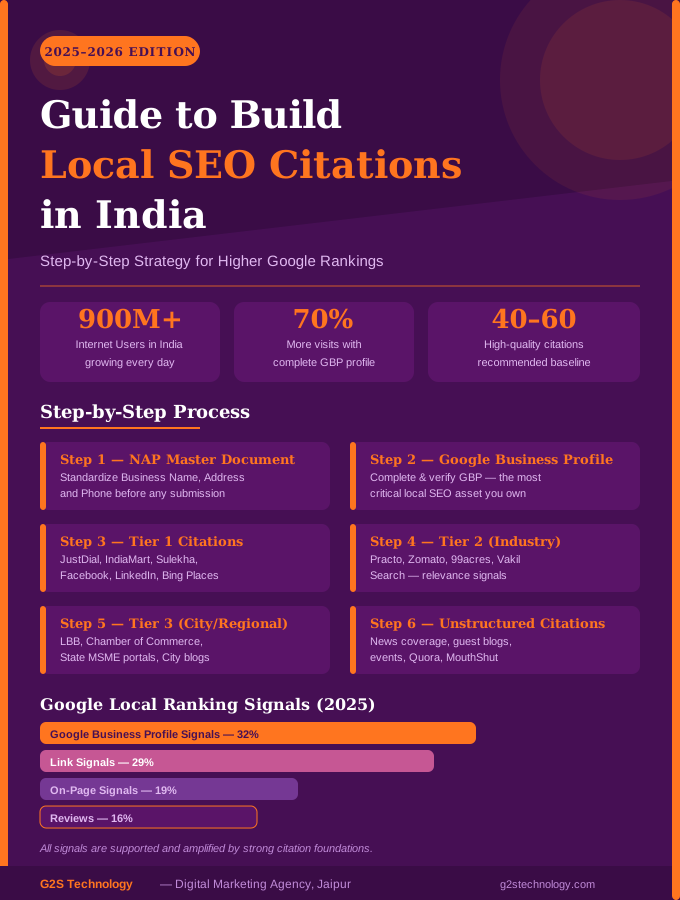
They directly influence local pack rankings. According to Whitespark’s Local Search Ranking Factors study, citations are the sixth most important signal for Local Pack rankings and the joint fifth most important for local organic results. Local ranking factors in 2025 weight Google Business Profile signals at approximately 32%, link signals at 29%, on-page signals at 19%, and reviews at 16% — all of which are supported and amplified by strong citation foundations.
Citations now feed AI search results too. With Google AI Overviews appearing in nearly 15–25% of searches in 2025, and tools like ChatGPT and Perplexity increasingly being used to find local services, citation data is now being pulled into AI-generated answers. A business with consistent, complete citations has a higher chance of being cited in these AI responses.
80% of consumers don’t trust businesses with inconsistent contact details online. Inconsistent NAP — for example, listing your number as 9876543210 on JustDial but +91-98765-43210 on Sulekha — confuses both Google and real customers. Standardization is not optional; it is foundational.
👉 Read More: Local SEO Ranking Factors — What Actually Moves the Needle
Structured vs. Unstructured Citations — With Indian Examples
Understanding the two types of citations helps you build a complete, balanced strategy rather than just spamming directories.
Structured citations appear in organized business directories where your NAP is presented in a uniform, consistent format. These are the “traditional” citations most people think of. Examples in India include:
- Your JustDial listing showing: ABC Catering Services | 14, Vaishali Nagar, Jaipur | 98765 43210
- Your IndiaMart profile for a textile supplier in Surat with full factory address and contact
- Your Practo profile for a dermatologist in Pune with clinic address, consultation hours, and phone number
- Your Google Business Profile (the single most important structured citation)
Unstructured citations appear organically — in places like news articles, blog posts, event listings, social media mentions, or forum discussions — without a standardized format. These are harder to acquire but carry strong trust signals because they reflect genuine editorial coverage.
Indian unstructured citation examples:
- A Times of India city supplement article mentioning “Ramesh Auto Repairs, Andheri West, Mumbai — 022-XXXXXXXX” in a feature on local garages
- A Zomato blog post about “Top 10 Dhabas in Chandigarh” that includes your restaurant’s name, area, and phone number
- A local event listing on a city blog covering a Jaipur fashion expo that mentions your boutique’s stall and address
- A review on MouthShut that includes your business name, city, and contact
Both types work together. Structured citations establish your core presence; unstructured citations build authority and authenticity.
👉 Also Read: 9 Types of Local SEO Content That Will Help Your Rankings
How Google Uses Citations to Rank Local Businesses
It helps to understand the mechanism before you start building. Google’s local ranking algorithm considers three primary factors for showing results in the Local Pack and Google Maps:
1. Relevance — How closely your business matches what the searcher is looking for. A dental clinic in Jaipur should appear when someone searches “dentist in Jaipur,” and citations on health-specific directories like Practo and Lybrate reinforce this relevance signal.
2. Distance — How physically close your business is to the person searching or the location mentioned in the query. Your GBP address and consistent NAP across citations help Google confirm your exact location.
3. Prominence — How well-known and trusted your business is online. This is where citations do the most work. The more authoritative websites mention your business consistently, the more “prominent” Google considers you to be.
Citations build prominence. When JustDial (DA 74), IndiaMart (DA 79), and Facebook (DA 96) all confirm the same business name, address, and phone number, Google’s confidence in your business rises significantly. This confidence translates directly into better Local Pack positions.
Additionally, Google uses entity recognition — meaning it tries to understand your business as a distinct “entity” in its knowledge graph. Consistent citations across diverse platforms help Google assemble a clear, confident picture of your business entity, which is increasingly important for appearing in AI-generated search results.
Step 1 — Set Up Your NAP Master Document
This is where every successful citation campaign begins, and it is the step most Indian businesses skip — which is why they end up with inconsistent listings that hurt more than they help.
Before you submit your business to a single directory, create a NAP Master Document — a standardized reference file that you use for every submission. Decide on the exact format of every piece of information and never deviate from it.
Your NAP Master Document should include:
| Field | Example |
| Business Name | G2S Technology Pvt. Ltd. |
| Address Line 1 | B-14, Sindhi Colony |
| Address Line 2 | Shastri Nagar |
| City | Jaipur |
| State | Rajasthan |
| PIN Code | 302016 |
| Phone (Primary) | 9876543210 |
| Phone (with STD) | 0141-XXXXXXX |
| info@g2stechnology.com | |
| Website URL | https://g2stechnology.com |
| Business Category | Digital Marketing Agency |
| Hours | Mon–Sat: 9:00 AM – 7:00 PM |
| Year Established | 2018 |
| Short Description (50 words) | [Write once, reuse everywhere] |
| Long Description (200 words) | [Write once, reuse everywhere] |
Critical consistency rules:
- If you use “Pvt. Ltd.” in your business name, always use it — never “Private Limited” on some listings and “Pvt Ltd” on others
- Decide on one phone format — either 9876543210 or +91-9876543210 — and use it everywhere. Do not mix both formats across platforms.
- Your address must match your GBP address character-for-character. Even “1st Floor” vs “First Floor” is a mismatch.
👉 Read More: 10 Essential On-Page SEO Factors Every Business Must Know
Step 2 — Optimize Your Google Business Profile First
Google Business Profile (GBP) — formerly known as Google My Business — is not just one citation among many. It is the single most important local SEO asset you own, and it should be completed perfectly before you build anything else. Every other citation you create will be compared against your GBP information.
Completing your GBP fully is not optional: businesses with complete Google Business Profiles receive 70% more visits and appear 18 times more often in search results compared to incomplete profiles.
Here is what a fully optimized GBP looks like for an Indian business in 2026:
Business Name: Exactly as registered legally / as displayed on your physical signage. Do not add keywords. “Joshi Law Associates” — not “Joshi Law Associates | Best Lawyers in Pune.”
Primary Category: This is the single most impactful ranking factor in local search. Choose the most accurate primary category. A dental clinic should select “Dental Clinic” — not the broader “Health” category. Add secondary categories to capture additional search intent. A dental clinic that also does teeth whitening should add “Cosmetic Dentist” as a secondary category.
Address: Must be a physical, verifiable address. This must match your NAP Master Document precisely.
Phone Number: Use your primary local number. If you have both a landline and mobile, list the most consistently used one first.
Website: Link to your main domain or to a specific landing page if you are a multi-location business.
Business Hours: Keep these updated for Indian festivals and holidays. GBP has special hours settings for days like Diwali, Holi, and Independence Day. Use them — outdated hours hurt both user trust and rankings.
Photos: Upload a minimum of 10 photos including your storefront, interior, team, products/services, and your logo. In 2025, businesses with photos on GBP receive 42% more direction requests and significantly more phone calls than those without.
Posts: Post at least twice a week on GBP. Share offers, updates, events, or service highlights. Regular posting is now a top-tier ranking signal in 2026.
Reviews: Actively request reviews from satisfied customers using Google’s official review link. Respond to every review — positive and negative. Businesses that respond to reviews build 1.7x more trust with potential customers.
Verification: In 2026, you can verify your GBP via postcard, phone, email, or video. Video verification is the fastest option and was expanded by Google in 2025. An unverified profile simply cannot rank in the Local Pack — verification is non-negotiable.
👉 Also Read: How to Create and Verify Your Google Business Profile Page
👉 Also Read: How to Update Your Google Business Listing Correctly
Step 3 — Build Tier 1 Citations (Top Indian Directories)
Once your GBP is complete and verified, begin building citations starting from the highest-authority platforms. These are your Tier 1 citations — the foundations of your local presence that Google trusts most heavily.
Submit to these platforms in the first 3–5 days and complete each profile as fully as possible. A partially filled listing is only marginally better than no listing at all.
Essential Tier 1 Platforms for Indian Businesses:
| Platform | Domain Authority | Why It Matters |
| Google Business Profile | DA 98 | #1 local ranking factor — covered in Step 2 |
| Facebook Business Page | DA 96 | Social trust + NAP citation + community reach |
| Bing Places for Business | DA 94 | Powers Microsoft Copilot AI search results |
| JustDial | DA 74–84 | India’s largest local search engine with massive user base |
| IndiaMart | DA 76–79 | Critical for B2B businesses across India |
| Sulekha | DA 71–78 | Dominant for local service providers and home professionals |
| LinkedIn Company Page | DA 98 | Professional credibility + NAP signal |
| Apple Maps (Apple Business Connect) | DA 96+ | Powers Siri search and iOS Maps for millions of iPhone users in India |
| Yellow Pages India | DA 55–60 | Long-established directory with strong trust |
| TradeIndia | DA 63 | Industrial and B2B companies |
Pro tips for each platform:
JustDial — Fill out every field including your tagline, service area, photos, and working hours. JustDial’s algorithm gives priority to complete profiles. Respond to every review on this platform — it is one of the first places Indian customers check for local service reviews.
IndiaMart — If you are a B2B business, create detailed product/service pages with clear descriptions, photos, and pricing ranges. Use keywords that your buyers actually search for — not generic terms.
Sulekha — Be very specific about your service area. If you serve only specific pin codes or neighborhoods in your city, mention them in your Sulekha profile. This helps with hyperlocal ranking.
Bing Places — This is often ignored by Indian businesses, which is a missed opportunity. Bing Places now feeds directly into Microsoft Copilot AI results. As AI-powered search grows, your presence here becomes increasingly important.
Facebook Business Page — Even if you are not active on Facebook for marketing, set up a complete Business Page for the citation value alone. Make sure your NAP on Facebook exactly matches your GBP and NAP Master Document.
Step 4 — Build Tier 2 Citations (Industry-Specific Platforms in India)
General directories establish breadth. Industry-specific directories establish relevance — and relevance is one of Google’s three core local ranking factors. This is where most Indian businesses leave significant ranking potential on the table.
After completing your Tier 1 submissions, spend the second week targeting the best industry-specific directories for your category.
Healthcare & Medical (Doctors, Clinics, Hospitals):
- Practo — India’s largest health platform for clinic listings, appointments, and doctor profiles
- Lybrate — Great for specialist doctors and teleconsultation listings
- 1mg — Pharmacies and health-focused listings
- Netmeds — For pharmacy and healthcare product businesses
- Healthgrades — If you serve NRI patients or international clientele
Example: A dermatology clinic in Mumbai should be listed on Practo with full profile including specializations, consultation fees, clinic photos, and patient reviews. This listing alone can drive more appointment inquiries than a dozen generic directory submissions.
Restaurants, Cafes & Food Businesses:
- Zomato — Essential for any food business. A complete Zomato listing with photos, menu, and reviews directly impacts your “near me” restaurant search rankings.
- Swiggy Business — Food delivery integration + citation
- Dineout — Great for upscale restaurants offering reservations
- EazyDiner — Reservation-focused platform popular in metro cities
Real Estate Agencies & Builders:
- 99acres — One of India’s most-visited real estate portals
- MagicBricks — High-traffic platform for property listings
- Housing.com — Strong for metro and tier-2 cities
👉 Also Read: A Complete Guide to Real Estate SEO in India
Travel, Tourism & Hospitality:
- TripAdvisor — International-level authority for hotels, restaurants, and tourist attractions
- MakeMyTrip Business — Hotel and travel business listings
- Goibibo — Strong hotel booking platform with business listings
Legal Services:
- Vakil Search — India’s leading legal platform for advocates and law firms
- LegalDocs — Document and legal service listings
- Bar Council of India affiliated directories
Education & Training Institutes:
- Shiksha — Coaching institutes and educational institutions
- Justdial’s education vertical
- Course Report — For coding bootcamps and technical training
Home Services (Electricians, Plumbers, Carpenters, Packers & Movers):
- Urban Company (UrbanClap) — High-intent platform where customers actively search for and book home services
- Sulekha Pro — Service-specific listings
- HomeAdvisor India equivalents
B2B, Manufacturing & Export:
- ExportersIndia — DA 58, strong for manufacturers and exporters
- TradeIndia — DA 63, excellent for industrial companies
- GlobalLinker — SME-focused business network
👉 Also Read: Top 10 Ways to Improve Your Local SEO Right Now
Step 5 — Build Tier 3 Citations (City & Regional Directories)
Tier 3 citations are often the most underutilized and most powerful for hyperlocal ranking — particularly for businesses targeting specific neighborhoods, districts, or tier-2 cities. Google’s local algorithm heavily rewards geographic specificity, and city-focused directories directly reinforce your location signals.
These are platforms specific to your city, state, or region. They typically have lower domain authority than national platforms, but their geographic relevance makes them valuable local SEO assets.
City-specific directories and platforms to target:
- LBB (Little Black Book) — Covers Delhi, Bengaluru, Mumbai, and other metros. Excellent for lifestyle businesses: cafes, boutiques, salons, and restaurants. A featured listing or editorial mention on LBB carries both citation and unstructured citation value.
- Burrp — City-based restaurant and entertainment guide covering major Indian cities
- Local Chamber of Commerce directories — Jaipur Chamber of Commerce, Bangalore Chamber of Commerce, FICCI member directories, and CII chapter listings are all credible local citations that most businesses ignore
- State government business directories — Many state governments maintain MSME directories and Udyam-linked business portals. These carry strong trust signals as government-backed sources.
- City-specific Facebook Groups and community pages — While not traditional citations, mentions of your business in city-level groups (e.g., “Best of Jaipur,” “Pune Business Network”) represent unstructured citation opportunities
How to find city-specific citation opportunities:
Search Google for: “[Your City]” + “business directory” or “[Your Industry]” + “[Your City]” and look at what directories or platforms appear on the first page. If a competitor is listed there, you should be too. This simple competitive research technique can surface dozens of relevant local citation opportunities.
Step 6 — Build Unstructured Citations (Blogs, News, Forums)
Unstructured citations require more effort but deliver disproportionate authority. When a credible third-party source — a news outlet, an industry blog, a local review site — mentions your business naturally, Google treats this as genuine editorial endorsement rather than self-submitted data.
Here are the most effective ways to earn unstructured citations in the Indian context:
Local press and news coverage — Reach out to city journalists and local digital news portals. A story about your business launch, a community initiative, or an award earned can result in a news article that mentions your full NAP. Platforms like Times of India City Supplements, Deccan Herald, Hindustan Times Delhi-NCR, and The Hindu Business Line all carry high domain authority.
Guest posts on industry blogs — Write genuinely helpful content for established blogs in your industry. Include your business name and location naturally in the author bio or within the content. Make sure the NAP mentioned matches your master document.
Local event and conference listings — If your business sponsors or participates in local trade fairs, exhibitions, or cultural events, request that the event organizer includes your NAP in their event listing. Trade India expo listings, MSME Summits, and local startup events are good opportunities.
Business award directories — Apply for and participate in local business awards — e.g., “Top Businesses in Rajasthan,” India SME100 Awards, or city-level entrepreneurship awards. Award announcement pages frequently include business name, city, and contact details.
Reddit India and Quora — Engaging genuinely in local subreddits (r/jaipur, r/bangalore, r/mumbai) or on Quora with answers that reference your expertise and business location builds unstructured citation signals that AI search engines are increasingly drawing from.
MouthShut.com and review communities — Encourage satisfied customers to leave detailed reviews on MouthShut with your business address and phone number included. MouthShut has high domain authority and is frequently indexed by Google.
👉 Also Read: 7 New Ways for Local Businesses to Get Links in India
How to Fix Inconsistent or Duplicate Citations
Before you build new citations, you must audit and fix the existing ones. If your business has been operating for more than a year, there is a good chance that some incorrect, outdated, or duplicate citations already exist across the web — and these actively harm your rankings.
Why inconsistency is dangerous:
Imagine your business moved from one area of the city to another two years ago, but your old address is still showing on JustDial, Sulekha, and a dozen other directories. Google sees two different addresses for the same business and loses confidence. The result? Lower rankings, confused customers, and wasted citation equity.
Step-by-step citation audit process:
Step 1 — Google yourself. Search for “[Business Name]” “[City]” and look for every listing that appears. Make a spreadsheet of what you find — correct information, incorrect information, and duplicates.
Step 2 — Use citation audit tools. BrightLocal’s Citation Tracker, Moz Local, and Semrush Listing Management are the three best tools for comprehensive citation audits. These tools scan hundreds of directories automatically and flag inconsistencies.
Step 3 — Claim and correct listings. For each incorrect listing, log in to the platform (or create an account if needed) and update the information to match your NAP Master Document. For platforms that don’t allow direct editing, submit a correction request.
Step 4 — Eliminate true duplicates. If a platform shows two listings for your business, request that the incorrect/older one be removed or merged with the correct one. Most major Indian directories have a process for this.
Step 5 — Verify major listings. After correcting, verify your listing on platforms that offer verification (JustDial, IndiaMart, and Sulekha all have verification processes). Verified listings carry significantly more trust — both for users and for search engines.
👉 Also Read: Google Business Profile Issues and How to Fix Them
Citation Building Tools That Actually Work in India
Doing all of this manually across 50+ platforms is time-consuming. The right tools can streamline the process significantly — though for Indian-specific directories like JustDial, IndiaMart, and Sulekha, manual submission often produces better results.
BrightLocal — The gold standard for local citation management globally. Excellent for citation audits, rank tracking in Local Pack, and review monitoring. Supports Indian businesses through its manual submission service for directories not included in its automated network.
Moz Local — Strong for auditing existing citations and ensuring consistency. The dashboard clearly shows which directories have your business listed, which have incorrect information, and which you haven’t claimed yet.
Semrush Listing Management — If you already use Semrush for keyword research and SEO, its Listing Management tool integrates citation building into your broader SEO workflow. Covers major global and some Indian directories.
WhiteSpark Local Citation Finder — Excellent competitive research tool. Enter a competitor’s business and see where they are listed. This is one of the best ways to discover Indian citation opportunities you haven’t considered.
Manual Google Search — Often overlooked, but simply searching “[competitor business name]” “[city]” site:justdial.com or variations thereof can reveal which directories your competitors are on — giving you a ready-made citation hit list.
Citation Maintenance — What to Do Every Month
Building citations is not a one-time task. Citations degrade over time — directories change their formats, business information gets corrupted, duplicates get created, and new high-value directories emerge. A consistent monthly maintenance routine protects your investment.
Monthly Citation Maintenance Checklist:
✅ Log in to Google Business Profile and check for any user-suggested edits that Google may have auto-applied to your listing. Reject any incorrect suggestions.
✅ Respond to all new reviews on GBP, JustDial, Zomato, Practo, and any other platform where you have an active listing. Aim to respond within 48 hours.
✅ Update festival and holiday hours in advance — Diwali, Holi, Eid, Christmas, and public holidays. Update these at least one week before the holiday.
✅ Add 2–3 new photos to your GBP each month. Google rewards freshness signals. Businesses that regularly update photos see stronger engagement metrics.
✅ Post twice weekly to your GBP (offers, updates, new services, team achievements).
✅ Run a quick Google search for your business name to check for any new incorrect listings or rogue duplicates that may have appeared.
✅ Check your NAP on your own website’s Contact page, About page, and footer — these must always match your NAP Master Document and GBP exactly.
✅ Track your Local Pack rankings for your top 5–10 target keywords using BrightLocal or Semrush once a month.
Common Citation Mistakes Indian Businesses Make
After working with businesses across India — from Jaipur to Bengaluru, from small retailers to multi-city service providers — we have seen the same citation mistakes appear again and again. Avoiding these will put you ahead of most of your local competitors.
Mistake 1: Using different business name formats across platforms. “Sharma & Sons” on GBP, “Sharma and Sons” on JustDial, “Sharma & Sons Pvt Ltd” on IndiaMart. These look like three different businesses to Google. Standardize before you build.
Mistake 2: Listing an old or incorrect address. Many businesses that have relocated still have their old address active on dozens of directories. A citation audit is essential to catch and fix this.
Mistake 3: Using a mobile number on some platforms and a landline on others without consistency. Decide on one primary contact number and use it uniformly. If you need to list multiple numbers, always lead with the same primary number on every platform.
Mistake 4: Submitting to hundreds of low-quality directories. Quantity without quality can actually dilute your citation profile. Focus on the top 40–50 high-authority, relevant directories rather than submitting to every directory site you can find.
Mistake 5: Building citations and then never monitoring them. Directory platforms can auto-update or corrupt your information. Monthly monitoring is not optional if you want to maintain consistent rankings.
Mistake 6: Ignoring industry-specific directories. A doctor listed on Practo and Lybrate will outrank a doctor listed only on JustDial and Google Business Profile — because industry-specific citations send a stronger relevance signal.
Mistake 7: Not claiming existing listings. JustDial and other platforms sometimes auto-generate listings for businesses. These unverified listings may have incorrect information. If an auto-generated listing exists for your business, claim and correct it immediately.
👉 Read More: 10 Ways to Optimize Your Website for Local SEO
👉 Also Read: Local SEO for Small Businesses — A Practical Guide
Frequently Asked Questions
Q1: How many citations does a business in India need?
There is no fixed magic number. For most competitive local markets, having 40–60 high-quality, relevant citations is a strong foundation. The key is quality over quantity — 30 accurate citations on relevant, high-authority platforms will outperform 200 submissions to irrelevant or low-authority directories every time.
Q2: What is the difference between a citation and a backlink?
A citation is an online mention of your business’s NAP (Name, Address, Phone). A backlink is a hyperlink from another website pointing to yours. Citations can include a backlink (and those with do-follow links are particularly valuable), but a citation can exist without a link and still carry local SEO value. Citations primarily help with local rankings; backlinks help with both organic and local rankings.
Q3: How long does it take for citations to affect rankings?
New citations typically take 4–12 weeks to be indexed by Google and begin influencing local rankings. High-authority platforms like GBP and JustDial can show impact faster. Fixing incorrect citations can sometimes produce ranking improvements within 2–4 weeks as Google recrawls the updated information.
Q4: Can I build citations for a home-based business in India?
Yes. For home-based or service-area businesses, set your Google Business Profile to hide your home address and instead display your service area. On other directories, use a “service area” setting if available, or list your city and PIN code without the full street address. Focus on directories that support service-area listings.
Q5: Do citations still matter in 2026 with AI search taking over?
More than ever. AI-powered search tools — including Google AI Overviews, ChatGPT, Perplexity, and Microsoft Copilot — pull business information directly from citation sources to generate local answers. A business with consistent, complete citations is far more likely to be recommended by AI search than one with inconsistent or missing data. Strong E-E-A-T (Experience, Expertise, Authority, Trust) signals, of which citations are a key component, are now prerequisite for visibility in both traditional and AI search results.
Q6: Are Indian directories like JustDial and Sulekha worth paying for premium listings?
Free listings on JustDial and Sulekha provide citation value regardless of paid tier. Premium listings add additional visibility within those platforms (featured position, lead notifications, etc.) but the citation SEO value is largely the same. Invest in paid upgrades only if you are seeing active customer leads from the platform — the SEO citation value is already present with a free, complete listing.
Final Thoughts
Local SEO citation building in India is not glamorous work. It requires patience, consistency, and attention to detail. But the businesses that get it right gain a compounding advantage — every accurate citation reinforces the next, every verified listing builds more trust, and every correct NAP signals make Google more confident about recommending your business to local customers.
The Indian local search market is growing faster than almost any other in the world. Your customers — whether they are searching on a smartphone in Jaipur, using Google voice search in Bengaluru, or asking ChatGPT to recommend a service provider in Mumbai — are actively looking for businesses like yours. The question is whether your citation presence is strong enough for them to find you first.
Start with your NAP Master Document today. Complete your Google Business Profile this week. Build your Tier 1 citations over the next few days. Then work steadily through Tier 2 and Tier 3. Monitor monthly. Fix inconsistencies promptly. This step-by-step approach, applied consistently, is how businesses move from invisible in local search to dominant in the Local Pack.
If you need expert help with citation building, audits, or a complete local SEO strategy for your Indian business, contact G2S Technology — we’ve helped businesses across Rajasthan, Maharashtra, Karnataka, and beyond build the citation foundations that drive real local rankings and real customer enquiries.
👉 Also Read: Why SEO Is Important for Your Business — 10 Compelling Reasons 👉 Read More: Complete SEO Audit Guide for 2025–2026