
Over 90% of web pages get zero organic traffic from Google — not because they lack information, but because they lack SEO-optimized content. If your content is not structured, keyword-targeted, and readable, search engines simply cannot rank it.
Writing content without an SEO strategy is like opening a store with no signboard. You may have excellent products, but nobody finds you. Whether you are a marketing professional managing a brand or a business owner trying to generate leads, mastering SEO-friendly content writing is the single most reliable way to drive sustainable organic traffic.
In this guide, you will learn 10 practical, proven tips for writing SEO-friendly content — tips that work for traditional search engines like Google and increasingly for AI-powered engines like ChatGPT, Gemini, and Perplexity.
What Is SEO-Friendly Content?
SEO-friendly content is written material that is structured, researched, and formatted to rank well in search engine results pages (SERPs). It satisfies both the search engine’s algorithm and the reader’s intent at the same time.
Why it matters: Content that ranks on page one of Google receives about 27% of all clicks, according to data from Backlinko. Everything below page one gets a fraction of that. Good SEO content is your ticket to page one.
How to achieve it: Follow a combination of keyword research, proper heading structure, internal and external linking, readability standards, and consistent publishing. The 10 tips below cover each of these in detail. For a deeper technical foundation, explore our On-Page SEO Cheat Sheet to Rank on the First Page.
Benefits of Writing SEO-Friendly Content
Before diving into the tips, here is a quick summary of what well-optimized content does for your business:
- Improves organic search rankings — more visibility, less ad spend
- Drives higher conversion rates — targeted readers are already interested in your solution
- Reduces bounce rate — structured content keeps readers engaged longer
- Increases brand awareness — consistent publishing builds authority in your niche
- Attracts social media shares — quality content earns organic amplification
- Earns AI citations — clear, factual writing is increasingly cited by AI search engines
These benefits compound over time. A single well-optimized article can generate traffic for years. That is the power of a strong content marketing strategy.
10 Tips for Writing SEO-Friendly Content
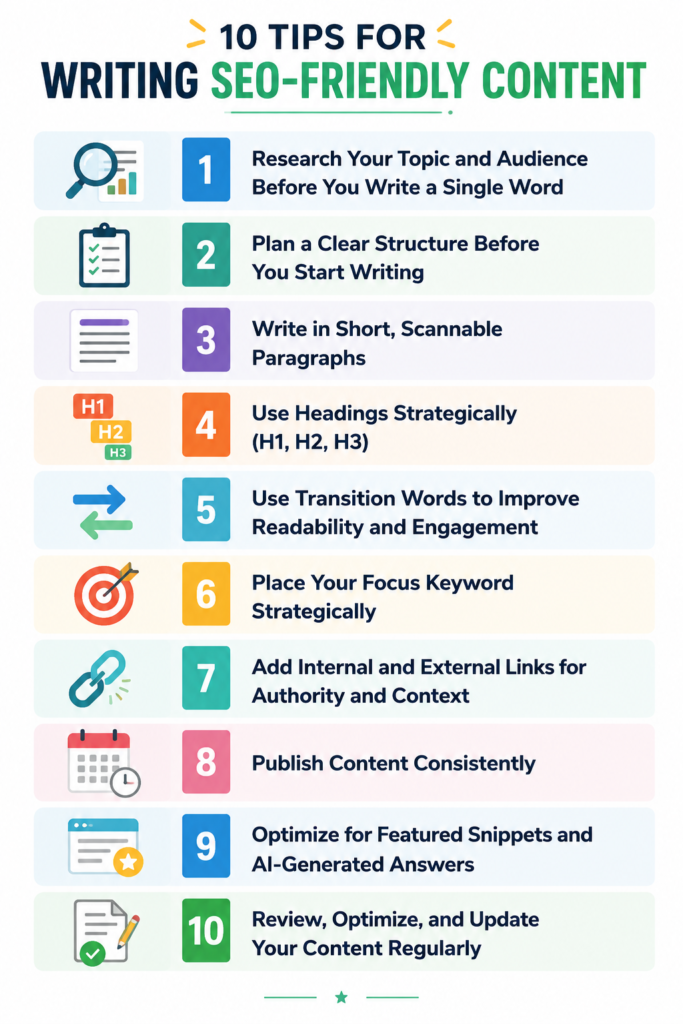
1. Research Your Topic and Audience Before You Write a Single Word
Most writers make the mistake of starting to type before they have answered three essential questions:
- Who am I writing for, and what problem are they trying to solve?
- What is the primary keyword or search query this piece should rank for?
- What does the reader expect to find — informational content, a product, or a solution?
This is called search intent mapping. Google’s algorithm is sophisticated enough to identify whether your content matches what the searcher actually wants. A mismatch between content and intent is one of the top reasons pages fail to rank.
Use tools like Google Search Console, Google’s autocomplete, or the “People Also Ask” box to understand what your audience is searching for before you draft a single line.
2. Plan a Clear Structure Before You Start Writing
A well-planned structure is the skeleton of great SEO content. Before writing, create a content outline that includes your H1 (main title), H2s (main sections), and H3s (subsections).
This approach works for a 500-word blog post and a 5,000-word pillar page alike. A clear outline prevents rambling, ensures logical flow, and signals to search engines what topics you are covering.
Your H2 headings should naturally incorporate secondary keywords. This helps search engines understand the breadth of your topic coverage.
3. Write in Short, Scannable Paragraphs
Online readers scan before they read. Research from the Nielsen Norman Group shows that users read only about 20–28% of the text on a page. That means dense, wall-of-text paragraphs actively hurt your performance.
Keep paragraphs to 2–4 lines. Use bullet points for lists of items. Use numbered lists for step-by-step instructions. White space is not wasted space — it is a readability tool.
Google uses the sameAs field to cross-reference your identity across multiple platforms. The more consistent your name, photo, and bio are across those platforms, the stronger your entity signal.
4. Use Headings Strategically (H1, H2, H3)
Every blog post should have one H1 (your main title with the primary keyword), multiple H2s (major sections), and H3s where needed (subsections within each H2).
Headings serve two purposes. For readers, they create a navigational map so people can jump to what they need. For search engines, they signal topical structure and keyword relevance.
AI search engines like Perplexity and ChatGPT use heading structure to extract and summarize content. Clear, descriptive headings dramatically increase your chances of being cited in AI-generated answers.
5. Use Transition Words to Improve Readability and Engagement
Transition words are the connective tissue of well-written content. Words and phrases like “as a result,” “in addition,” “however,” “for example,” and “consequently” signal to readers — and to search engines — how ideas relate to each other.
According to Yoast SEO, transition words improve a page’s readability score, which is one of the factors assessed during content quality evaluations. Incorporate these naturally. Forced transitions read awkwardly and hurt the user experience.
6. Place Your Focus Keyword Strategically
Keyword placement is not about stuffing your target phrase into every other sentence. It is about placing it in the right spots where search engines look first:
- Title (H1): Include the primary keyword near the beginning of the title
- First 100 words: Introduce the keyword naturally in the opening paragraph
- At least one H2 heading: Use a natural variation in a subheading
- Meta title and description: Ensure the keyword appears in both
- URL/slug: Keep the URL short and keyword-rich
- Image alt text: Describe images accurately using relevant keywords
Keyword density is secondary to natural usage. Write for humans, and optimize for engines — not the other way around.
7. Add Internal and External Links for Authority and Context
Links are one of the most powerful on-page SEO signals. Internal links help search engine crawlers discover and understand your site architecture. They also keep readers on your site longer, reducing bounce rate. For example, our guide on why SEO is important for your business provides excellent context on why consistent content investment pays off.
External links to authoritative sources — like Google Search Central’s content guidelines — signal to Google that your content is well-researched and trustworthy. This is a key component of E-E-A-T (Experience, Expertise, Authoritativeness, Trustworthiness).
Every blog post should include 2–4 internal links and 1–2 credible external links. Use descriptive anchor text — avoid generic phrases like “click here.
8. Publish Content Consistently
Google treats fresh, regularly updated content as a trust signal. Websites that publish new posts consistently tell search engine crawlers that the site is active and maintained.
Consistency does not mean daily publishing. It means maintaining a predictable cadence — whether that is weekly, bi-weekly, or monthly. What matters is that you keep delivering value to your audience on a reliable schedule.
Consistency also builds reader loyalty. Audiences return to sources they trust. When your content appears regularly in their searches or email newsletters, your brand becomes associated with expertise in your field.
9. Optimize for Featured Snippets and AI-Generated Answers
A featured snippet is the boxed answer that appears at the top of Google search results — often called “Position Zero.” Earning a featured snippet can multiply your click-through rate dramatically.
To optimize for featured snippets and AI answer engines, structure your content in a “What is X / Why it matters / How to do it” format. Use direct, concise answers to common questions. Keep definition-style sentences under 50 words.
AI tools like ChatGPT and Perplexity scan for clearly stated facts, structured definitions, and numbered how-to steps. If your content answers questions directly and cites credible data, it is significantly more likely to be quoted in an AI-generated response.
Related Read: 10 Reasons Why SEO Is Important for Your Business
10. Review, Optimize, and Update Your Content Regularly
SEO content is not a “publish and forget” activity. Algorithms change. Search intent shifts. Competitors update their pages. Content that ranked last year may slip this year if left untouched.
Set a quarterly review schedule for your top-performing pages. Update statistics, refresh examples, add new sections to address emerging questions, and check for broken links. This signals to Google that your content is current and maintained.
Use Google Search Console to identify which pages are losing impressions or clicks — those are your highest-priority update candidates.
If your website runs on WordPress, the Yoast SEO plugin is an excellent real-time content assessment tool. It evaluates your keyword usage, readability score, heading distribution, transition word frequency, and meta data — all before you hit publish. It is not a replacement for sound SEO strategy, but it is a practical checklist to catch optimization gaps in every post.
Putting It All Together: Your SEO Content Checklist
Before publishing any blog post or article, run through this quick checklist:
- Target keyword researched and search intent confirmed
- Content outline created with H1, H2, H3 structure
- Primary keyword in title, first 100 words, at least one H2, meta title, and URL
- Paragraphs kept to 2–4 lines; bullet points used where appropriate
- Transition words used to connect ideas
- 2–4 internal links added with descriptive anchor text
- 1–2 credible external links included
- Direct, definition-style sentences included for featured snippet optimization
- Meta title under 70 characters; meta description under 160 characters
- Content scheduled for quarterly review and update
Great SEO content is the intersection of what your audience needs and what search engines reward. Master that intersection, and organic growth follows. If you need hands-on help building a content strategy, our team at G2S Technology’s Digital Marketing Services can help you build a content engine that delivers long-term results.
Frequently Asked Questions
What is SEO-friendly content writing?
SEO-friendly content writing is the practice of creating written content that is optimized to rank in search engine results pages (SERPs). It involves researching target keywords, structuring content with proper headings, matching the reader’s search intent, and following technical on-page guidelines. The goal is to satisfy both the search algorithm and the human reader simultaneously.
How long should an SEO blog post be?
There is no universal word count rule for SEO. However, research consistently shows that longer, more comprehensive content (typically 1,000–2,000+ words for competitive topics) tends to rank higher because it covers a topic in greater depth. More important than length is completeness — your content should fully answer the reader’s question without unnecessary padding.
How many keywords should I use in an article?
Focus on one primary keyword and 3–5 related secondary keywords per article. Avoid keyword stuffing — using a keyword unnaturally many times can trigger Google’s spam filters and hurt your ranking. Modern SEO favors natural language and topical depth over keyword density.
Does publishing content frequently help SEO?
Yes, consistent publishing signals to Google that your website is active and regularly maintained. However, quality outweighs frequency. One well-researched, thoroughly optimized article per week delivers more long-term SEO value than five thin, poorly-structured posts. Aim for a sustainable publishing cadence you can maintain without sacrificing quality.
What is the difference between SEO content and regular content?
Regular content is written primarily for the reader, with no structured effort to optimize for search visibility. SEO content is also written for the reader — but it is additionally structured to be discovered by search engines. This means deliberate keyword placement, proper heading hierarchy, internal and external linking, optimized meta data, and content that matches a specific search intent.
How does content affect Google’s E-E-A-T score?
E-E-A-T stands for Experience, Expertise, Authoritativeness, and Trustworthiness — a quality framework Google uses to evaluate web content. Content that demonstrates first-hand experience, cites credible sources, avoids exaggerated claims, and is written by identifiable experts earns a higher E-E-A-T signal. This is especially important for topics in health, finance, and legal niches, but it matters for all content categories.
Can AI search engines like ChatGPT rank my content?
AI search engines like ChatGPT, Perplexity, and Gemini do not “rank” content in the traditional sense — they cite and summarize sources. To improve your chances of being cited by AI engines, write clear definition-style sentences, structure answers in a direct Q&A format, publish factually accurate content, and earn backlinks from authoritative sources. This practice is called Generative Engine Optimization (GEO).