
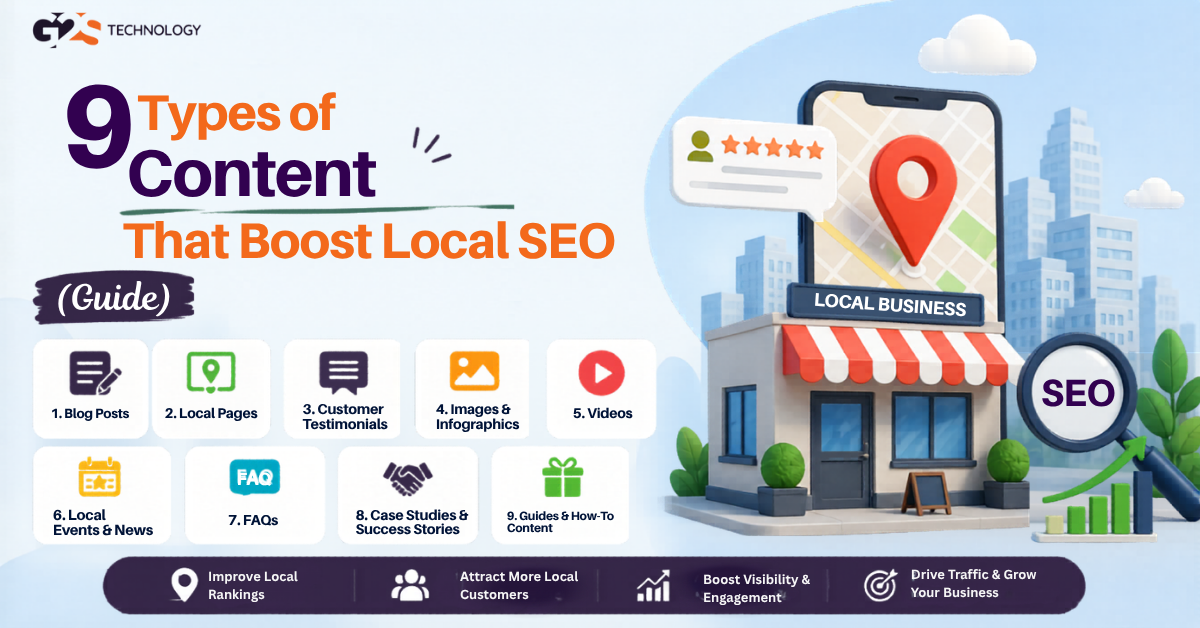
Roughly 46% of all Google searches have local intent — and a large share of “near me” searches lead to a visit or purchase within a day. The businesses that capture that traffic aren’t lucky; they publish the right content for local searchers.
This guide breaks down nine content types that genuinely move local rankings, what each one is, why it works, and how to do it well. It’s written for marketers and owners who want a practical plan, not vague theory — with honest notes on what content can and can’t do on its own.
What Is Local SEO Content?
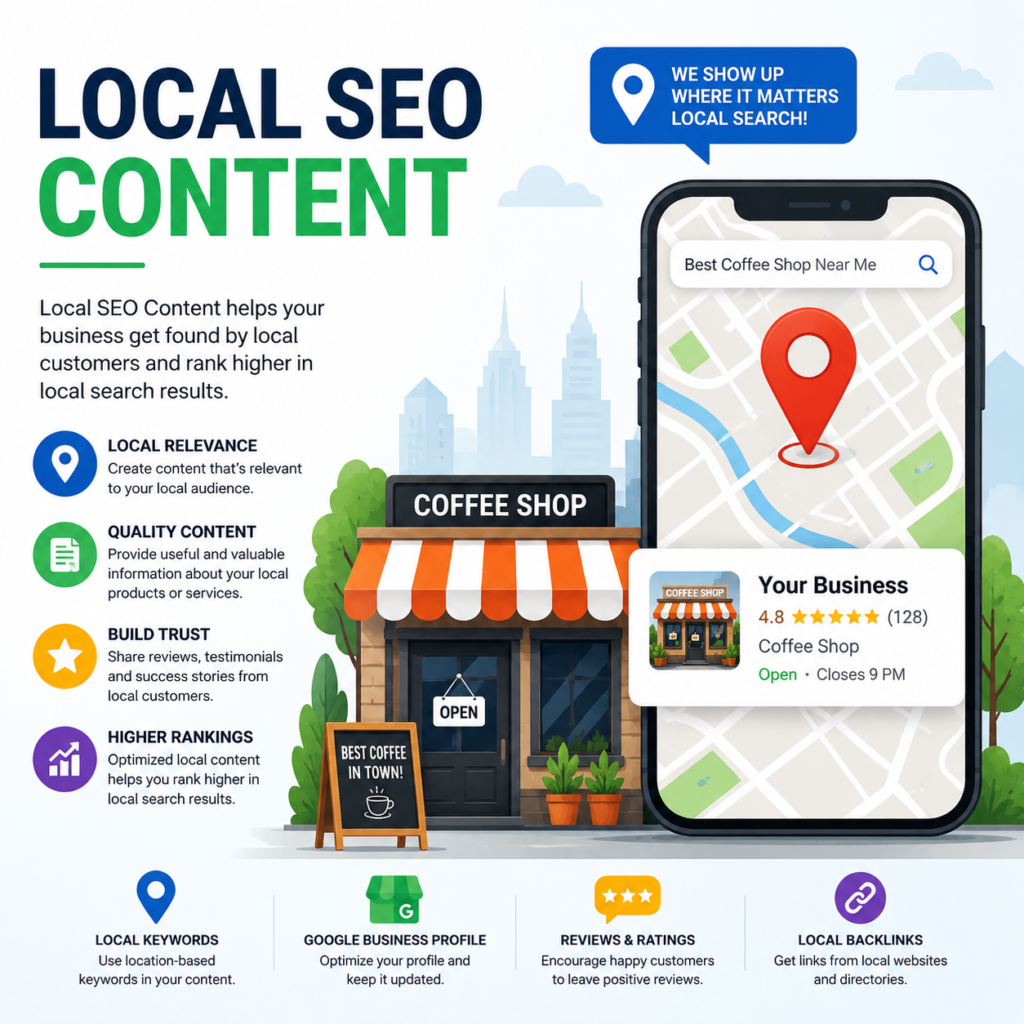
Local SEO content is text, images, or video about your business created to meet the needs of nearby searchers. It can live on your website, on local landing pages, on your Google Business Profile, and across local listings.
The difference between regular content and local content is the search intent behind the query. Local content thinks about the local user, local entities, and local relationships — not just inserting a city name into a generic post. Done well, it helps a smaller business compete against national brands that rely on broad keywords and brand size rather than local relevance.
One honest caveat up front: there’s no single piece of content that instantly drives foot traffic. As experienced local SEO put it, results come from consistent, intent-matched content over time — a pattern echoed in Google’s local ranking guidance, which weighs relevance, distance, and prominence together.
The 9 Local SEO Content Types That Work
Here are the nine, roughly in order of impact for most local businesses.
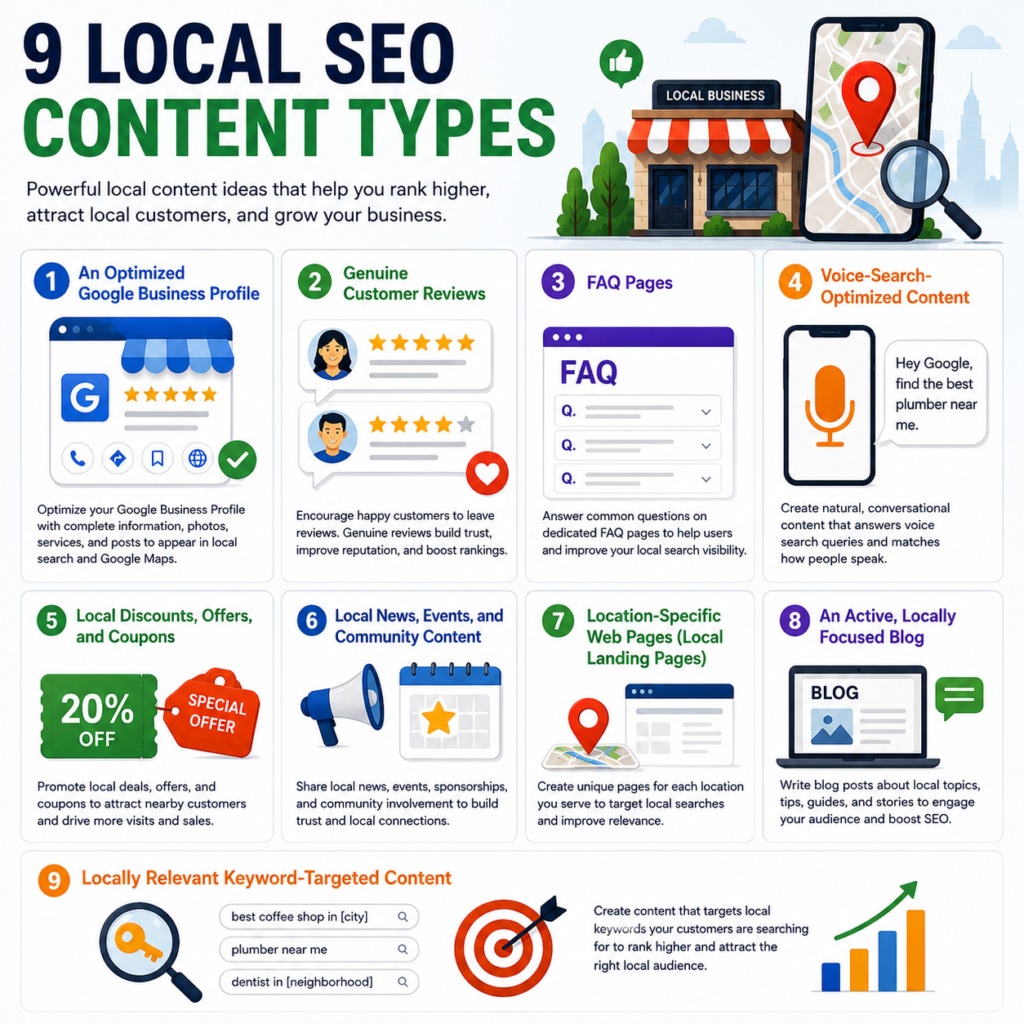
1. An Optimized Google Business Profile
Your Google Business Profile (formerly Google My Business) is the free listing that controls how you appear on Google Search and Maps. It is usually the highest-impact local asset because its content feeds the map pack and local panel directly.
How to do it well:
- Claim and verify the profile, then complete every field accurately.
- Add your logo, hours, payment methods, services, and clear real photos.
- Publish Posts (offers, events, updates) regularly from the dashboard.
- Encourage and respond to reviews promptly and honestly.
For a full walkthrough, see our guide to creating and verifying a Google Business Profile.
2. Genuine Customer Reviews
Reviews are content too — and they strongly influence both rankings and whether a searcher chooses you. Studies have consistently shown the vast majority of consumers trust online reviews nearly as much as personal recommendations, a finding repeated across years of
BrightLocal’s Local Consumer Review surveys. Fresh, genuine reviews signal prominence to Google.
How to do it well:
- Ask for a review in person right after a positive experience.
- Send a follow-up email or text with a direct review link.
- Respond to every review — thank positive ones, address negative ones calmly.
- Never buy fake reviews; it violates guidelines and erodes trust.
3. FAQ Pages
A well-built FAQ page answers the real questions local customers ask — hours, parking, insurance, service areas, pricing. It captures long-tail and voice queries and can lift click-through rate. A classic example is an organization devoting a full, well-organized page to frequently asked questions.
Write answers in clear, direct language. This structure also helps AI search engines extract and cite your answers, which matters more every year.
4. Voice-Search-Optimized Content
Voice search optimization means writing content that matches how people speak, not how they type. Spoken queries are longer, more conversational, and often tied to immediate intent “who’s the best plumber open now near me”.
Use natural-language question headings, answer concisely right after them, and target long-tail conversational phrases. Focus on the specific information a person needs in the moment.
5. Local Discounts, Offers, and Coupons
Location-specific deals are content that converts. Personalizing specials for local residents attracts a nearby audience and makes them feel recognized. No discount is too small to feature, and offers work well as Google Business Profile Posts and dedicated landing pages.
Keep offers honest and current — expired or misleading deals damage trust and bounce rates.
6. Local News, Events, and Community Content
Content tied to a local issue, event, or cause grabs local attention in a way generic posts can’t. Blog posts about neighborhood news, coverage of events you sponsor, or videos about local charities you support all build relevance and community connection.
This is also where you demonstrate genuine local experience — a real E-E-A-T signal that national competitors can’t easily fake.
7. Location-Specific Web Pages (Local Landing Pages)
Location pages are pages optimized for a specific area you serve. If you serve multiple neighborhoods or cities, a well-differentiated page for each can rank for that area’s searches.
Many businesses copy one page and swap the city name. That thin, duplicated approach rarely ranks. Each page needs genuinely unique, locally relevant content — real clients, local industries, area-specific details — not just a find-and-replace.
8. An Active, Locally Focused Blog
Blog content is where much of the ongoing local SEO work happens. An active blog targeting local topics steadily improves rankings and gives you fresh pages to earn links and answer questions.
a new location or product announcement, customer interviews and testimonials, “best of” local guides, problem/solution posts about local concerns, and comparison posts on local options. Always end with a clear next step or call to action.
9. Locally Relevant Keyword-Targeted Content
Keywords are the thread that ties all of the above together. Your target terms should reflect how local users actually search. Google Keyword Planner can filter searches by location to reveal popular local terms, and those terms belong in your titles, copy, URLs, and meta content — used naturally, not stuffed.
Include region-specific landmarks, neighborhoods, and hotspots where they fit naturally. These local entities deepen the relevance signal beyond a simple city-name match.
You May Also Like:- Google Business Profile Suspension: Causes, Reinstatement Process
How to Prioritize These Nine
You don’t need all nine live at once. A practical order for most local businesses:
- Optimize the Google Business Profile — fastest, highest impact.
- Build a steady review engine — it compounds.
- Create strong location pages and an FAQ page for conversions.
- Run an active local blog targeting local keywords and events.
- Layer in offers and voice-friendly content over time.
An honest limitation: local content supports rankings but works alongside reviews, citations consistency, and technical health — not instead of them. For the bigger picture, see our SEO services, explore our digital marketing services, or read our related guide on on-page SEO factors.
The difference between content and local content is the search intent behind the query — write for the local user first, and the rankings follow.
FAQ Section
What is local SEO content?
Local SEO content is text, images, or video created to meet the needs of nearby searchers and improve visibility for local queries. It can appear on your website, local landing pages, your Google Business Profile, and local listings. What separates it from regular content is the local search intent behind the query. Done well, it helps smaller businesses compete against larger national brands.
Which local SEO content type has the biggest impact?
For most local businesses, an optimized Google Business Profile delivers the highest immediate impact because its content feeds the map pack and local panel directly. Genuine customer reviews are a close second, since they influence both rankings and customer choice. Location pages and an active local blog then build longer-term visibility. Start with the profile because it’s free and fast.
Do customer reviews really affect local rankings?
Yes. Reviews are a recognized local ranking and trust signal, and surveys have repeatedly shown most consumers trust online reviews nearly as much as personal recommendations. Fresh, genuine reviews signal prominence to Google and help searchers choose you. Responding to reviews shows engagement. Buying fake reviews violates guidelines and undermines the trust the strategy is meant to build.
How many location pages should I create?
Create one well-differentiated page for each distinct area you genuinely serve, not a page for every nearby town you’d like to rank in. The common mistake is copying one page and swapping the city name, which rarely ranks. Each page needs unique, locally relevant content such as local clients, industries, and area details. Quality and genuine relevance matter far more than quantity here.
How is local SEO content different from regular content?
The core difference is search intent. Local content targets queries where the searcher wants a nearby solution, so it focuses on local users, entities, and relationships rather than broad topics. It’s more than inserting a city name into a generic post. Matching genuine local intent is what makes it rank for local searches.
Does local content help with AI search engines?
Yes, indirectly. Clear, well-structured local content — especially FAQ-style answers and accurate business details — helps AI engines extract and cite your information in local answers. Accurate structured business data also supports AI-generated overviews. The same clarity that helps a human decide also helps an AI engine represent you correctly. Accuracy matters more than cleverness here.
How long does local SEO content take to work?
There is no instant result; local content compounds over time with consistency. Google Business Profile improvements can show within weeks, while blog and location-page gains often take a few months. Timelines vary by market and competition. The businesses that win treat local content as an ongoing habit rather than a one-time project.