
When a homeowner spots a cockroach infestation or a nest of termites, the first thing they do is reach for their phone and search ‘pest control near me.’ They are not scrolling through social media or waiting for a flyer in the post. They need a solution immediately. If your pest control business is not appearing in those search results, you are handing that urgent, ready-to-book customer directly to a competitor.
Pest control is a high-intent service industry. Customers search when they have an active problem, which means the searches that reach your website carry an unusually high conversion rate. The challenge is getting seen at that exact moment of need.
Pest Control SEO (Search Engine Optimisation) is the process of optimizing a pest control company’s digital presence so it appears prominently in search results when local customers search for pest-related services. It combines on-page content strategy, technical website health, local map optimization, and authority-building to consistently drive inbound leads.
This guide covers everything you need to build a working SEO strategy for your pest control business — from Google Business Profile setup to local keyword targeting, technical SEO, content planning, and link building. Each section is practical and actionable.
What Is Pest Control SEO?
Pest control SEO is the application of search engine optimization techniques specifically to pest control and fumigation businesses. The goal is to improve the website’s ranking in Google’s organic results and local map listings so that potential customers in the business’s service area can find it easily.
Why it matters: The pest control industry is highly local and highly competitive. Most customers select a provider from the first page of Google — research consistently shows that more than 90% of searchers never move past page one, and the top three results attract the lion’s share of all clicks. A pest control company that ranks on page one for local search terms like “pest control [city]” or “termite treatment near me” gains a significant competitive advantage that compounds over time.
How it works: Pest control SEO operates across two primary pillars. On-page SEO covers the optimization of website content, meta tags, URL structure, landing pages, and site architecture. Off-page SEO covers everything external to the website — backlinks, directory citations, Google Business Profile, and online reputation management. Both pillars work together to build the authority and relevance signals that Google uses to rank businesses in local search.
Also Read This:- Google Business Profile Suspension
Why SEO Is a Growth Channel Pest Control Businesses Cannot Ignore
The pest control market has one characteristic that makes organic search particularly valuable: urgency-driven demand. Customers rarely plan a pest control booking weeks in advance. They search when they have a problem — and they make a decision quickly. This creates a customer acquisition opportunity that paid-per-click and social media advertising struggle to match in cost efficiency.
According to BrightEdge’s channel research, organic search drives 53% of all website traffic — more than any other digital channel. For local service businesses like pest control, that percentage is even higher because most searches are explicitly local. SEO captures that demand efficiently and at a fraction of the long-term cost of paid advertising.
Here is why SEO investment makes commercial sense for pest control companies:
- First-mover advantage in local results: Google’s local pack (the map and three business listings at the top of local search results) generates the highest click rates on the page — ranking in it is the single most impactful thing a local business can do
- High-conversion traffic: Organic visitors arriving through pest-related searches are actively looking for help — conversion rates for high-intent local searches are significantly above average
- Cost efficiency over time: Unlike Google Ads, where visibility stops the moment your budget runs out, a well-optimized website continues attracting customers for months and years from a single investment
- Year-round lead generation: While pest control has seasonal peaks, strong SEO can generate leads across all seasons by targeting different pests and services relevant to each time of year
- Trust and credibility: Businesses that appear consistently at the top of organic results are perceived as more credible by potential customers before the first phone call is made
For a broader view of why organic search matters for business growth, read our in-depth guide on why SEO is important for your business.
6 Proven SEO Strategies for Pest Control Companies
Building a pest control SEO campaign does not require an enormous budget — it requires a clear, systematic approach. The six strategies below are the exact framework our team applies when working with local service businesses.
Strategy 1: Claim and Optimize Your Google Business Profile
Google Business Profile (GBP) is the single most important tool for pest control local SEO. It is free, managed directly by Google, and determines whether your business appears in the local pack — the map and three business listings that appear above organic results for searches like “pest control near me” or “exterminator [city name].”
Businesses with verified, fully completed GBP profiles receive significantly more calls and website visits than those with incomplete listings. According to Google’s own business data, businesses with photos on their GBP receive 42% more requests for directions and 35% more website clicks than those without. For a pest control company, these are direct calls-to-book.
How to set up and optimize your Google Business Profile for pest control:
- Go to business.google.com and claim or create your listing
- Select the most specific business category available (e.g., ‘Pest Control Service’)
- Complete every available field: address, service area, phone number, website, hours, and holiday hours
- Verify your listing through Google’s postcard, phone, or video verification process
- Upload at least 10 high-quality photos: your team, vehicles, before/after service results, and your premises
- Add all services individually (termite control, rodent removal, mosquito treatment, etc.) with descriptions
- Post weekly Google Business Profile updates: seasonal promotions, new services, or pest prevention tips
- Respond to every review — positive and negative — promptly and professionally
Maintaining a well-optimized GBP is part of a broader local SEO strategy. For a detailed breakdown of citation building and local visibility, read our guide onlocal SEO and Google Business Profile optimization.
Strategy 2: Build a Strong Citation Profile in Pest Control Directories
A citation is any online mention of your pest control business that includes your business name, address, and phone number (NAP). Citations appear in general business directories, local directories, and industry-specific pest control directories. They signal to Google that your business is a legitimate, established local entity — which strengthens your rankings in local search.
The critical rule for citations is consistency. Your business name, address, and phone number must be identical across every directory listing. Even minor variations (“St” vs “Street,” or different phone number formats) confuse Google’s local search algorithm and dilute your citation authority.
For pest control businesses, prioritize these citation sources:
- General directories: Google Business Profile, Yelp, Facebook Business, Justdial, Sulekha, IndiaMART (for Indian markets), and LinkedIn Company Pages
- Local directories: Your city or region’s local business directories, Chamber of Commerce listings, and municipal business registers
- Industry-specific directories: PestWeb (pestweb.com), FindPestControl (findpestcontrol.net), PestControlPortal (pestcontrolportal.com), and PestControlExperts (pestcontrolexperts.com)
- Home services platforms: Urban Company, HomeAdvisor, Angi, and similar platforms that connect homeowners with service providers in your market
For a step-by-step guide to building citations correctly, read our complete guide to building local SEO citations.
Strategy 3: Fix Your Technical SEO Foundation
Technical SEO refers to the optimization of a website’s infrastructure so that search engine crawlers can access, read, and index it efficiently. Even the best content strategy will underperform if technical problems prevent Google from understanding and ranking your pages.
For pest control companies that have had a website for several years, technical issues are common — and fixing them often produces rapid ranking improvements without any new content needed.
Key technical SEO priorities for pest control websites:
- Page speed: Most pest control searches happen on mobile devices from customers in a moment of urgency — pages that take more than 3 seconds to load lose a significant percentage of visitors before they even see your content. Use Google PageSpeed Insights to measure and fix speed issues
- Mobile responsiveness: Google uses mobile-first indexing, meaning it evaluates and ranks your mobile site rather than your desktop version. A non-mobile-friendly site is at a severe ranking disadvantage
- HTTPS security: An SSL certificate is a basic trust and ranking signal — any pest control website still on HTTP is flagged as ‘not secure’ by browsers and penalized in rankings
- XML sitemap: Submit a complete XML sitemap to Google Search Console so all your service pages and blog posts are discovered and indexed quickly
- Crawl error resolution: Check Google Search Console weekly for 404 errors, redirect chains, and blocked resources — each unresolved error is a page that cannot rank
- Schema markup: Add LocalBusiness structured data markup to help Google understand your business type, service area, hours, and contact information — this can improve how your listing appears in search results
Our team conducts comprehensive technical audits as part of every professional SEO service engagement. A technical audit is always the first step — there is no point building content on a broken foundation.
Strategy 4: Build Dedicated Service and Location Pages
One of the most impactful SEO actions a pest control company can take is creating dedicated pages for each core service and each geographic area it serves. Instead of a single “Our Services” page, a well-structured pest control website has individual landing pages for termite control, rodent removal, mosquito treatment, cockroach control, bed bug removal, and every other service offered.
Why individual pages outperform single service pages: Each service page can be optimized for its own specific keyword (e.g., “termite treatment [city]”), provide in-depth information that answers the customer’s questions, and rank independently in search results. A single services page can only realistically rank for one or two keywords.
The same logic applies to geography. If your pest control business serves multiple cities or suburbs, create a dedicated page for each service area (e.g., “Pest Control in [City Name]”) with unique content describing your services in that area, any local context (common pest issues in that region), and locally relevant testimonials.
Essential elements of a high-converting pest control service page:
- Primary keyword in H1 title and first paragraph (e.g., “Professional Termite Control in [City]”)
- Description of the specific pest or service, including signs of infestation customers should watch for
- Your treatment methodology — what to expect before, during, and after the service
- Pricing information or a clear process for getting a quote
- Customer testimonials specific to that service or location
- A prominent click-to-call button and contact form for mobile visitors
Strategy 5: Create Consistent, Pest-Specific Blog Content
Content is the engine of long-term SEO performance. Google’s helpful content guidelines reward websites that consistently publish original, expert-level information that genuinely helps the reader. For pest control companies, a blog is the most efficient way to target informational keywords, demonstrate expertise, and earn the topical authority that elevates rankings across the entire domain.
The pest control industry has a rich seam of content topics to mine — seasonal pest activity, DIY prevention tips, treatment comparisons, pest identification guides, and frequently asked customer questions all make for high-value content that attracts organic traffic and builds trust before a customer ever calls.
High-performing content ideas for pest control websites:
- Seasonal pest guides: “Mosquito Season in [City]: When to Book Treatment and What to Expect”
- Pest identification content: “How to Identify Termite Damage vs Wood Rot: A Homeowner’s Guide”
- DIY prevention tips: “10 Ways to Keep Cockroaches Out of Your Kitchen This Summer” (positions your expertise while attracting searchers who may eventually book a professional)
- Service comparison pages: “Chemical Pest Control vs Heat Treatment: Which Is Right for Your Home?”
- FAQ-targeted posts: “How Long Does Pest Control Treatment Last?” or “Is Pest Control Safe for Pets and Children?”
- Community and local content: “[City] Pest Control: The 5 Most Common Pest Problems We See and How We Solve Them”
For guidance on structuring and writing content that ranks, read our post on tips for writing SEO-friendly content.
Strategy 6: Build Backlinks Through Partnerships and Local Authority
A backlink is a hyperlink from another website pointing to yours. Google treats backlinks as third-party endorsements of your content’s quality and authority. For pest control businesses operating in local markets, earning backlinks from geographically relevant and locally authoritative sources has an outsized impact on local search rankings.
Effective link-building tactics for pest control companies:
- Local business partnerships: Partner with estate agents, property management companies, building inspectors, and home renovation businesses — cross-referral arrangements naturally generate backlinks
- Guest articles in local media: Pitch seasonal pest prevention tips to local newspapers, community blogs, and neighbourhood association websites — these earn highly relevant local backlinks
- Supplier and association directories: Get listed on pest control industry association websites and pest control product supplier directories
- Testimonials for trade partners: Write genuine testimonials for chemical suppliers, equipment companies, or training providers your business uses — many link back to the reviewer’s website
- Community sponsorships: Sponsoring local sports teams, community events, or school programs often results in a website mention and backlink from the sponsored organization
What to avoid: Never purchase backlinks from link farms or use automated link-building tools. Google’s spam algorithm is highly effective at detecting unnatural link patterns, and the risk of a manual penalty — which can remove your site from search results entirely — is not worth any short-term benefit.
High-Value SEO Keywords for Pest Control Businesses
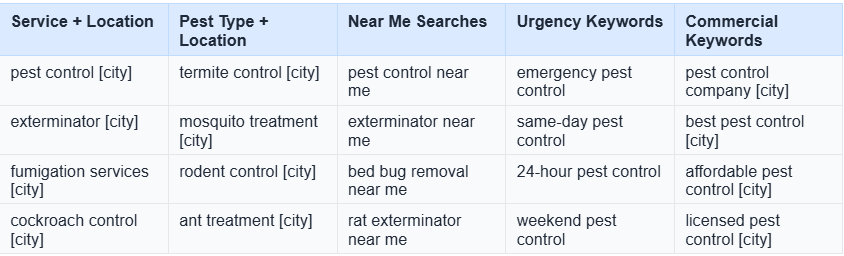
Targeting the right keywords determines who finds your website and how likely they are to convert into paying customers. Below is a categorized reference of high-value keyword types for pest control SEO campaigns.
High-Intent Local Keywords (Primary Targets)
Informational Keywords (Blog and Content Targets)
- how to get rid of [pest type]
- signs of [pest] infestation
- how long does pest control treatment last
- is pest control safe for pets
- pest control cost / price [city]
- DIY pest control vs professional
- what pests are common in [region] in [season]
Targeting both high-intent commercial keywords and informational blog keywords builds a diversified traffic profile that is more resilient to algorithm changes. For a detailed keyword research methodology, read our on-page SEO cheat sheet.
How Much Does Pest Control SEO Cost?
SEO investment for a pest control business varies based on the size of the service area, the number of target keywords, competitive intensity in the local market, and how much foundational work is required on the website. There is no universal price, and any provider quoting a fixed “SEO package” without first auditing your website and competitive landscape should be approached with caution.
General cost benchmarks for pest control SEO in India:
- Foundational SEO setup (audit, technical fixes, GBP optimization, citation building): INR 15,000–35,000 one-time
- Ongoing monthly SEO (content, link building, monitoring, reporting): INR 12,000–40,000 per month depending on market competitiveness and scope
- Content-only packages (blog writing, service page creation): INR 5,000–15,000 per month
The most important thing to understand about SEO cost is the ROI context. A pest control company booking an average service worth INR 2,000–5,000 that earns even 10 additional inbound leads per month from organic search is generating INR 20,000–50,000 in revenue from a channel that compounds in value over time. The economics of SEO become very favourable once rankings are established.
For a custom cost estimate based on your specific market and goals, request a free SEO consultation.
Pest Control SEO Quick-Start Checklist
Use this checklist to audit your current SEO readiness:
- Google Business Profile claimed, verified, and fully completed with photos and services
- Business NAP (name, address, phone) consistent across all directory listings
- Website on HTTPS with SSL certificate active
- XML sitemap submitted to Google Search Console
- Individual landing pages created for each core service
- Individual location pages created for each service area
- Primary keyword included in H1 title, first paragraph, meta title, and URL of each key page
- Website loads in under 3 seconds on mobile
- Blog section active with at least one new post per month
- At least 5 quality backlinks from local or industry-relevant sources
- Google Analytics and Google Search Console both active and tracking
Need help completing this checklist? Our pest control SEO and local digital marketing services cover every item, from technical audits and content strategy to citation building and Google Business Profile management.
FAQ Sectio
What is pest control SEO?
Pest control SEO is the process of optimizing a pest control company’s website and online presence to rank higher in Google search results for queries related to pest control services in its geographic area. It includes on-page optimization (keyword targeting, content, meta tags, page structure), technical SEO (page speed, mobile optimization, indexing), local SEO (Google Business Profile, directory citations), and off-page SEO (backlinks and online reputation). The goal is to drive inbound leads from customers actively searching for pest control services at the moment they need them.
How long does SEO take to work for a pest control business?
For most pest control businesses with an existing website, meaningful ranking improvements typically begin appearing within 3 to 4 months of implementing a focused SEO strategy. For brand-new websites, the timeline is typically 4 to 6 months. Local SEO improvements — particularly Google Business Profile optimization and citation building — often produce visible results more quickly (within 4 to 8 weeks) because local ranking factors respond faster than broad organic rankings. Patience and consistency are key: SEO results compound over time and become increasingly cost-efficient as rankings improve.
What SEO keywords should a pest control company target?
Pest control companies should prioritize two categories of keywords. Commercial intent keywords — searches made by customers ready to book a service — include terms like ‘pest control [city],’ ‘exterminator near me,’ ‘termite treatment [city],’ and ‘same-day pest control.’ These should be targeted on service and location pages. Informational keywords — searches made by customers researching a pest problem — include terms like ‘how to get rid of cockroaches,’ ‘signs of termite infestation,’ and ‘is pest control safe for pets.’ These are best targeted through blog content. A well-rounded SEO strategy covers both categories.
Does Google Business Profile help pest control SEO?
Yes — Google Business Profile is arguably the single most important tool for local pest control SEO. A verified, fully optimized GBP listing determines whether your business appears in the ‘local pack’ — the map and three business cards that appear at the very top of local search results, above all organic website listings. Because most pest control searches are explicitly local (‘near me’ or ‘in [city]’), the local pack generates the majority of clicks and calls for local service searches. GBP optimization — including accurate service listings, regular photo uploads, weekly posts, and proactive review management — is a high-return, zero-cost activity.
What is the difference between on-page and off-page SEO for pest control?
On-page SEO for pest control covers everything done directly on the website: keyword optimization of page titles, headings, and content; technical health factors like page speed and mobile responsiveness; site architecture including internal linking and URL structure; and the creation of dedicated service and location pages. Off-page SEO covers external factors that influence a website’s authority in Google’s eyes: backlinks from other websites, directory citations (consistent NAP mentions across business directories), Google Business Profile management, and online review acquisition and management. Both dimensions are required for strong local rankings — on-page SEO ensures your pages are relevant, while off-page SEO builds the authority that earns top positions.
Should a pest control business manage SEO in-house or hire a specialist?
Most pest control business owners have the time and expertise to handle some foundational SEO tasks in-house — particularly Google Business Profile management, responding to reviews, and publishing basic blog content. However, technical SEO audits, competitive keyword research, structured link-building campaigns, and ongoing performance analysis require specialist knowledge and tools that take significant time to develop. The most cost-effective approach for growth-focused pest control businesses is typically to partner with an experienced local SEO agency for strategy and technical execution, while handling simpler ongoing tasks (GBP updates, photo uploads, review responses) in-house.
How do online reviews affect pest control SEO?
Online reviews are a significant local SEO ranking factor. Google’s local search algorithm evaluates review quantity, recency, rating, and the presence of keywords in reviews when determining local pack rankings. A pest control business with a consistently high rating and a large volume of recent reviews will outrank equally-optimized competitors in local search. Beyond rankings, reviews directly influence conversion rates — potential customers making urgent purchasing decisions are heavily influenced by recent, authentic reviews. Pest control businesses should actively ask satisfied customers to leave Google reviews and respond professionally to every review, positive or negative.