
An Ahrefs study of over a billion pages found that roughly 96% of content gets no organic traffic from Google at all. Visibility isn’t automatic — a great website that Google can’t find, crawl, or trust simply doesn’t exist to searchers.
This guide covers ten proven ways to make your website more visible on Google in 2026 — what each one is, why it matters, and how to do it. It’s written for marketers and owners who want a clear, honest checklist rather than hype or shortcuts.
What Does “Website Visibility” Actually Mean?
Website visibility is how easily search engines and users can find your site for relevant queries. It depends on three things working together: Google being able to crawl and index your pages, your content being relevant to searches, and your site being trustworthy enough to rank.
You can’t earn visibility by staring at your site — Google evaluates the concrete signals you create. The fundamentals below align with Google’s Search Essentials documentation, the official baseline for getting found.
Also Read This :-How Page Speed Affects SEO
The 10 Ways to Increase Your Google Visibility
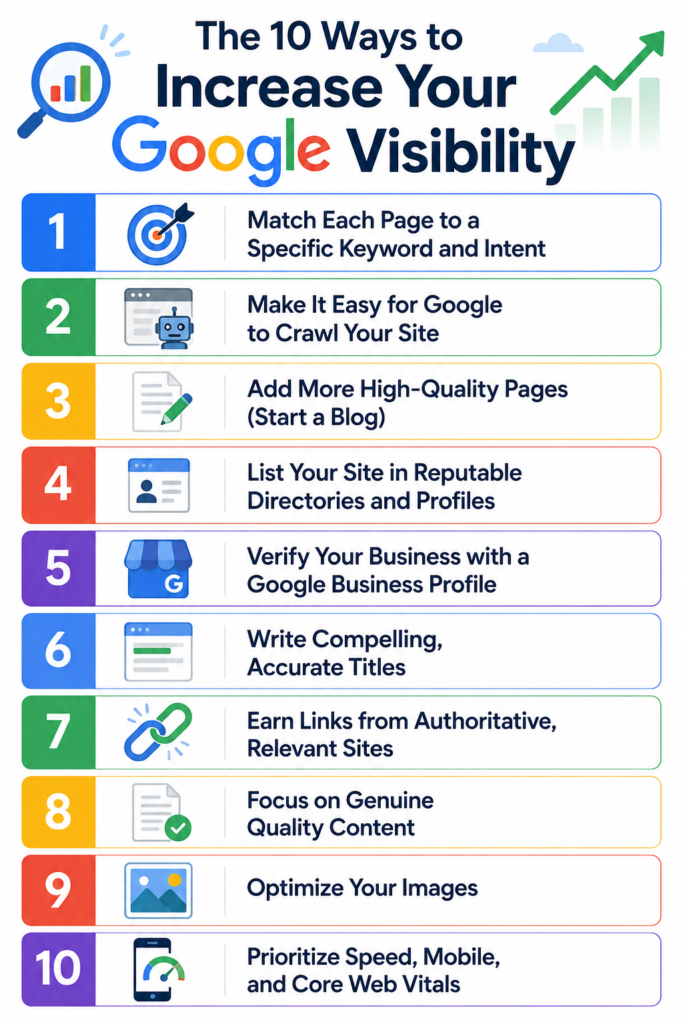
1. Match Each Page to a Specific Keyword and Intent
Google ranks relevant pages, not just active ones. Every important page should target one clear topic and the search intent behind it. That means real keyword research — high-volume terms plus long-tail and related phrases — then using them naturally in your content and meta tags, never stuffing.
For the deeper method, see our guide on choosing the right long-tail keywords.
2. Make It Easy for Google to Crawl Your Site
The harder your site is to crawl, the slower it gets indexed — and unindexed pages can’t rank. Give Google a clean path in.
- Add descriptive meta titles, descriptions, URLs, and image alt text.
- Use internal linking so the whole site is easy to crawl and more authoritative.
- Run a technical SEO audit to find and fix indexation gaps.
- Submit an XML sitemap through Google Search Console.
3. Add More High-Quality Pages (Start a Blog)
More genuinely useful pages give Google more chances to rank you for diverse queries and signal an active, authoritative site. A blog is the most reliable way to expand organic reach — but only if posts are helpful, not padding. Quality per page matters more than raw page count.
4. List Your Site in Reputable Directories and Profiles
Business profiles and directories — social platforms, industry directories, review sites — add legitimate places for people and Google to discover you. Focus on relevant, reputable directories with consistent business details rather than spraying low-quality listings, which add little and can look spammy.
5. Verify Your Business with a Google Business Profile
A Google Business Profile (formerly Google My Business) is the free listing that puts your business on Google Search and Maps. It’s one of the fastest visibility wins, especially for local searches.
Create the profile, claim your business, and verify it. For a full walkthrough, see our guide to creating and verifying a Google Business Profile.
6. Write Compelling, Accurate Titles
Titles do two jobs: help Google understand the page and earn the human click. The goal is to get noticed, not just identified — without overpromising. A simple test using a digital marketing post as an example:
- Not compelling: “Benefits of online marketing.”
- Too extreme: “Why digital marketing is the best tactic for business.”
- Compelling: “6 Ways Digital Marketing Can Improve Your Business Growth.”
Aim for clarity and completeness. Clickbait that the page can’t deliver increases bounce rate and hurts visibility.
7. Earn Links from Authoritative, Relevant Sites
Backlinks act like endorsements; Google weighs links from credible, relevant sites far more than volume. Pursue guest posts, expert round-ups, and genuine relationships with reputable industry sites and creators.
Avoid services promising thousands of links — link schemes violate Google’s spam policies and can trigger penalties. One quality link beats a hundred junk ones.
8. Focus on Genuine Quality Content
There is no ranking shortcut; quality is the strategy. Research topics deeply, answer the questions people actually ask, and demonstrate real experience and expertise. This is the core of Google’s E-E-A-T expectations and what AI engines look for when deciding what to cite.
Support text with relevant images and video, keep pages fast, and make them easy to act on.
9. Optimize Your Images
People search Google Images often, and well-optimized images open an extra discovery route. Use descriptive filenames and alt text, compress files, serve modern formats like WebP, and size images correctly so they don’t slow the page.
10. Prioritize Speed, Mobile, and Core Web Vitals
Core Web Vitals are Google’s metrics for real-world loading, responsiveness, and visual stability. Because Google uses mobile-first indexing, a fast, stable mobile experience is now a baseline requirement, not a bonus.
Test your pages with Google PageSpeed Insights and fix the highest-impact issues first. For the full breakdown, see our guide on how page speed affects SEO.
Also Read This :- 10 Proven Tips to Write SEO
How to Apply These in the Right Order
You don’t need all ten at once. A practical sequence for most sites:
- Fix crawlability and indexing — nothing else matters if Google can’t read the site.
- Set up and verify your Google Business Profile.
- Match key pages to clear keywords and intent, with strong titles.
- Publish genuinely helpful content consistently (start the blog).
- Optimize speed, mobile, and images.
- Build authority through quality links over time.
An honest limitation: visibility is earned gradually, and results vary by competition, niche, and consistency — no tactic guarantees a ranking. For broader help, see our SEO services or explore our digital marketing services.
Google doesn’t just notice vibrant websites — it notices relevant, trustworthy pages that are clearly the best answer for a specific search.
FAQ Section
How do I make my website visible on Google?
Start by making sure Google can crawl and index your site, then match each key page to a clear keyword and search intent. Add genuinely helpful content, verify a Google Business Profile, optimize speed and images, and earn quality links over time. Visibility comes from these fundamentals working together, not a single trick. It builds gradually with consistency.
Why is my website not showing up on Google?
Common reasons include the site or pages not being indexed, weak or thin content, crawl and technical errors, or simply being newer and lower-authority than competitors. Check Google Search Console for indexing and crawl issues first. If pages are indexed but not ranking, the issue is usually relevance, quality, or authority. Fixing crawlability is always the first step.
How long does it take to become visible on Google?
There is no fixed timeline. New pages may be indexed within days to weeks, but competitive rankings often take several months of consistent work. Timelines depend on competition, site authority, and content quality. Be cautious of anyone promising instant top rankings, as that is not how Google works.
Do backlinks still help website visibility?
Yes. Quality backlinks from credible, relevant sites remain a strong signal of authority and help visibility. However, volume alone does not help — Google weighs link quality heavily and penalizes manipulative link schemes. One link from a trusted, relevant site is worth more than many low-quality ones. Focus on earning links through genuinely useful content.
Does a Google Business Profile improve visibility?
Yes, especially for local and branded searches. A verified, complete Google Business Profile can place your business in Google Search and Maps and is one of the fastest visibility wins. It is free to set up and verify. It works alongside, not instead of, a well-optimized website.
Does website speed affect Google visibility?
Yes, indirectly but meaningfully. Speed and Core Web Vitals influence rankings and strongly affect user experience and conversions. Because Google uses mobile-first indexing, mobile speed matters most. A fast, stable site is now a baseline expectation rather than an optional improvement.
Does content quality matter more than quantity for visibility?
Quality matters more. Adding many thin pages can dilute a site, while genuinely helpful, expert content earns rankings, links, and trust. A blog helps visibility only when posts provide real value. Focus on depth, accuracy, and demonstrated experience rather than page count.