
The Shift That Changed Real Estate Marketing Forever According to research by the National Association of REALTORS® (NAR), 44% of property buyers begin their search online — before they ever contact an agent. That means nearly half of your potential clients have already formed an impression of the market, shortlisted areas, and developed expectations before making a single phone call. If your business is not visible in those early online searches, you are not just missing leads — you are missing the conversation entirely.
The real estate industry has always been relationship-driven. But relationships increasingly begin online. Buyers and investors search for properties, research neighbourhoods, evaluate agents, and compare listings on Google — often weeks or months before they are ready to transact. The agents and agencies that show up consistently in those searches earn the trust that eventually converts into business.
Real estate SEO (Search Engine Optimisation) is the process of optimizing a real estate website and online presence to rank prominently in search results for property-related queries. Done correctly, it is one of the highest-return marketing investments available to realtors, property managers, and real estate developers.
This guide covers what real estate SEO is, why it matters, and exactly how to implement it — from keyword research and on-page optimization to local SEO, content strategy, and backlink building.
What Is Real Estate SEO?
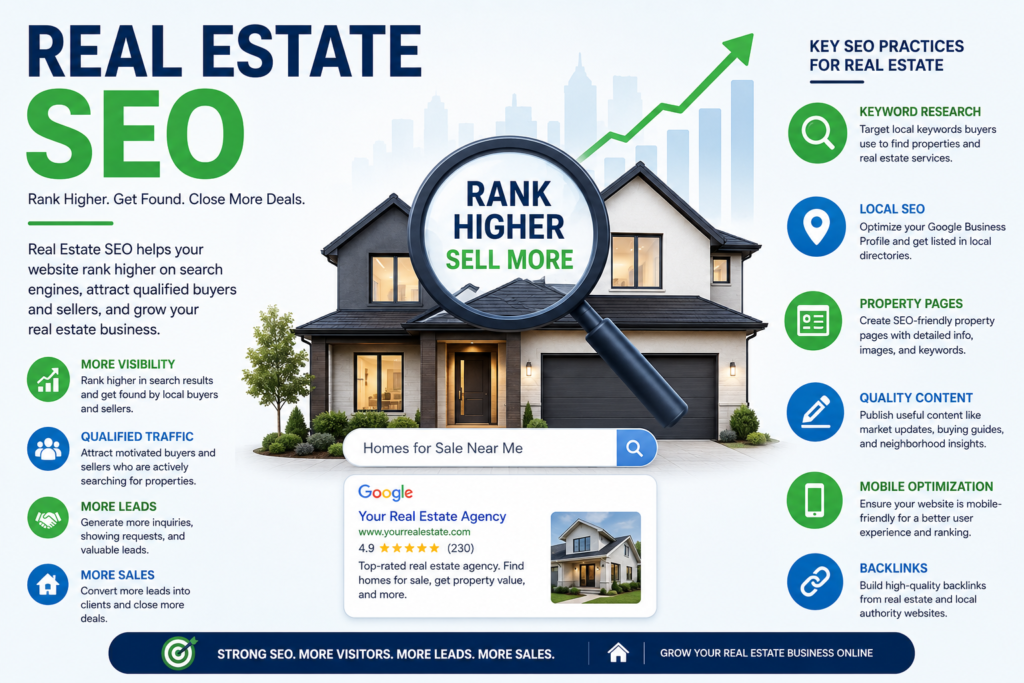
Real estate SEO is the application of search engine optimization strategies to property-related websites, including those of individual agents, real estate agencies, property developers, and rental management companies. The goal is to improve the website’s visibility in Google’s organic search results and local map listings so that buyers, sellers, renters, and investors can discover the business when they search for relevant properties or services.
Why it matters: Real estate is among the most competitive and highest-value industries in local search. Consumers make one of the largest financial decisions of their lives through an online research journey that spans weeks or months. Ranking consistently in search results across that journey — from early research queries like “best neighbourhoods to live in [city]” to high-intent queries like “3BHK flat in [area] for sale” — creates multiple touchpoints that compound into leads and conversions.
How it works: Real estate SEO combines three interconnected pillars. On-page SEO covers the optimization of property listings, service pages, and blog content for target keywords. Technical SEO ensures the website is fast, mobile-friendly, and crawlable by Google. Off-page SEO builds domain authority through backlinks, directory citations, and Google Business Profile management. All three must work together for consistent ranking performance.
Related Read: 10 Proven Ways to Increase Your Website Visibility on Google
Why SEO Is a Non-Negotiable Strategy for Real Estate Businesses
The core argument for real estate SEO comes down to where buyers and sellers spend their research time. NAR’s Home Buyers and Sellers Generational Trends report has consistently shown that the internet is the most commonly used information source in the home-buying process, ahead of real estate agents, yard signs, and open houses. For realtors who are not investing in search visibility, that means competitors are capturing the first-mover trust advantage that the internet delivers.
The economics are compelling. BrightEdge research shows that organic search drives 53% of all website traffic — more than paid search, social media, and email combined. In a high-ticket industry like real estate, where a single closed transaction can generate tens of thousands of rupees in commission, even a modest improvement in organic visibility can deliver exceptional ROI on the SEO investment.
Here is what real estate SEO delivers for agents and property businesses:
- Sustained lead generation: A well-optimized page can attract leads for months or years from a single content investment — unlike paid ads that stop the moment the budget runs out
- Qualified inbound traffic: People who find your website through property-specific search terms are actively in the buying or selling process — conversion rates are significantly above average
- Local brand authority: Consistently appearing at the top of local real estate searches builds the kind of credibility and recognition that referral marketing alone cannot match
- Competitive differentiation: Most local real estate agents invest minimally in SEO, which means early movers gain a durable competitive advantage that is difficult to displace
- Insights into buyer intent: Keyword and search data reveal exactly what buyers, sellers, and investors are looking for in your market — intelligence that can inform every part of your marketing strategy
For a comprehensive view of why organic search investment matters for business growth, read our guide on why SEO is important for your business.
7 Real Estate SEO Strategies That Drive Consistent Results
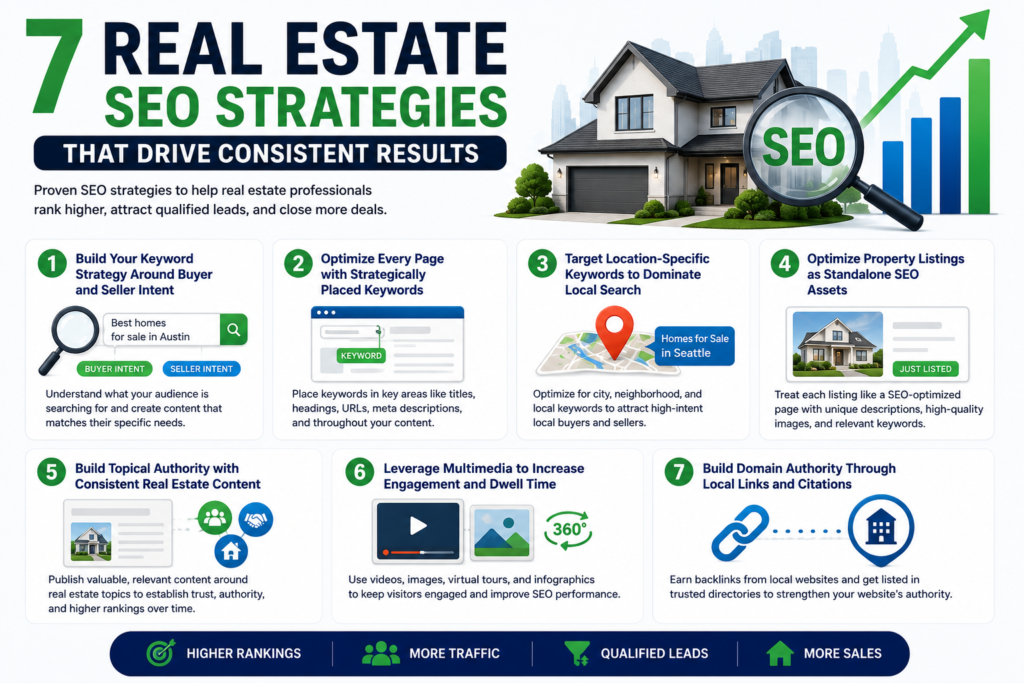
The following seven strategies represent the complete framework our team applies when developing real estate SEO campaigns. They work for individual agents, boutique agencies, and large property developers alike — the scale changes, but the principles do not.
1. Build Your Keyword Strategy Around Buyer and Seller Intent
Keyword research is the foundation of every real estate SEO campaign. It reveals precisely what your potential clients type into Google when they are looking for properties, agents, or market information — and it allows you to create content that appears at the exact moment of that need.
Real estate keyword intent falls into three categories, each requiring a different content approach:
- Informational intent: Buyers and sellers researching the process — e.g., “how to sell property in [city],” “what is stamp duty in India,” “tips for first-time home buyers.” These are best targeted through blog posts and guides
- Navigational intent: Prospects looking for a specific type of agent or agency — e.g., “best real estate agent in [area],” “top property consultants in [city].” These are best targeted through About pages and service area landing pages
- Commercial intent: Active buyers and sellers ready to transact — e.g., “2BHK flat for sale in [neighbourhood],” “sell my house fast [city],” “property for rent in [area].” These are your highest-converting keywords and should be targeted on dedicated listing and service pages
Research consistently shows that a significant portion of real estate searches carry strong commercial intent — buyers who have done their research and are ready to contact an agent. These keywords should receive your highest content investment. For detailed keyword placement guidance, read our On-Page SEO Cheat Sheet to Rank on the First Page.
2. Optimize Every Page with Strategically Placed Keywords
Identifying the right keywords is only half the work. The second half is placing them in the locations where Google looks first when evaluating page relevance. Keyword placement is not about stuffing phrases into every paragraph — it is about putting the right keywords in the right structural positions.
For every key page on your real estate website, follow this keyword placement checklist:
- Page title (H1): Include the primary keyword near the beginning — e.g., “3BHK Flats for Sale in Vaishali Nagar, Jaipur”
- Meta title and meta description: Keep the title under 70 characters and the description under 160, both including the primary keyword and a soft call to action
- URL slug: Keep URLs short, readable, and keyword-rich — e.g., /properties/3bhk-vaishali-nagar-jaipur
- First 100 words: Introduce the primary keyword naturally in the opening paragraph
- H2 subheadings: Include keyword variations in section headings throughout the page
- Image alt text: Describe every property image with a keyword-relevant alt attribute — this also enables your images to appear in Google Image Search
- Body content: Use the primary keyword and semantically related phrases naturally throughout the content — density is less important than natural usage and topical depth
3. Target Location-Specific Keywords to Dominate Local Search
In real estate, location is everything. The same is true in real estate SEO. A generic keyword like “flats for sale” is both highly competitive and too broad to attract genuinely qualified local traffic. Location-specific keywords — combining the property type or service with a specific neighbourhood, city, or micro-market — attract the buyers and sellers who are actively searching in exactly the area you serve.
For example, a real estate agent specializing in Vaishali Nagar, Jaipur, should build pages and content targeting terms such as:
- “Real estate agent in Vaishali Nagar”
- “Flats for sale in Vaishali Nagar Jaipur”
- “Property for rent near Civil Lines Jaipur”
- “2BHK apartment Vaishali Nagar under 50 lakh”
- “Best localities to buy property in Jaipur”
Each of these phrases targets a specific combination of property type, price band, and location that a real buyer or renter would actually type. Creating dedicated landing pages or blog posts for each significant local keyword variation builds a comprehensive local search presence that is very difficult for competitors to displace quickly.
For a systematic approach to building local visibility beyond keyword targeting, our local SEO and Google Business Profile services provide the complete framework.
4. Optimize Property Listings as Standalone SEO Assets
Every property listing on your website is a potential standalone search result. When listings are optimized with the right keywords, structured with clear headings, and described with the specific attributes buyers search for, they can rank individually for highly targeted queries.
Property buyers search for very specific combinations of features. Research into real estate search behavior consistently shows buyers using phrases like “spacious,” “storage,” “modern appliances,” “hardwood floors,” “close to schools,” “gated community,” and “vastu-compliant” in their searches. Incorporating these feature-level keywords naturally into your listing descriptions ensures your properties appear when buyers search for exactly those attributes.
Best practices for SEO-optimized property listings:
- Unique listing titles: Avoid generic titles like “Lovely 2BHK” — instead use “2BHK Flat with Terrace in Malviya Nagar, Jaipur — Vastu Compliant”
- Feature-rich descriptions: Write at least 200 words per listing, incorporating specific keywords related to property features, nearby landmarks, schools, and transport links
- Schema markup: Use RealEstateListing structured data to help Google display your listings with rich snippets (price, location, property type) directly in search results
- High-quality images with alt text: Include a minimum of 8 professional photos per listing, each with a descriptive, keyword-relevant alt attribute
- Location-specific URL: Structure listing URLs to include the property type and location — /listings/3bhk-flat-malviya-nagar
5. Build Topical Authority with Consistent Real Estate Content
Google’s helpful content guidelines reward websites that demonstrate consistent, first-hand expertise on their core topic area. For real estate professionals, a regularly updated blog is the most effective tool for building the topical authority that elevates rankings across the entire domain — including your listing and service pages.
A real estate blog serves two functions simultaneously: it targets informational keywords that attract buyers and sellers at the earliest stages of their research, and it demonstrates your local market expertise in a way that builds trust before a prospect ever makes contact.
High-performing content ideas for real estate websites:
- Area and neighbourhood guides: “Living in Jagatpura, Jaipur: Neighbourhood Guide for 2025” — these rank for local searches and build market authority
- Buyer and seller guides: “A First-Time Home Buyer’s Guide to Jaipur,” “How to Sell Your Property Fast in a Buyer’s Market”
- Market updates: Quarterly or monthly reports on property prices, demand trends, and investment hotspots in your coverage area
- Process explainers: “Understanding Stamp Duty and Registration Charges in Rajasthan,” “What Is RERA and How Does It Protect Home Buyers?”
- Comparison content: “Renting vs Buying Property in Jaipur: A 2025 Cost Analysis”
- FAQ content: Dedicated pages answering the questions your clients ask most — “How long does property registration take?” “What documents are needed to buy a flat?”
For practical guidance on structuring and writing content that earns rankings, read our post on tips for writing SEO-friendly content.
6. Leverage Multimedia to Increase Engagement and Dwell Time
Real estate is inherently visual. Buyers make emotional connections with properties through images and videos before they ever visit in person. High-quality multimedia does not just improve the user experience — it has measurable SEO benefits. Pages with rich visual content earn longer average session durations and lower bounce rates, both of which are positive signals in Google’s ranking algorithm.
Multimedia best practices for real estate SEO:
- Professional photography: Every listing should include a minimum of 8–12 high-resolution photos. Optimize each with a descriptive alt text attribute containing relevant keywords
- Virtual tours: 360-degree virtual tours significantly increase time-on-page and reduce the bounce rate for listing pages. Google recognizes engagement signals at the page level
- Video walkthroughs: Short property walkthrough videos (60–120 seconds) can be embedded on listing pages and syndicated to YouTube, creating an additional search channel for property discovery
- Image file optimization: Compress all images before upload using tools like TinyPNG or Squoosh — large uncompressed images are one of the most common causes of slow page load times in real estate websites
- Neighbourhood maps and infographics: Visual content showing local schools, transport links, and amenities adds value for buyers and provides additional indexable content for Google
7. Build Domain Authority Through Local Links and Citations
Domain authority — the overall strength and trustworthiness of a website in Google’s eyes — is built primarily through backlinks: hyperlinks from other credible websites pointing to yours. For real estate businesses, the most valuable backlinks come from locally authoritative and industry-relevant sources.
Effective link-building approaches for real estate businesses:
- Local media and press: Provide property market commentary to local newspapers, business publications, and real estate platforms — expert quotes earn editorial backlinks
- Guest articles: Write informative pieces on property buying, investing, or market trends for local lifestyle blogs, financial websites, and community platforms
- Developer and builder partnerships: Listing partnerships with property developers often result in reciprocal links between the developer’s project page and your agency site
- Real estate association directories: Get listed on NAR, CREDAI, and other real estate association member directories — these carry high domain authority
- Local business directories: Maintain consistent NAP (name, address, phone) citations across JustDial, Sulekha, MagicBricks, 99acres, and other property and local directories
Consistent citation management is particularly important for local pack rankings. For a detailed guide to building citations that improve local visibility, read our complete guide to building local SEO citations in India.
Technical SEO: The Foundation Every Real Estate Website Needs
All seven content and link-building strategies above will underperform without a technically sound website foundation. Technical SEO ensures Google can find, read, and understand your pages — and that visitors stay on your site long enough to convert.
Essential technical SEO checklist for real estate websites:
- Page speed: Real estate websites are image-heavy by nature, making speed optimization critical. Use Google PageSpeed Insights to identify issues, and implement image compression, lazy loading, and caching. Pages should load in under 3 seconds on mobile
- Mobile responsiveness: The majority of property searches happen on mobile devices. Google’s mobile-first indexing means your mobile experience directly determines your rankings
- HTTPS security: An SSL certificate is a baseline ranking signal and trust indicator — a non-HTTPS real estate website will be flagged as ‘not secure’ by browsers
- Structured data markup: Implement LocalBusiness and RealEstateListing schema to help Google display rich results for your agency and individual property listings
- XML sitemap: Submit a complete sitemap through Google Search Console — particularly important for large property websites with hundreds of listing pages
- Core Web Vitals: Monitor your Largest Contentful Paint (LCP), Cumulative Layout Shift (CLS), and Interaction to Next Paint (INP) scores in Google Search Console — these are direct ranking factors
Our team at G2S Technology provides complete technical SEO audits as part of every professional real estate SEO engagement. A technical audit is always the starting point — there is no value in building content on a poorly structured foundation.
Real Estate SEO Quick-Start Checklist
Use this checklist to assess your current real estate website’s SEO readiness:
- Every key page has a unique, keyword-optimized meta title (under 70 chars) and meta description (under 160 chars)
- Primary keyword included in H1, first paragraph, at least one H2, and URL slug
- Location-specific keywords incorporated into all service and listing pages
- Google Business Profile claimed, verified, and fully completed
- Website on HTTPS with SSL certificate active
- All listing images have descriptive alt text attributes
- Website loads in under 3 seconds on mobile devices
- XML sitemap submitted to Google Search Console
- Blog section active with at least two new posts per month
- Property listings include feature-specific keywords in descriptions
- NAP (name, address, phone) consistent across all directory listings
- At least 3 quality backlinks earned from locally or industry-relevant sources
Need a professional assessment of where your real estate website stands today? Our real estate digital marketing and SEO services include a free website review and competitive gap analysis.
FAQ Section
What is real estate SEO?
Real estate SEO is the practice of optimizing a property business’s website and online presence to appear higher in Google’s organic search results for relevant property-related queries. It includes keyword optimization of listing and service pages, technical website health, local SEO through Google Business Profile and citations, content marketing through blog posts and guides, and backlink building. The goal is to attract buyers, sellers, renters, and investors to the website through organic search — without ongoing paid advertising spend.
Why is SEO important for real estate agents?
SEO is important for real estate agents because the majority of the property search journey now begins online, often weeks or months before a buyer or seller contacts an agent. Research by the National Association of REALTORS® shows 44% of buyers start their property search on the internet. An agent who ranks on page one of Google for local property search terms captures that early trust advantage and appears in front of the right audience at the exact moment of need. Over time, strong organic rankings reduce dependence on paid advertising and referrals as standalone lead sources.
How long does real estate SEO take to show results?
For an established real estate website with existing content, meaningful ranking improvements typically appear within 3 to 5 months of implementing a focused SEO strategy. For brand-new websites, the timeline extends to 4 to 7 months before significant organic traffic develops. Local SEO improvements — particularly Google Business Profile optimization and citation building — often produce visible increases in map pack visibility within 4 to 8 weeks. Real estate SEO compounds over time: the rankings earned in months 3 to 6 continue delivering traffic and leads for years with relatively modest ongoing maintenance.
What are the most important keywords for real estate SEO?
The most valuable real estate keywords combine a property type, a specific location, and a buyer action — for example, “3BHK flat for sale in [neighbourhood],” “real estate agent in [city],” or “commercial property for rent [area].” Location-specific keywords consistently outperform generic property keywords in both ranking difficulty and conversion quality because they attract buyers and sellers who are actively looking in a specific market. In addition to commercial-intent keywords, informational keywords targeting property research questions (“how to buy property in [city],” “best areas to invest in [city]”) are valuable for attracting buyers in the early stages of their search.
How does local SEO differ from regular SEO for real estate?
Local SEO for real estate specifically optimizes a business’s visibility in geographically targeted search results — particularly Google’s local pack (the map and three business listings at the top of local searches) and location-specific organic results. Regular SEO focuses on ranking for broad, non-geographic keywords nationally or globally. For real estate businesses, local SEO is typically the higher priority because most buyers and sellers search for agents and properties in specific areas. The key local SEO tools are Google Business Profile optimization, consistent NAP citations across directories, location-specific landing pages, and reviews management.
Should a real estate agent use a blog for SEO?
Yes — a blog is one of the highest-return SEO investments a real estate agent can make. It enables targeting of informational keywords (buyer guides, neighbourhood profiles, market updates) that attract potential clients in the early stages of their property search — audiences that listing pages and service pages cannot reach. Well-written local content (such as neighbourhood guides and area market reports) also signals to Google that the website is a genuine authority on local real estate, which elevates rankings for commercial-intent keywords as well. A realistic publishing cadence of two to four quality posts per month builds compounding organic traffic over time.
What is the cost of real estate SEO services in India?
Real estate SEO costs in India vary based on the competitive intensity of the target market, the number of service areas and property types being targeted, and the scope of work required. Foundational SEO setup (technical audit, keyword research, on-page optimization, GBP setup) typically ranges from INR 20,000–50,000 as a one-time investment. Ongoing monthly SEO services covering content creation, link building, and performance reporting typically range from INR 15,000–60,000 per month depending on market competitiveness. Given that a single additional transaction can generate INR 50,000–500,000 in commission depending on property value, the ROI case for real estate SEO is exceptionally strong.