
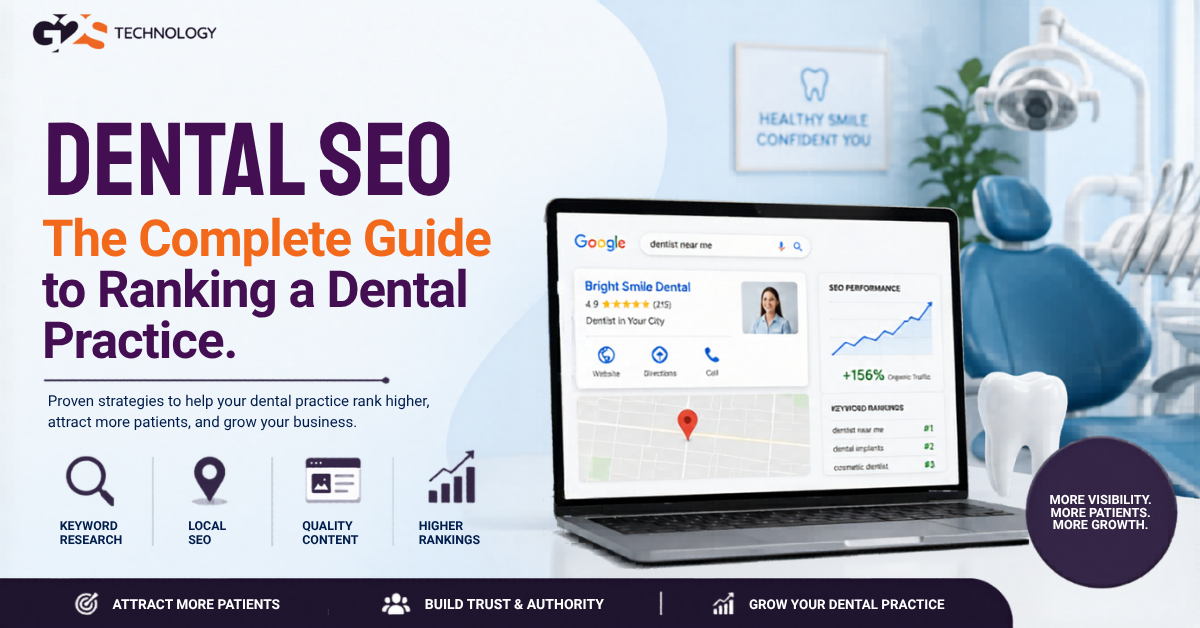
Nearly half of all Google searches have local intent — and when someone types “dentist near me” or “emergency dentist,” they’re not browsing, they’re ready to book. If your practice isn’t in the top results, a competitor is getting that call instead.
This guide explains what dental SEO is, why it matters for practices in 2026, and the exact areas to work on — local SEO, your Google Business Profile, on-page optimization, content, technical health, and the trust signals Google weighs heavily for healthcare. It’s written for practice owners and the marketers who support them, with honest notes on what SEO can and can’t promise.
What Is Dental SEO?
Dental SEO is the practice of optimizing a dental website and online presence so it ranks higher in search results and attracts more patients. It combines local SEO, on-page optimization, content, and technical fundamentals to make your practice visible when people search for the services you offer.
In plain terms: when a patient searches for a cleaning, an implant, or an emergency appointment, dental SEO is what helps your practice appear, earn the click, and win the booking. Unlike paid ads, the visibility it builds compounds over time rather than stopping the moment you stop paying.
Also Read This:- 10 Proven Tips to Write SEO-Friendly Content
Why Is SEO Important for Dentists?
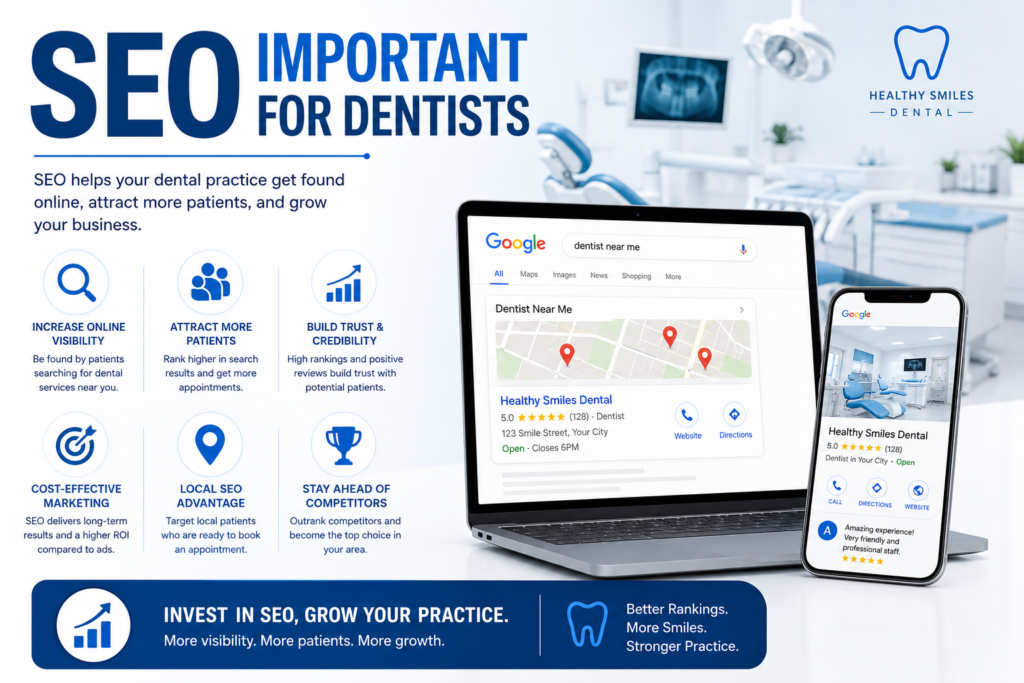
The dental market is competitive, and more practices invest in search every year. Patients increasingly start their care journey with a search bar, so visibility is no longer optional. SEO matters for three concrete reasons.
1. It Builds Trust and Credibility
Patients tend to trust practices that appear at the top of results, especially across multiple relevant searches. Ranking well signals legitimacy before a patient ever visits your site. For a health decision, that early trust strongly influences who gets the call.
2. It Drives Qualified Traffic at Lower Cost
Organic search typically costs less per patient than ongoing paid ads and brings in people actively looking for dental care. The traffic is qualified by intent, which usually means better conversion into booked appointments. The trade-off is honest to state: SEO takes longer to build than ads, but the results are more durable.
3. It Improves the Patient Experience
Good SEO and good user experience overlap heavily. Practices that rank well usually also load fast, work on mobile, use clear headings, and publish helpful, original content. Those same qualities make it easier for a nervous patient to find answers and book. With that foundation clear, here’s how to actually optimize a dental practice for search in 2026.
Local SEO: The Highest-Impact Starting Point
Local SEO is the practice of optimizing to appear in geographic, “near me” style searches and the local map results. For a dental practice, this is usually the single highest-return area because most patients choose a dentist close to home or work.
It centers on three Google ranking considerations: relevance, distance, and prominence, as outlined in Google’s guidance on local ranking. You can’t change a searcher’s location, but you can strongly influence relevance and prominence.
Priorities for local dental SEO:
- Claim and fully complete your Google Business Profile (categories, services, hours, photos).
- Keep your Name, Address, and Phone number (NAP) identical across every directory and listing.
- Earn and respond to patient reviews consistently — they influence rankings and choice.
- Create location-specific pages if you serve multiple neighborhoods or cities.
Your Google Business Profile Is the Anchor
A Google Business Profile (formerly Google My Business) is the free listing that controls how your practice appears on Google Search and Maps. Ranking in the top three map results — the “local pack” — can generate a meaningful share of new-patient calls each month.
Complete every field, add real photos, post updates, and answer the Q&A section yourself with common questions like insurance and hours. For a step-by-step walkthrough, see our guide to creating and verifying a Google Business Profile.
On-Page SEO for Dentist Websites
On-page SEO is everything you optimize on the website itself — structure, content, and HTML signals. It tells search engines and patients what each page is about.
Build on a Solid, SEO-Friendly Platform
WordPress remains a popular, flexible choice for dental sites because of its open-source CMS, large plugin ecosystem, and SEO-friendly structure. It isn’t the only good option, but it lowers the technical barrier for most practices and supports the on-page work below. The platform matters less than how well it’s configured and maintained.
Does Website Design Affect SEO? Yes — Indirectly
This question has been debated for years, and the honest answer is nuanced. Design is not a direct ranking factor, but it heavily shapes user experience signals — speed, mobile usability, navigation, and time on page — which do influence rankings and conversions. A confusing or slow site quietly drags down both.
Also Read This:- Web Design Company in Jaipur
Design priorities for dental sites:
- Fast load times on mobile and desktop.
- Mobile-friendly, responsive layout (Google indexes mobile-first).
- Accessible design that follows ADA guidance, and HIPAA-compliant handling of any patient data or forms.
- Simple navigation so patients reach booking and services quickly.
Optimize Titles, Headings, and Service Pages
Each important page needs a unique, descriptive title tag and a clear heading structure. Service pages should target specific treatments and locations — for example, a dedicated “Dental Implants in [City]” page rather than burying implants inside a generic services page. For the full element-by-element checklist, see our 10 essential on-page SEO factors, which covers title tags, meta descriptions, headers, and more.
Also Read This:- How Page Speed Affects SEO and Google Rankings
Content: Develop Original, Keyword-Optimized, Patient-First Pages
Content is the foundation that holds dental SEO together. Google rewards original, helpful content that genuinely answers patient questions and penalizes copied or thin pages. For a healthcare topic, accuracy is non-negotiable.
A proven structure is the pillar-and-cluster model: a comprehensive guide on a core service (for example, “The Complete Guide to Dental Implants”) linked to shorter posts answering specific questions like cost, recovery, or alternatives. This signals genuine topical authority rather than a single shallow page.
Strong content types for dental practices:
- In-depth service pages for each major treatment.
- FAQ pages answering real patient concerns (using natural long-tail phrasing).
- Educational posts on oral health, procedures, and aftercare.
- Honest, accurate cost and process explanations patients actually search for.
Keyword Research Tips for Dentists
Keyword research identifies the exact phrases patients type. Start by listing your services, then add intent and location: “emergency dentist [city],” “Invisalign cost,” “tooth extraction near me.” Tools like Google Keyword Planner help you find terms with real volume and reasonable competition.
Prioritize high-intent, local terms over broad, generic ones. “Best dentist in [neighborhood]” converts far better than “dental care,” even with lower search volume, because the searcher is closer to booking.
Technical SEO and Site Health
Technical SEO ensures search engines can crawl, index, and trust your site. It’s the price of entry: weak technical health undermines everything else you do.
Focus on page speed, mobile usability, secure HTTPS, clean site structure, and optimized images with descriptive filenames and alt text. Google’s Search Essentials documentation is the baseline reference, and PageSpeed Insights shows exactly what to fix.
E-E-A-T: Why Trust Signals Matter Extra for Dental Sites
E-E-A-T stands for Experience, Expertise, Authoritativeness, and Trustworthiness — the framework Google’s quality raters use to assess content. Dentistry is a “Your Money or Your Life” (YMYL) topic, so Google applies extra scrutiny to medical content.
As described in Google’s Search Quality Rater Guidelines, health content should demonstrate real expertise and trust. Practically, that means:
- Experience & Expertise: Publish content under named dentists with visible credentials.
- Authoritativeness: Earn links and citations from reputable health and local sources.
- Trustworthiness: Clear contact details, privacy policy, real reviews, and a secure site.
Avoid exaggerated medical claims. Accurate, transparent content protects patients and aligns with how Google evaluates healthcare sites.
A Realistic Timeline and Honest Limitations
SEO is a long-term strategy, not a switch. Local profile improvements can show results within weeks, but competitive on-page and content gains often take several months. Results vary by market, competition, and how consistently the work is maintained — no agency can honestly guarantee a specific ranking.
If managing this alongside running a practice is too much, professional help can speed it up. See our SEO services or explore our broader digital marketing services. The fundamentals here work whether you do them in-house or with a partner.
In 2026, dentists can’t effectively market a practice without SEO — but the practices that win are the ones that focus on patients first and let the rankings follow.
FAQ Section
What is dental SEO?
Dental SEO is the process of optimizing a dental practice’s website and online presence so it ranks higher in search engines and attracts more patients. It combines local SEO, on-page optimization, quality content, and technical health. The goal is to be visible when patients search for services you offer, then earn the click and the booking. Unlike paid ads, the visibility it builds compounds over time.
How long does dental SEO take to work?
It varies, but most practices see early local gains within a few weeks and more competitive content and on-page gains over several months. Timelines depend on your market, competition, and how consistently the work is maintained. SEO rewards patience and steady effort rather than one-time fixes. Any provider guaranteeing instant top rankings should be treated with caution.
What is the most important part of dental SEO?
For most practices, the Google Business Profile and local SEO deliver the highest immediate impact because patients choose dentists close to them. A complete, well-reviewed profile can drive a significant share of new-patient calls. After that, a fast, mobile-friendly website with quality content matters most. These fundamentals usually outrank competitors who ignore them.
Do dental websites need to be on WordPress?
No. WordPress is a popular, flexible, SEO-friendly choice that lowers the technical barrier, but it isn’t required. What matters more is that the site is fast, mobile-friendly, secure, well-structured, and properly maintained. A well-configured site on another platform can rank just as well. Choose the platform your team can maintain consistently.
Why does E-E-A-T matter so much for dental SEO?
Dentistry is a “Your Money or Your Life” topic, so Google applies extra scrutiny to its accuracy and trustworthiness. Demonstrating real expertise — named dentists, credentials, accurate information, reviews, and a secure site — helps content rank and protects patients. Exaggerated or unsupported medical claims can hurt both rankings and credibility. Transparency is a ranking advantage here, not just an ethical one.
Is SEO better than paid ads for dentists?
They serve different goals. Paid ads deliver fast, immediate visibility but stop the moment you stop paying. SEO takes longer to build but creates durable, lower-cost visibility over time. Many practices use ads for quick wins while SEO matures, then lean more on organic as it strengthens. The best mix depends on your budget and timeline.
How do reviews affect dental SEO?
Patient reviews influence both local rankings and whether a patient chooses you once they find you. Consistent, genuine reviews signal prominence to Google and trust to patients. Responding to reviews — positive and negative — shows engagement and care. Never buy fake reviews, as this violates guidelines and erodes the trust SEO is meant to build.