
By the end of this post, you will know exactly which social media strategies work for hospitals and healthcare centres, why platforms like Facebook and LinkedIn are non-negotiable in 2026, and how to start building patient trust at scale — without compromising compliance or wasting budget.
We have spent time working with healthcare clients across India, and the patterns are consistent: the clinics that show up online, consistently, win the trust game. Let’s break it down.
Why Social Media Marketing Is Essential for Healthcare
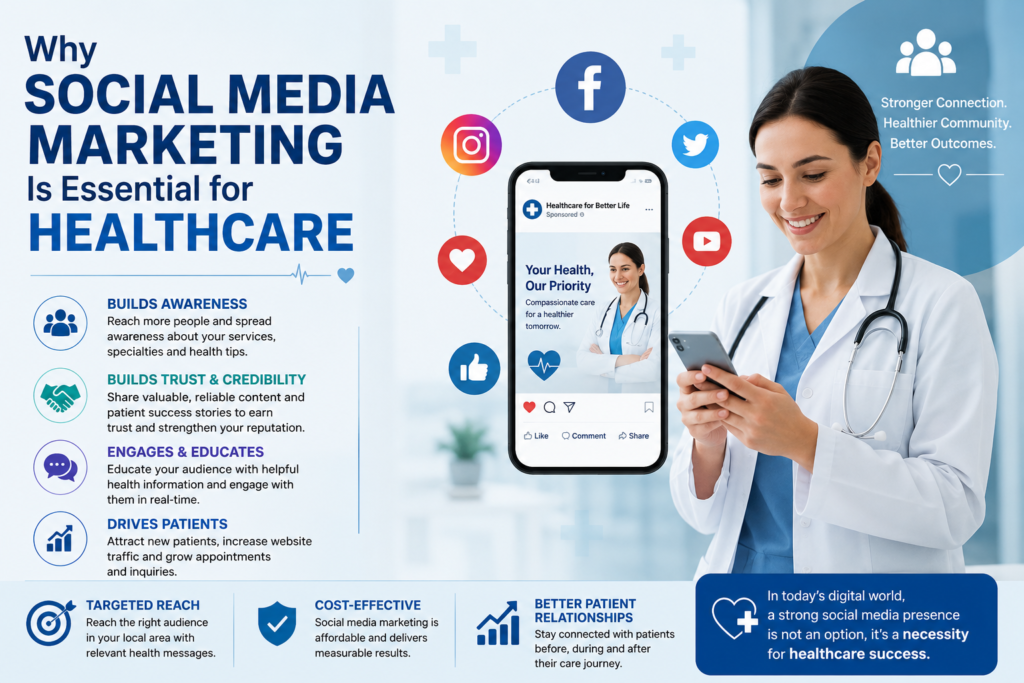
Healthcare social media marketing is the practice of using social platforms — Facebook, Instagram, LinkedIn, YouTube, and more — to build patient relationships, share medical information, and grow the visibility of a hospital or clinic.
It is not just about posting. Done well, it drives appointment bookings, builds community trust, and positions your centre as the go-to authority in your specialty.
World-class institutions like Mayo Clinic and Massachusetts General Hospital treat social media as the new word-of-mouth. They engage with patients daily — answering questions, sharing health news, celebrating milestones. The result? Millions of followers who trust them before they ever walk through the door.
According to Pew Research Center, over 70% of adults in emerging markets now use social media actively — and they are using it to research healthcare options. For hospitals, that is an audience too large to ignore.
Here is what a strong healthcare social media presence achieves:
- Shares critical, timely health information with a wide audience
- Opens direct communication channels between providers and patients
- Builds peer-to-peer learning among healthcare professionals
- Generates organic website traffic and improves local SEO rankings
- Establishes brand authority in a competitive medical landscape
The scope is genuinely wide. Whether you run a general hospital, a dental clinic, or a sleep disorder centre, social platforms give you a direct line to the people you serve.
Advantages and Challenges of Social Media in Healthcare
Like any marketing channel, social media for hospitals comes with both opportunities and responsibilities. Here is a clear-eyed view of both sides:
The Advantages
- Wider reach: Reach thousands of potential patients in your city or specialty with a single well-crafted post.
- Trust building: Patient testimonials, doctor Q&As, and health tips create a credible, human brand.
- Cost-effective: Organic content and targeted paid ads both offer strong ROI compared to traditional advertising.
- Real-time communication: Answer patient queries instantly, turning followers into booked appointments.
- Competitive differentiation: Most hospitals still under-invest in social media — which means the opportunity cost of not being there is significant.
The Challenges (and How to Handle Them)
- HIPAA and patient privacy: Stick to general health information and never share identifiable patient data. The U.S. Department of Health & Human Services HIPAA guidelines provide clear, actionable rules for healthcare social media use.
- Fear of negative comments: Respond professionally, take sensitive issues offline, and treat feedback as data.
- Staying ‘professional’: Social media does not make you less credible — it makes you accessible. Patients prefer doctors who communicate.
The challenges are real, but manageable. Every hospital we have worked with initially hesitated — and every one of them saw a measurable uptick in patient inquiries within three months of going active.
5 Social Media Content Ideas for Healthcare That Drive Engagement
Before we get into the 11 strategies, let’s talk content. These five formats consistently outperform everything else in the healthcare space:
1. Answer Patient Questions Publicly
Patients are already searching for health answers on Google and social media. Position your hospital as the trusted source by responding to common questions in posts, Stories, and comment threads. This builds both trust and discoverability.
2. Invest in Video Content
Around 65% of healthcare companies in India that use video content report a 20% or greater increase in conversions. Educational explainers, procedure walkthroughs, and doctor introductions all perform exceptionally well on Instagram Reels and YouTube.
3. Host Online Webinars
Approximately 35% of reputed hospitals use webinars to connect with potential patients in real time. A 45-minute session on a topic like ‘Managing Diabetes in Your 40s’ can position your specialists as authorities while generating quality leads.
4. Blog and Share on Social
Nearly 86% of healthcare websites maintain a blog — and the ones that actively share those blogs on social media generate significantly more organic traffic. Pair a solid
Nearly 86% of healthcare websites maintain a blog. Pair a solid content marketing strategy with consistent social sharing and watch your website authority climb.
5. Run Polls
Live polls generate up to 80% faster audience feedback compared to standard posts. Use them on Instagram Stories, Facebook, and YouTube to gauge patient interests — then create content around the results.
11 Healthcare Social Media Marketing Strategies for Your Centre
These are not generic tips. They come from what actually works when you are trying to grow a hospital or clinic’s online presence in a competitive, compliance-heavy environment.
1: Share Pre-Emptive Health News
Time-sensitive health updates — new treatment protocols, seasonal health alerts, outbreak information — drive immediate engagement. A post about monsoon-related illnesses in July will perform far better than a generic wellness tip.
Even linking to a credible government or research source with your own commentary positions your hospital as a proactive, trustworthy voice.
2: Educate, Not Just Promote
The most common mistake hospitals make is posting only promotional content. Patients do not follow you to see ads — they follow you to learn. Share educational posts: how a procedure works, what to expect during recovery, when to see a specialist versus a GP.
Tie these posts back to your social media marketing services to ensure content is optimised for both engagement and search discovery.
3: Promote Events and New Treatments
About to launch a new cardiac unit? Running a free health camp? Tell your audience — before, during, and after. Event promotion creates anticipation, and post-event coverage extends the content lifecycle.
4: Show Your Brand’s Human Side
Your hospital is not just a building — it is a team. Showcase your staff, your values, and the small moments that make your centre special. Even a post celebrating a nurse’s birthday or a doctor returning from a medical conference humanises your brand in a way no ad ever could.
5: Highlight Staff Accomplishments
Did one of your surgeons publish research? Did your team complete advanced training? Share it. These posts build trust with patients and attract high-quality talent — a double win for growing hospitals.
6: Leverage User-Generated Content
Patient testimonials and shared experiences are among the most powerful marketing assets in healthcare. A patient sharing a recovery photo or a thank-you post to your staff — with their permission — builds social proof that no paid campaign can replicate.
Always obtain written consent before resharing patient-generated content.
7: Go Live and Tell Real Stories
Facebook Live, Instagram Live, and YouTube Live let you connect with audiences in real time. Host live Q&A sessions with doctors, broadcast health awareness events, or take followers on a behind-the-scenes tour of your facility. Authenticity drives engagement — and engagement drives trust.
8: Respond to Every Patient Query
Social media is a two-way channel. When someone asks a question on your page — publicly or via DM — respond promptly and helpfully. Patients who receive timely, caring responses become long-term advocates for your hospital.
For sensitive cases, acknowledge publicly and move the conversation to a private channel.
9: Run Branded Social Media Campaigns
Campaigns create momentum. Here are five campaign types that work particularly well in healthcare:
- Polls on health awareness topics
- Health event promotions (World Diabetes Day, Heart Month, etc.)
- Giving back campaigns (free screenings, donation drives)
- Partnerships with NGOs or wellness brands
- Contests and giveaways (health check packages, consultation vouchers)
10: Manage Your Online Reputation Actively
Online reputation management is not optional in healthcare — it is essential. Actively monitor review platforms, respond to feedback professionally, and encourage satisfied patients to leave Google reviews.
Pair this with a strong local SEO strategy to ensure your centre appears prominently when patients search for specialists near them.
11: Optimise Social Profiles for Search (Social SEO)
Search engines index social profiles and posts. Fill out every field in your hospital’s Facebook, LinkedIn, and Instagram profiles. Use relevant keywords in your bio, captions, and hashtags. A well-optimised social profile can rank in Google results for branded and local searches.
For deeper visibility, combine social optimisation with professional SEO services to cover both channels simultaneously.
The Best Social Media Platforms for Healthcare Marketing
With nearly 3 billion active users, Facebook remains the most powerful platform for healthcare marketing. Use it for educational posts, patient testimonials, Facebook Live sessions, event promotions, and targeted advertising to local audiences.
Instagram is ideal for visual storytelling — doctor profiles, facility tours, Reels, and health infographics. It skews younger, making it perfect for attracting patients in the 25–45 age bracket.
LinkedIn is where healthcare professionals build their authority. Post research insights, team achievements, and thought leadership content. While it may not drive appointment bookings directly, it builds the institutional reputation that makes patients trust you.
YouTube
Long-form video content — procedure explanations, patient journeys, expert interviews — performs best on YouTube. It also contributes to SEO since Google surfaces YouTube videos in search results.
According to the World Health Organization’s digital health guidelines emphasise that digital communication channels, including social media, play a critical role in public health education and patient engagement.
Current Challenges in Healthcare Social Media Marketing
Many healthcare professionals still approach social media with caution — and some of those concerns are valid. Here are the three most common challenges we see, and how to address them:
- Privacy compliance: Focus on general health education rather than individual patient information. Follow HIPAA guidelines or the equivalent regulations in your country.
- Consistency: The biggest social media failure in healthcare is starting strong and then going quiet. Build a monthly content calendar and stick to it — even a cadence of three posts per week compounds over time.
- Misinformation risk: Every piece of content should be reviewed by a qualified medical professional before publishing. Accuracy is not optional — it is your credibility.
These challenges have solutions. The hospitals that grow fastest on social media are not the ones with the biggest budgets — they are the ones with the clearest content strategy and the consistency to execute it.
Frequently Asked Questions
What is healthcare social media marketing?
Healthcare social media marketing is the use of social platforms — such as Facebook, Instagram, LinkedIn, and YouTube — by hospitals, clinics, and medical professionals to educate patients, build brand trust, attract new appointments, and communicate health information. It combines content strategy, community management, and paid advertising tailored to the healthcare industry’s compliance requirements.
Which social media platform is best for hospitals?
Facebook is the most effective platform for hospitals overall due to its large user base, detailed targeting options, and versatility for video, events, and educational content. Instagram works well for visual storytelling and reaching younger demographics. LinkedIn is best for building professional reputation and recruiting medical talent.
How can social media help a hospital attract new patients?
Social media attracts new patients by increasing your hospital’s visibility in local search results, building trust through patient testimonials and educational content, and enabling direct engagement with people actively seeking healthcare information. Consistent, high-quality content positions your centre as the most credible option in your specialty and location.
Is social media marketing safe for healthcare organisations from a compliance standpoint?
Yes, when done correctly. The key is to share general health information and never disclose identifiable patient data without explicit written consent. Following HIPAA guidelines (or equivalent local regulations) protects your organisation. Many healthcare providers successfully maintain active, compliant social media presences by focusing on education, events, and team stories rather than individual patient cases.
How often should a hospital post on social media?
A consistent posting cadence of three to five times per week is a solid starting point for most hospitals. Quality always matters more than quantity — one genuinely useful post outperforms five filler updates. The most important thing is consistency: showing up regularly builds algorithmic favour and audience trust simultaneously.
What type of content performs best for healthcare social media?
Short educational videos, patient testimonials (with consent), doctor Q&A sessions, live streams, health awareness campaign posts, and behind-the-scenes content consistently outperform generic promotional posts in the healthcare space. Content that answers real patient questions or solves a real health concern generates the highest engagement.
How much does healthcare social media marketing cost?
Costs vary widely depending on whether you manage social media in-house or through a specialist agency, and the scale of your paid advertising. Organic content creation can be handled with a modest monthly budget if you have internal resources. Paid social advertising in healthcare typically works most cost-effectively with a minimum monthly ad spend in the range of ₹15,000–₹50,000 for local campaigns. Partnering with a digital marketing agency often provides better results per rupee through expertise and tools.