
After Google’s March 2026 Core Update, websites with strong author entities and verifiable bylines outranked many older, higher-DA competitors. In my 10+ years of working with businesses across SEO, I have rarely seen a single update shift rankings this fast — and this specifically toward author credibility.
If your blog posts have a generic byline like ‘Admin’ or ‘Team G2S’ — or worse, no byline at all — you may already be feeling the impact. This post will show you exactly what changed, what Google is looking for now, and how to fix it, step by step.
What Are Author Entities — and Why Does Google Care?
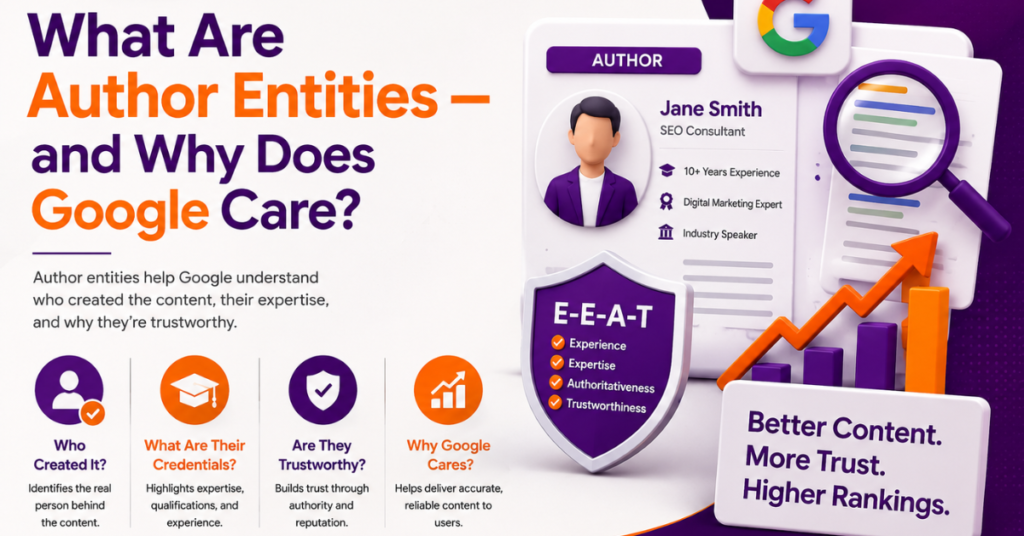
An author entity is a structured, machine-readable identity that Google can verify across the web. It is not just a name on a page. It is a connected profile — linking your name, your website, your social presence, and your published work into a coherent, trusted identity that Google’s systems can understand and validate.
Definition: An author entity is a unique, verified digital identity that allows search engines to attribute content to a specific, credible individual — verified across multiple authoritative sources.
Google has always cared about who is writing content. But the March 2026 Core Update made this a much harder ranking signal. It is no longer enough to just have a name on a page. Google now checks:
- Does this author have a consistent identity across the web?
- Are they cited or mentioned on credible third-party sites?
- Is their author profile marked up with proper structured data?
- Does their expertise match the topic they are writing about?
Main yeh isliye bol raha hoon kyunki I have seen this happen with startups, MSMEs, even funded companies — they invest lakhs in content and ignore the single thing Google is now checking hardest: who wrote it, and why should anyone trust them.
What Changed in the March 2026 Core Update
According to Google’s Search Central documentation, the March 2026 update placed increased emphasis on Experience, Expertise, Authoritativeness, and Trustworthiness — particularly at the content creator level, not just the domain level. This is a critical distinction.
Before this update, a high-DA domain could carry average content written by unnamed authors. That cushion has significantly narrowed. Here is what shifted:
- Google’s systems now evaluate the author’s entity graph — not just the domain’s backlink profile.
- Pages with properly structured author markup (Schema.org Person) saw measurable ranking stability.
- YMYL (Your Money or Your Life) content — health, finance, legal — faced the harshest scrutiny around author credentials.
- Thin bylines (first name only, no linked profile) were flagged in quality reviewer guidelines as low-trust signals.
The Search Quality Evaluator Guidelines — used by Google’s human quality raters — explicitly now look for: author’s name, verifiable credentials, and a body of consistent published work on the subject.
The Four Pillars of E-E-A-T for Authors
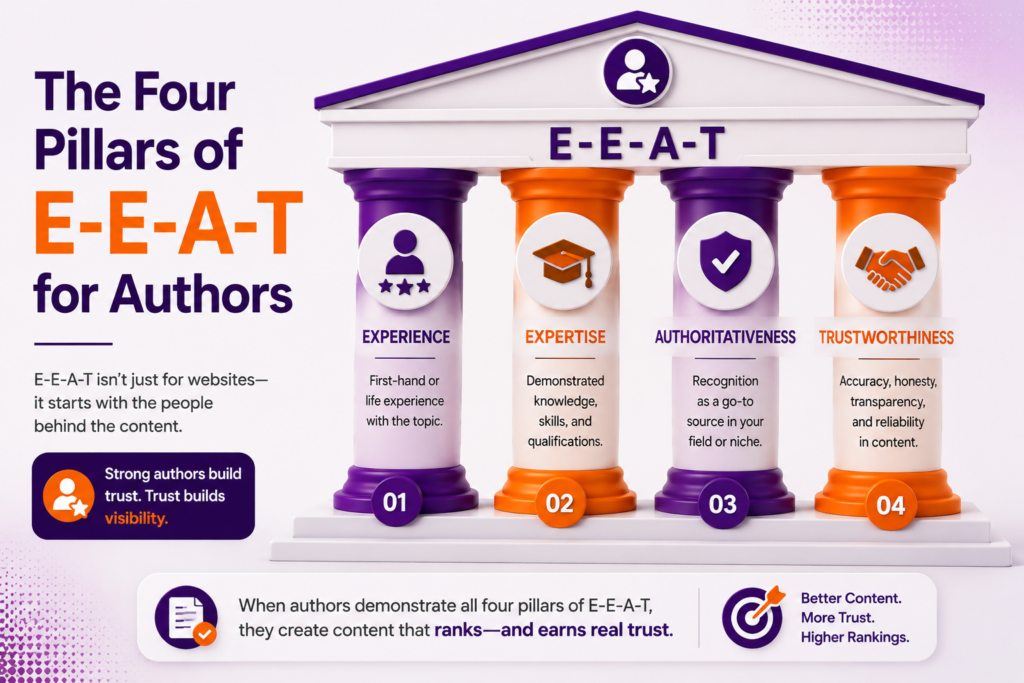
Here is what most people get wrong about E-E-A-T: they treat it as a checklist for the website, not the author. After March 2026, you need both. Let me break down each pillar from an author’s perspective.
1. Experience — Show You Have Done This
Experience means demonstrating that the author has first-hand involvement with the topic. This is different from expertise (which is about knowledge). Experience is about doing.
- Mention real client results, real campaigns, real numbers in your posts
- Add an author bio that includes specific industries you have worked in
- Use phrases like ‘In my work with eCommerce brands…’ or ‘When we ran this campaign for an MSME client…’
Yeh mistake almost har client karta hai — they write theoretical content when they have actual experience sitting in their head. That experience is your biggest asset for E-E-A-T. Use it.
2. Expertise — Prove You Know the Subject
Expertise is about depth of knowledge. Google evaluates this by looking at the consistency of your published content, your credentials, and how often others cite your opinions.
- Maintain a consistent topical focus in your author profile
- Get published or quoted on industry platforms
- Cite credible data and link to authoritative sources within your posts
- Keep your ‘About the Author’ section updated with relevant qualifications
3. Authoritativeness — Build Your Off-Page Author Signal
This is where most Indian businesses fall short. Authoritativeness is built off your own website — through mentions, citations, and backlinks to your author profile from credible sources.
- Get interviewed on podcasts, news sites, or industry blogs
- Contribute guest articles on reputed platforms (with your byline linking to your main author page)
- Build a Wikipedia mention or Wikidata entry if your profile qualifies
- Your Google Knowledge Panel is the clearest signal of authoritativeness — it means Google has built an entity around you
4. Trustworthiness — The Foundation of Everything
Trustworthiness is not just about SSL certificates and privacy policies. For authors, it means transparency. Is the byline real? Is the content original? Are the claims verifiable?
- Use your full real name — never a pseudonym for business content
- Link your author profile to your LinkedIn, Google Scholar (if applicable), or official company page
- Disclose conflicts of interest where relevant
- Correct factual errors publicly — this actually builds trust
Also Read This :- 11 Healthcare Social Media Marketing Strategies
How to Build a Strong Author Entity — Step by Step
Sach bataaun toh, building an author entity is not a one-week task. It is a 3–6 month process done consistently. But you can start seeing signals shift within weeks if you follow this sequence.
Step 1: Create a Dedicated Author Profile Page
Every author who publishes on your website needs their own URL. Not a generic /team/ page — a dedicated /author/[name]/ page.
This page should include:
- Full name and professional title
- Photo (real, professional)
- A 150–250 word bio with specific experience, industries served, and expertise areas
- Links to LinkedIn, Twitter/X, and any external publications
- A list of articles published on the site
Step 2: Add Schema.org Person Markup
This is non-negotiable after March 2026. Add Schema.org Person structured data to every author profile page and to each article page in the article’s Schema markup.
Key fields to include in your Person schema:
- name, jobTitle, description
- url (your author page), sameAs (LinkedIn, Twitter, Wikipedia if applicable)
- knowsAbout (list of topic areas)
- worksFor (your organization’s Schema)
- alumniOf (if relevant educational credentials exist)
Google uses the sameAs field to cross-reference your identity across multiple platforms. The more consistent your name, photo, and bio are across those platforms, the stronger your entity signal.
Step 3: Claim and Complete Your Google Knowledge Panel
If you are a founder, agency owner, or published author, you may already qualify for a Knowledge Panel. To build toward one:
- Be consistently mentioned by name on credible third-party sites
- Keep your Wikipedia entry (if eligible) or Wikidata profile accurate
- Use Google’s ‘Claim this Knowledge Panel’ feature once it appears
- Ensure your name appears in structured data across your website consistently
Step 4: Fix Your Bylines Across All Published Content
Go back through your existing content. Every post should have:
- Full author name (not ‘Admin’, not ‘Staff Writer’, not initials)
- A hyperlinked byline pointing to the author profile page
- A brief 2–3 line author bio at the bottom of each post
- Publication date and last updated date (both matter for freshness signals)
Step 5: Build Off-Page Author Authority
This is the long game, but it is worth starting now.
- Contribute one guest article per month to a relevant, credible publication
- Get interviewed — podcasts, YouTube shows, industry newsletters
- Respond to HARO (Help a Reporter Out) or similar platforms to get quoted in news articles
- Encourage clients to mention you by name in testimonials and case studies
If you are just starting your SEO journey or want to understand how Google’s updates affect small businesses, read our guide on Local SEO for Indian Businesses.
What This Means for Indian Businesses Specifically
Agar aap seriously grow karna chahte ho in search rankings post-March 2026, this section is specifically for you.
Most Indian MSMEs and startups run their blogs with:
- Content written by interns or content agencies with no author attribution
- A single generic ‘Editorial Team’ byline for everything
- No author schema, no linked profiles, no off-page author presence
In my experience, this was ‘okay’ for a long time because Google was primarily evaluating domain-level signals. That era is over — or at least, significantly reduced.
The good news? This is fixable. And Indian businesses that move fast on this have a real window to outrank international competitors who are slower to adapt their author strategy.
Your local knowledge, your real experience with Indian consumers, and your on-the-ground expertise — these are genuine E-E-A-T signals. You just need to structure them properly so Google can read them.
Frequently Asked Questions
What is an author entity in SEO?
An author entity is a structured digital identity that Google can verify across the web. It connects your name, professional credentials, published content, and social profiles into a single, recognizable identity. When Google can confidently associate content with a verified entity, it assigns greater trust and authority to that content.
How did the March 2026 Core Update affect author signals?
The March 2026 Core Update elevated author-level E-E-A-T signals as direct ranking factors — particularly for YMYL content. Websites with properly structured author entities, complete bylines, and off-page author authority saw stronger ranking stability. Sites with anonymous or thin bylines experienced measurable ranking volatility during the rollout.
Do I need Schema markup for every author?
Yes — for any author who regularly publishes on your site, Schema.org Person markup on their author profile page is now considered a best practice and a trust signal. Adding the author’s structured data to each individual article’s Schema (via the ‘author’ property in Article schema) strengthens this further.
What is the difference between E-E-A-T and EAT?
EAT (Expertise, Authoritativeness, Trustworthiness) was Google’s original quality framework. E-E-A-T added ‘Experience’ as the first E — recognizing that first-hand, lived experience with a topic is a distinct and valuable quality signal, separate from academic or formal expertise. The March 2026 update made Experience the most actively evaluated of the four for blog and editorial content.
Can a small business or startup build author authority?
Absolutely — and in many ways, a founder’s genuine experience and domain knowledge is more credible than generic agency content. Start with a proper author profile page, add Schema markup, and begin contributing to credible external publications. Author authority is built incrementally, and consistent effort over 3–6 months produces measurable results.
How long does it take to build a Google Knowledge Panel for an author?
There is no guaranteed timeline. Generally, consistent mentions on authoritative third-party sites over 3–12 months, combined with accurate Wikidata entries and structured data on your own site, create the conditions for a Knowledge Panel to appear. The more unique and consistent your name-entity signal is across the web, the faster Google connects the dots.
Does a LinkedIn profile help with author entity building?
Yes, significantly. LinkedIn is one of the platforms Google uses as a sameAs reference when verifying author identities. A complete, regularly updated LinkedIn profile — with consistent name, title, and employer matching your website’s author schema — strengthens your entity signal. It should always be included in your Schema’s sameAs field.