
In late 2024, Google’s global search share slipped below 90% for the first time in a decade — and AI engines like ChatGPT and Perplexity have only grown since. Search isn’t dying; it’s splitting. The playbook that worked a few years ago needs an update.
This guide covers the SEO trends that actually matter heading into 2026, which older predictions aged well, and what to do differently now. We’ll be straight about what’s hype and what’s holding up, because guessing wrong here wastes real budget.
How the Old Predictions Aged (Honest Scorecard)
A few years back, the big calls were AI in search, long-form quality content, mobile-first, E-A-T, and video. Most of those held up remarkably well — AI and content quality especially. Others, like the idea of “pre-crawling” search terms, never materialized the way people expected. Keeping that honesty in mind, here’s where things stand now.
Also Read This:-How to Demonstrate E-E-A-T After the March 2026 Core Update
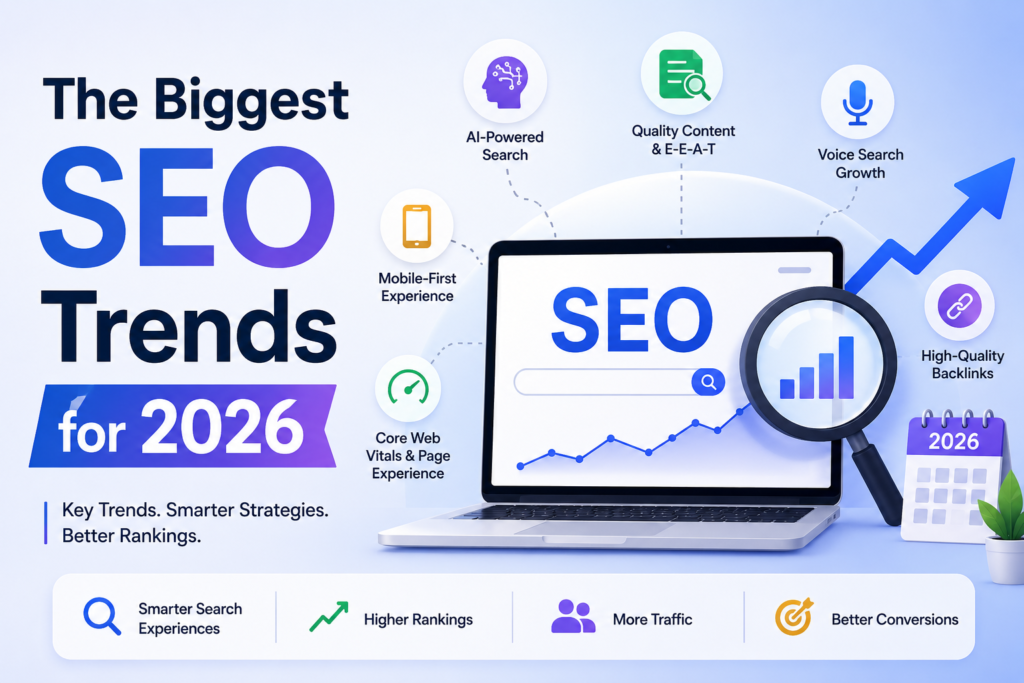
The Biggest SEO Trends for 2026
1. AI Overviews and Generative Search Change What “Ranking” Means
Generative search is when an engine answers a query with an AI-written summary instead of a list of links. Google’s AI Overviews, ChatGPT, and Perplexity now answer many questions before a user ever clicks. Ranking #1 matters less if the answer appears above the results.
Structure content for extraction — clear definitions, direct answers, and logical headings. This is the core of generative engine optimization (GEO). Strong organic content still feeds AI answers, so classic SEO isn’t dead; it’s the foundation.
2. Zero-Click Search Shifts the Goal to Visibility
Studies have found that a majority of mobile searches and a large share of desktop searches now end without a click, a pattern documented in the zero-click search research summarized on Wikipedia. The job of SEO is shifting from pure traffic to brand presence in answers.
Optimize for being cited and seen, not just clicked. Track impressions and branded search alongside clicks, and accept that some informational queries will convert on visibility rather than a visit.
3. AI-Assisted SEO Workflows Are Now Standard
AI-powered SEO — using machine learning to guide keyword research, content planning, and technical audits — was a prediction a few years ago and is now everyday practice. The shift in 2026 isn’t speed; it’s where human effort goes.
Let AI handle data processing and pattern detection, and invest human time in interpretation, strategy, and the unique insights AI can’t replicate. AI-generated-only content tends to lack the depth search engines now reward.
4. Long-Form, Genuinely Useful Content Still Wins
The long-form prediction held up. Quality, in-depth content (well-structured guides, original data, tutorials) still ranks, earns links, and builds authority. The bar is just higher now that AI can mass-produce mediocre content.
Prioritize original insight over word count. A focused 1,500-word piece with first-hand expertise beats a padded 3,000-word one. Add data, examples, and perspective competitors can’t easily copy.
5. E-E-A-T and Trust Signals Carry More Weight
E-E-A-T stands for Experience, Expertise, Authoritativeness, and Trustworthiness — the framework Google’s quality raters use to judge content. Google added “Experience” in December 2022, and trust signals matter even more now that AI surfaces and cites sources.
As outlined in Google’s Search Quality Rater Guidelines, clear authorship, accurate sourcing, and real expertise help content surface in both classic and AI results. Build buyer personas so content actually matches audience intent.
Also Read This:-7 Common Google Business Profile Issues
6. Video and Visual Search Keep Expanding
Video remains a major discovery channel, and structured video markup helps engines surface key moments. Younger audiences increasingly treat platforms like YouTube and TikTok as search engines in their own right.
Add chapters and accurate captions, use clip and video structured data, and optimize titles and descriptions like web pages. Repurpose long content into short video to capture social search.
7. Technical SEO Is the Price of Entry
Every AI trend still runs on a sound website. Speed, mobile-friendliness, clean code, and structured data determine whether content surfaces at all — in organic results or AI overviews.
Mobile-first indexing, predicted years ago, is now simply how Google works. Google’s Search Essentials documentation remains the baseline checklist. Regular technical audits keep the foundation healthy.
What This Means for Your 2026 Strategy
The throughline is clear: SEO is becoming about trust and presence across both Google and AI engines, not just ranking links. Practical priorities:
- Audit technical health first — it gates everything else.
- Write for extraction: definitions, direct answers, clean structure.
- Strengthen E-E-A-T with real authorship and sourcing.
- Use AI to accelerate, not to replace, human insight.
- Measure visibility and citations, not clicks alone.
An honest limitation: SEO predictions are directional, not certain — algorithms and AI products change fast. Treat this as a strategy compass, not a guarantee. For deeper guidance, see our SEO services, explore our digital marketing services, or read our related guide on on-page SEO factors.
FAQ Section
Is SEO still worth it in 2026 with AI search?
Yes. SEO is still worth it, but its role is shifting from driving clicks to building visibility and trust across Google and AI engines. AI overviews often pull directly from top organic content, so strong SEO still powers the newest search experiences. The brands investing in quality and structure are the ones getting cited in AI answers. Ignoring SEO now means being absent from both classic and AI results.
What is generative engine optimization (GEO)?
Generative engine optimization is the practice of structuring content so AI search engines can extract, summarize, and cite it accurately. It overlaps heavily with good SEO: clear definitions, direct answers, logical headings, and trustworthy sourcing. The goal is to be the source an AI engine references, not just a link on page one. GEO and traditional SEO work best together rather than as separate efforts.
What is the biggest SEO trend for 2026?
The biggest trend is the rise of AI Overviews and generative search changing what “ranking” means. Many queries are now answered before a user clicks any result. This makes content structure, E-E-A-T, and brand presence more important than chasing a single ranking position. Classic SEO still matters because AI answers are often built from top organic content.
Did the old SEO predictions about AI come true?
Largely yes. Predictions about AI guiding search and SEO workflows aged very well, and long-form quality content and mobile-first also held up. Some specific predictions, like “pre-crawling” of search terms, did not play out as described. The honest takeaway is that broad direction (AI, quality, trust) was right even when the exact mechanics were not.
Does long-form content still rank well?
Yes, but the bar is higher. Long-form content still improves rankings, engagement, and backlink potential, but only when it delivers genuine depth and original insight. Padding word count no longer works, especially now that AI can mass-produce shallow content. Focused, expert content outperforms long content that says little.
How do I measure SEO success when clicks are dropping?
Shift from clicks alone to a broader set of signals. Track impressions, branded search growth, citations in AI answers, and assisted conversions alongside organic clicks. Many informational queries now convert on visibility rather than a site visit. Measuring only clicks will undervalue work that is actually building presence and trust.
Is mobile-first still important in 2026?
Yes, and it is now simply how Google operates rather than a future trend. Google primarily evaluates the mobile version of your site for indexing and ranking. A fast, stable mobile experience is a baseline requirement for visibility in both classic and AI results. Weak mobile performance undermines everything else you do.