

98% of consumers use the internet to find local businesses — yet most websites are set up as if that statistic doesn’t exist. If your competitors are showing up and you’re not, this post will change that.
After working through local SEO audits and strategy sessions with over 100+ businesses across Rajasthan and beyond, our team at G2S Technology has seen the same gaps come up again and again. This guide covers the 10 most impactful things you can do right now to rank higher in local searches, attract more walk-ins and calls, and consistently beat bigger brands in your own backyard.
Here’s what you’ll learn: what local SEO actually is, why it matters for your specific type of business, and a practical step-by-step optimisation checklist you can start applying today.
What Is Local SEO and Why Does It Matter?
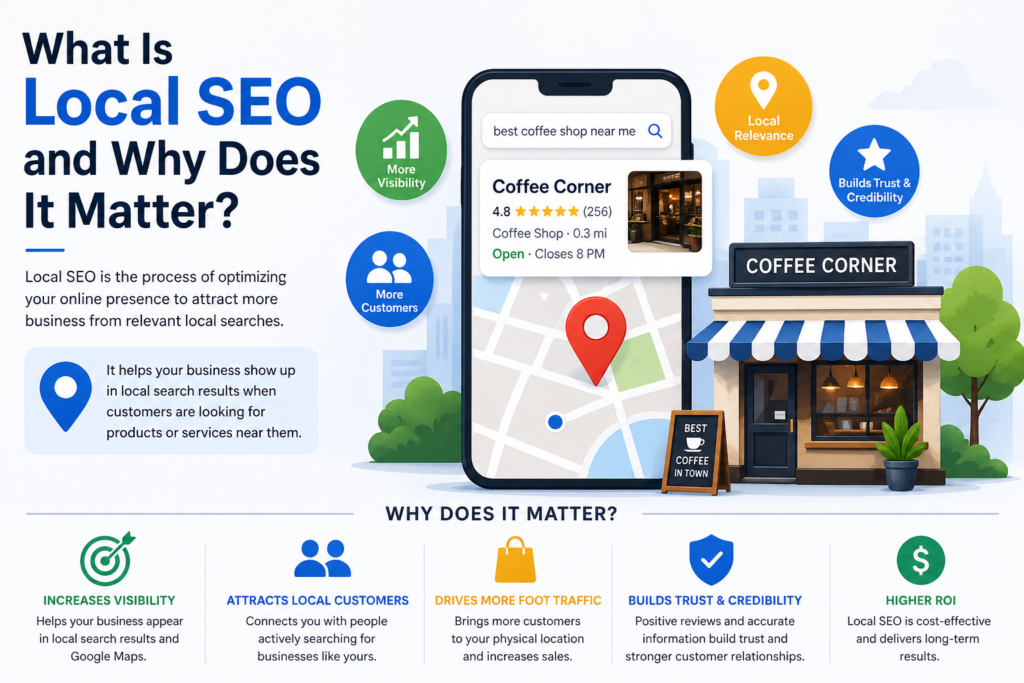
Local SEO is the process of optimizing your online presence so your business appears prominently in search results when people in your geographic area search for relevant products or services. Unlike broad SEO, local SEO targets people who are nearby, ready to act, and looking for exactly what you offer.
When someone types “digital marketing agency near me” or “best restaurant in Jaipur,” Google shows a Local 3-Pack — three businesses with maps, ratings, and contact details right at the top of the results. That is the prime real estate you are competing for.
Why it matters in hard numbers:
- 98% of consumers use the internet to research local businesses (BrightLocal, 2023)
- Local searches on mobile lead to a purchase or visit within 24 hours for the majority of users
- Businesses appearing in Google’s Local 3-Pack capture the lion’s share of clicks on any local query
The good news? Local SEO is one of the most level playing fields in digital marketing. A well-optimised small business in Jaipur can consistently outrank a national chain that hasn’t done the groundwork. Here’s how.
Read this too:- Top 13 Ways to Improve Your Local SEO Right Now 2026
10 Ways to Optimize Your Website for Local SEO
1. Claim and Fully Optimise Your Google Business Profile
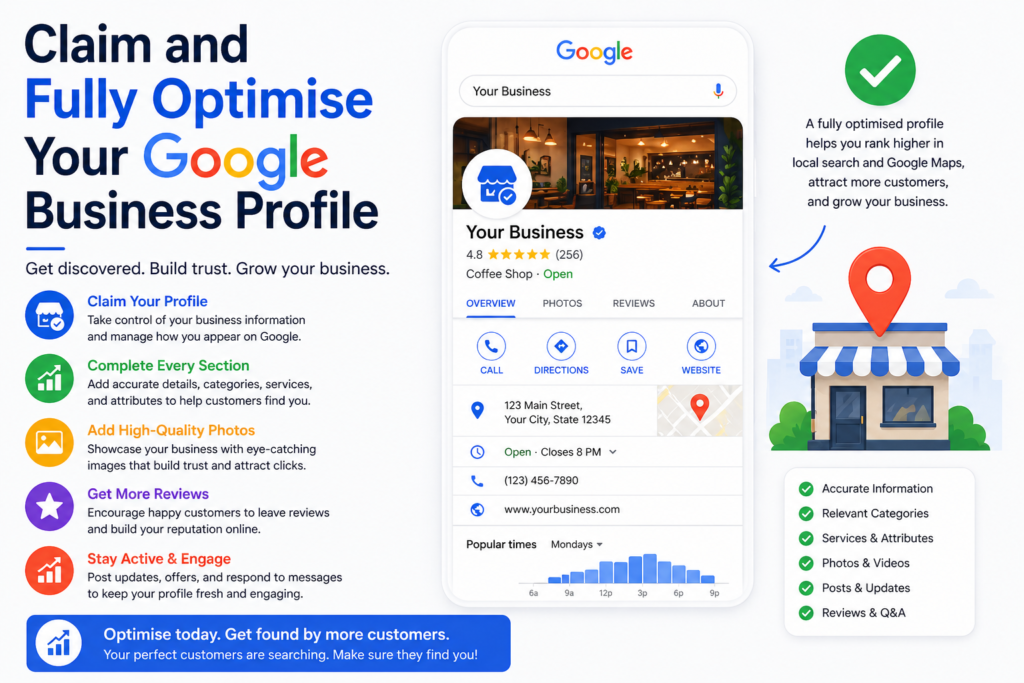
Your Google Business Profile (GBP) is the single most important local SEO asset you own. It controls what appears in the Local 3-Pack, Google Maps, and the knowledge panel on the right side of search results.
To optimise it fully:
- Claim your listing at Google Business Profile if you haven’t already
- Fill in every section — name, address, phone, website, hours, services, and category
- Upload at least 10 high-quality photos of your business, team, and products
- Add your primary and secondary business categories accurately
- Use Google Posts weekly to share updates, offers, or events
From what we’ve seen working with local businesses in Jaipur, incomplete GBP listings are one of the most common reasons a business fails to appear in local searches — even when the business has been operating for years. Filling in your profile completely takes under two hours and delivers results within weeks.
For a step-by-step breakdown, read our guide on how to optimise your Google Business Profile for local SEO.
2. Keep Your NAP Information Perfectly Consistent
NAP stands for Name, Address, and Phone Number. It is the foundational signal that tells Google — and potential customers — that your business is legitimate and reliably located where you say it is.
Any inconsistency in your NAP across your website, Google Business Profile, social media profiles, and online directories confuses search engine crawlers and erodes trust. Even small differences — “Road” vs. “Rd.”, old phone numbers, or a slightly different business name format — can suppress your rankings.
Action steps:
- Audit every place your business is listed online (use a tool like Moz Local or BrightLocal)
- Standardise your NAP format and apply it consistently everywhere
- Update old listings and remove duplicates
- Include your NAP in the footer of every page on your website
3. Target Local Keywords Throughout Your Site
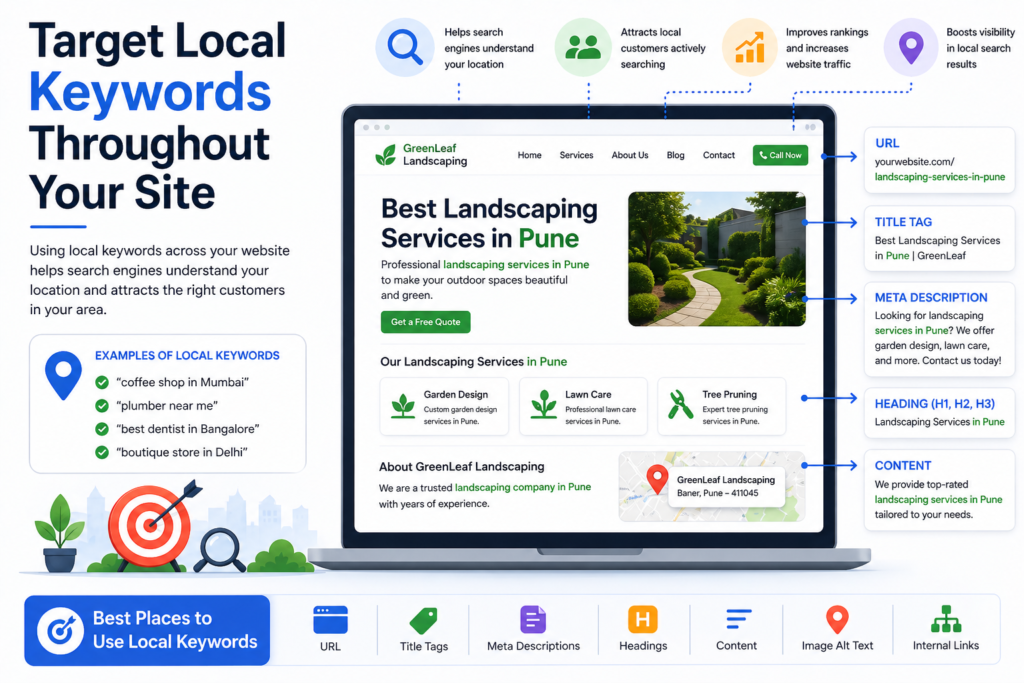
Generic keywords like “digital marketing” are extraordinarily competitive. Local keyword variants — “digital marketing agency in Jaipur” or “SEO services Civil Lines” — are far more achievable and, more importantly, attract people who are ready to contact you.
How to identify and use local keywords:
- Use Google Search Console to see what location-based queries you already rank for
- Research with Google Keyword Planner to find high-intent local variants
- Integrate location keywords naturally into your page titles, H1 tags, meta descriptions, and body content
- Do not stuff keywords — if it reads unnaturally, it will also rank poorly
A practical tip from client work: if you serve multiple areas, create a dedicated landing page for each location. A law firm covering Jaipur, Ajmer, and Jodhpur should have three separate, well-written location pages — not one page trying to cover all three.
4. Build and Clean Up Your Local Citations
A local citation is any online mention of your business name, address, and phone number — whether on a directory, review platform, or local website. Google uses citations as a trust signal for local search rankings.
Priority citation directories for Indian businesses include:
- Justdial, Sulekha, IndiaMART, and IndiaBizOnline
- Yelp, Bing Places, Apple Maps
- Industry-specific directories relevant to your sector (Practo for healthcare, MagicBricks for real estate, etc.)
Submit new listings, update outdated ones, and remove duplicates. Consistent citations reinforce your location signals and help your GBP rank higher.
5. Actively Collect and Respond to Customer Reviews
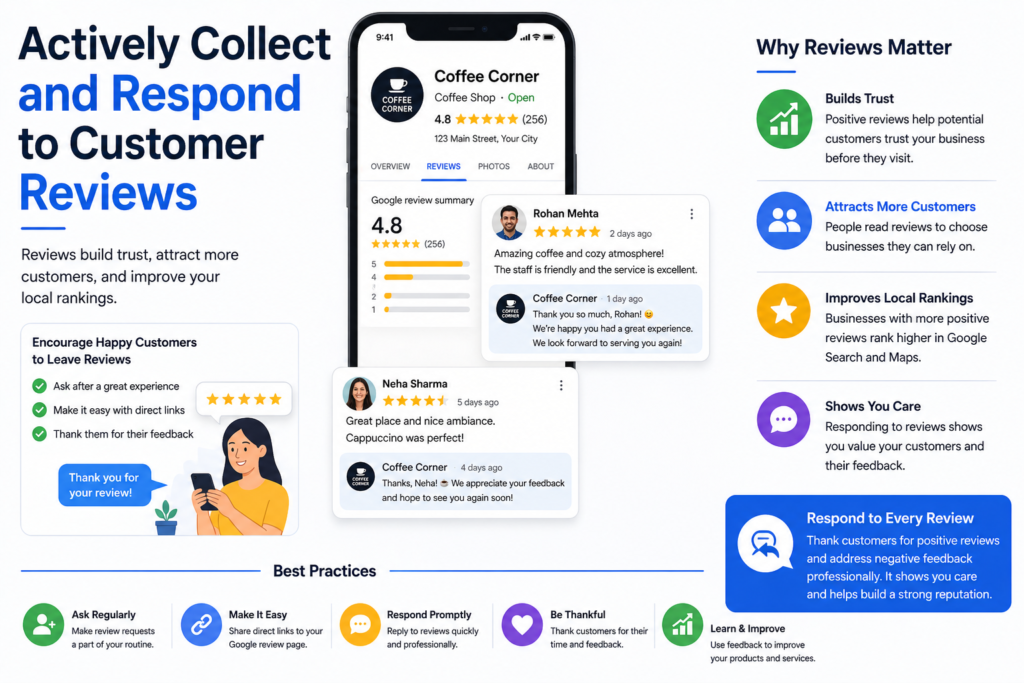
Online reviews are a direct local ranking factor — and they are also what converts a searcher into a customer. Research consistently shows that consumers trust online reviews as much as personal recommendations.
A business with 50 recent 4.5-star reviews will outrank a competitor with 10 old reviews, all else being equal.
How to build your review profile:
- After every successful transaction or project, send a follow-up message with a direct link to your Google review page
- Train your team to ask for reviews in person — a direct ask is still the most effective method
- Respond to every review — positive and negative. A thoughtful response to a negative review demonstrates professionalism and can actually increase conversions
- Never buy fake reviews. Google’s detection has improved significantly and penalties are severe
6. Ensure Your Website Is Mobile-First and Fast
The majority of local searches happen on mobile devices. A website that loads slowly or renders poorly on a phone does not just frustrate users — it actively suppresses your rankings. Google uses mobile performance as a core ranking signal through its Core Web Vitals framework.
Check your site’s performance using Google’s official PageSpeed Insights tool. Target scores above 70 on mobile. Key improvements often include:
- Compressing and properly sizing images
- Enabling browser caching and using a CDN
- Removing unused JavaScript and CSS
- Ensuring tap targets (buttons, links) are large enough for mobile users
From our audits, page speed is the most commonly neglected factor among local businesses. A one-second improvement in mobile load time can produce a meaningful lift in both rankings and conversions.
7. Implement Local Schema Markup
Schema markup is structured data code added to your website that helps search engines understand the specific details of your business — your address, opening hours, service areas, and more. For local businesses, LocalBusiness schema is the most important type to implement.
This markup does not change what your website looks like to visitors, but it gives Google explicit, machine-readable information it can use to display rich results and power its local search rankings.
Key schema types for local businesses:
- LocalBusiness (or a specific subtype: Restaurant, MedicalBusiness, LegalService, etc.)
- GeoCoordinates — your exact latitude and longitude
- OpeningHoursSpecification — days and hours of operation
- Review — to display star ratings in search results
You can validate your implementation using Google’s Rich Results Test at search.google.com/test/rich-results.
8. Create Locally Relevant Content
Content marketing is not just for national brands. Local businesses that publish relevant, useful content about their area and industry consistently outrank competitors who rely only on service pages.
Local content ideas that genuinely work:
- Guides specific to your city: “How to Choose the Right Interior Designer in Jaipur”
- Case studies featuring local clients (with permission)
- Coverage of community events or local industry news
- FAQ pages addressing questions your local customers actually ask
When you write content that is genuinely useful to your local audience, other local sites link to it, people share it, and Google recognises you as an authority in your area. This compounds over time in a way paid ads cannot replicate.
See how we approach this for our clients in the article on local search engine optimisation for small businesses.
9. Build Local Backlinks
A backlink is a link from another website pointing to yours. For local SEO, links from websites in your city, region, or industry carry more weight than generic links from unrelated sources.
How to earn local backlinks without cold emailing strangers:
- Sponsor a local event or school programme — most will list you on their website
- Partner with complementary local businesses for cross-promotions and mutual links
- Get listed on your local Chamber of Commerce website or industry association directory
- Contribute guest articles to local news portals or community blogs
- Create genuinely useful local resources that other sites reference naturally
Even five strong, relevant local backlinks can move your rankings more than fifty generic directory submissions. Quality consistently beats quantity.
10. Track, Measure, and Refine Your Local SEO Performance
Local SEO is not a one-time task. Rankings change, competitors adapt, and Google’s algorithm updates regularly. The businesses that maintain strong local rankings are those that monitor their performance and adjust proactively.
What to track:
- Google Business Profile Insights — impressions, calls, direction requests, website clicks
- Google Search Console — organic clicks and impressions for local keyword queries
- Ranking positions — use a rank tracker to monitor your position for 10–20 target local keywords
- Review velocity — how frequently new reviews are coming in
- Conversion rate — what percentage of website visitors make an enquiry or purchase
Set a monthly review cadence. Thirty minutes per month reviewing these metrics will consistently surface the highest-leverage opportunities and prevent small problems from becoming ranking emergencies.
For a deeper look at technical optimisation and audit frameworks, Google’s own Search Essentials documentation is an authoritative reference worth bookmarking.
Quick Reference: Local SEO Optimisation Checklist
- Claim and complete your Google Business Profile
- Standardise NAP across all platforms and directories
- Research and integrate local keywords into all key on-page elements
- Build citations on relevant local and industry directories
- Set up a system to consistently collect and respond to reviews
- Test and improve mobile speed using Google PageSpeed Insights
- Implement LocalBusiness schema markup on your site
- Publish locally relevant content monthly
- Earn at least 3–5 quality local backlinks per quarter
- Review GBP Insights and Search Console data monthly
Frequently Asked Questions
What is local SEO and how is it different from regular SEO?
Local SEO is the practice of optimising your online presence to rank higher in search results for users in a specific geographic area. Regular (or national) SEO targets broad keyword rankings without a location focus. Local SEO specifically optimises for location-based queries like “dentist in Jaipur” and prioritises signals like Google Business Profile, NAP consistency, and local reviews — signals that national SEO does not depend on as heavily.
How long does local SEO take to show results?
Most businesses see initial movement in Google Business Profile rankings within 4–8 weeks of completing a full optimisation. Website ranking improvements through on-page changes and citation building typically take 3–6 months to materialise meaningfully. Review collection and content publishing compound over time — businesses that stay consistent for 6–12 months typically see the strongest results and are much harder for competitors to displace.
Is Google Business Profile optimisation the most important local SEO step?
It is the single highest-impact starting point, yes. Your GBP controls your visibility in the Local 3-Pack and Google Maps — the two most visible positions in local search. However, GBP alone is not sufficient. NAP consistency, on-site local keyword optimisation, reviews, and local backlinks all work together. Businesses that optimise only their GBP and ignore their website rarely reach top local rankings for competitive queries.
How do online reviews affect local SEO rankings?
Reviews are a confirmed local ranking factor for Google. The quantity of reviews, the recency of reviews, and the average star rating all influence where your business appears in local search results. Google also reads the content of reviews for relevance signals — if multiple reviewers mention a specific service you offer, that can help you rank for that service. Responding to reviews is not a direct ranking factor but demonstrates business activity, which Google rewards.
What is NAP consistency and why does it matter for local SEO?
NAP stands for Name, Address, and Phone Number. NAP consistency means your business details are listed identically across every online platform — your website, Google Business Profile, social media pages, and directories. Inconsistencies confuse Google’s algorithms and reduce the trust signals required for local rankings. Even formatting differences (“St.” vs. “Street”) can cause problems at scale. Consistent NAP is one of the easiest wins in local SEO because it is fully within your control.
Do I need a separate page for each city or area I serve?
If you actively serve customers in multiple locations, creating dedicated location pages for each area is best practice. Each page should be genuinely useful — not just a copy of your main service page with the city name swapped out. Include location-specific content, testimonials from that area, and relevant local schema markup. Thin or duplicate location pages can actually hurt your rankings, so invest the effort to make each one substantive.
How do I know if my local SEO strategy is working?
Track these four metrics monthly: the number of impressions and clicks in your Google Business Profile Insights; your ranking positions for 10–15 target local keywords; the volume of calls and website visits attributed to organic local search; and the number of new reviews received. Positive trends across these indicators — even gradual ones — confirm that your strategy is working. Flat or declining metrics indicate where to focus next.
Where Will You Start?
If you have read this far, you already know more about local SEO than most of your competitors. The only variable left is execution.
Pick one item from the checklist above and do it today. Seriously — even completing your Google Business Profile categories, or sending three review request messages to recent customers, will move the needle. Local SEO rewards consistency over perfection.
Tried any of these? Ran into a roadblock on a specific step? Drop your question in the comments below — our team reads every one and we’re happy to help you think through it. ↓
And if you want a professional eye on your current local SEO setup — no sales pitch, just an honest look at what’s working and what needs attention — we offer a
→ Free website and local SEO audit from G2S Technology
Also worth reading:
→ How to Optimise Your Google Business Profile for Maximum Local SEO Results