
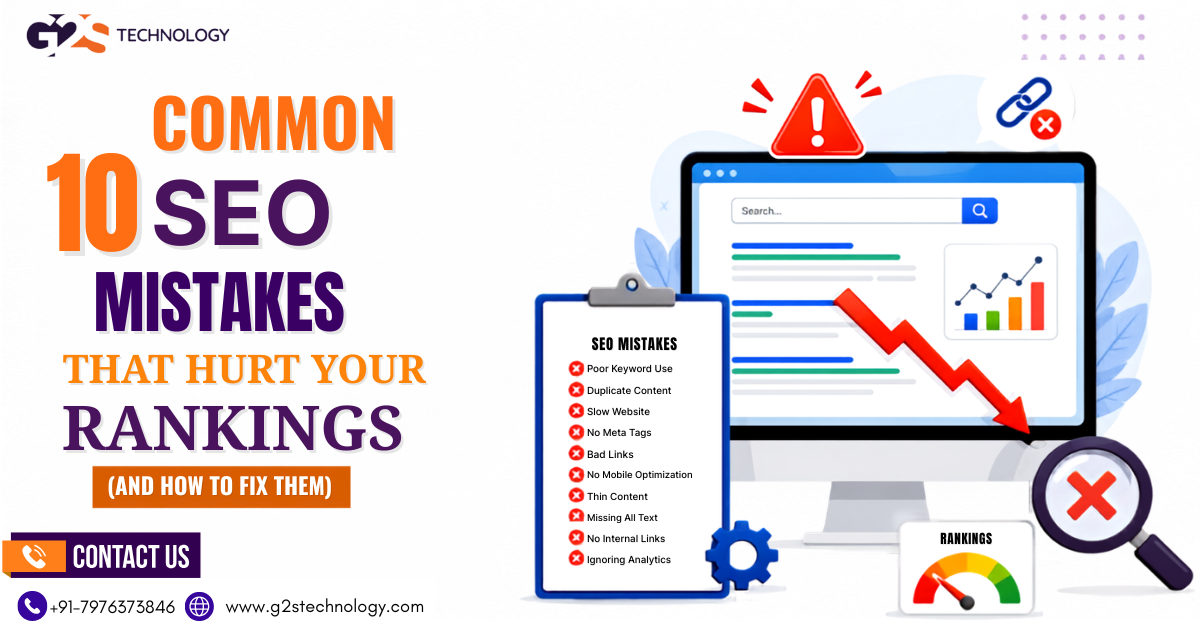
You publish content, build links, and wait, yet your rankings barely move or even slip. Often the culprit is not what you are missing, but a handful of mistakes quietly working against you.
In this guide, you will learn the 10 most common SEO mistakes that hurt rankings, and exactly how to fix each one. We have shaped this from 100+ business conversations our team has had with founders and business owners.
No scare tactics. Just clear problems and practical fixes.
Why Small SEO Mistakes Cost You So Much
An SEO mistake is any practice that works against how search engines rank pages, whether through poor content, technical issues, or risky tactics. Individually they seem minor, but together they can stall your growth or trigger penalties.
The good news: every mistake below is fixable, and most fixes are within your control. Let us walk through them.
Also Read This:- Complete SEO Audit Guide For 2026–27
1. Prioritising Quantity Over Quality
Publishing lots of thin posts no longer works. Google rewards helpful, well-written content that genuinely serves the reader, as its helpful content guidance makes clear.
The fix: write fewer, better pages. One thorough, well-organised post that solves a real problem beats ten shallow ones. Quality is the foundation of every other SEO effort.
2. Writing for Yourself, Not Your Readers
Many businesses write about what they want to say, not what their audience is searching for. People use Google to solve problems, so your content must answer their questions.
The fix: research what your audience actually wants, then match your content to that intent. Get into their mindset, address their pain points, and answer clearly. Our content marketing services can help you map this.
3. Ignoring Page Speed and Core Web Vitals
Slow pages frustrate users and raise bounce rates, and speed is a confirmed Google ranking signal. Today, speed is measured through Core Web Vitals: loading, responsiveness, and visual stability.
The fix: test your site with Google PageSpeed Insights, then compress images, reduce redirects, minimise code, and use caching or a CDN. Our guide on how page speed affects rankings goes deeper.
4. Weak or Missing Structured Data (Schema)
Structured data, also called schema markup, is code that helps search engines understand your content and can enable rich results like star ratings and FAQs. Skipping it means missing easy visibility wins.
The fix: add relevant schema for your pages, such as articles, products, reviews, or FAQs, and validate it with Google’s Rich Results Test. Our technical SEO team handles this routinely.
5. Poor Internal and External Linking
Links help both users and search engines navigate your content, but misusing them backfires. Too many low-quality or irrelevant links can hurt, not help.
The fix: add relevant internal links to related pages, and link out to trustworthy, authoritative sources where it adds value. For backlinks, prioritise quality and relevance over quantity, and avoid spammy link schemes. Our off-page SEO team focuses on safe, quality links.
6. Messy URL Structure
Long, confusing URLs are harder for users and search engines to read. Clean URLs support both usability and ranking.
The fix: keep URLs short, descriptive, and keyword-relevant, usually three to five words. Separate words with hyphens, not underscores, since search engines read hyphens as spaces. Our on-page SEO team can tidy your structure.
7. Publishing Duplicate Content
Copying content, or repeating it across your own pages, confuses search engines about which version to rank. Google filters duplicates and may show none of them.
The fix: write original content, and watch for duplicate meta descriptions, paragraphs, and H1 tags across pages. For unavoidable duplicates, use canonical tags to point to the main version. Our post on how plagiarism hurts your business explains more.
8. Underusing Social Media
Social signals are not a direct ranking factor, but social media drives traffic and discovery that support your SEO indirectly. Ignoring it leaves reach on the table.
The fix: share your content, engage your audience, and build your brand on the platforms your customers use. More visibility means more visits and natural links. Our social media marketing team can run this for you.
Also Read This:- The Social Media Post Checklist
9. Neglecting Mobile-Friendliness
Here is an important update: this used to be the place people mentioned AMP, but Google has moved on from prioritising Accelerated Mobile Pages. What matters now is that your whole site is fast and mobile-friendly, since Google uses mobile-first indexing.
The fix: use a responsive design, make sure your site works smoothly on phones, and pass your Core Web Vitals. Test on real devices and with PageSpeed Insights. Our guide on optimising your website for mobile covers the details.
10. Poor Keyword Research and Irrelevant Targeting
Targeting the wrong keywords, or guessing instead of researching, wastes your entire effort. You may rank for terms no one searches, or miss the ones that convert.
The fix: research your niche and choose keywords with real search demand and clear intent. Balance informational keywords that build trust with commercial ones that drive sales. Tools like Google Keyword Planner help you find and validate them. Our guide on choosing the right long-tail keywords is a useful next read.
Final Thoughts
Most ranking problems come down to a few avoidable mistakes, not some mysterious algorithm change. Fix your content quality, technical health, links, and keyword targeting, and your rankings tend to follow.
Pick the two or three mistakes you recognise on your own site and fix them this week. Small, consistent corrections often produce the fastest gains.
FAQ
What are the most common SEO mistakes?
The most common SEO mistakes include prioritising quantity over quality, writing for yourself instead of your audience, ignoring page speed, weak schema, poor linking, messy URLs, duplicate content, underusing social media, neglecting mobile-friendliness, and poor keyword research. Each can quietly lower your rankings. The good news is they are all fixable.
Why is my website ranking dropping?
A ranking drop is often caused by fixable issues like slow pages, thin or duplicate content, poor mobile experience, or risky links, rather than a mysterious penalty. Start by auditing content quality, technical health, and your backlink profile. Fixing these usually recovers rankings over time.
Does page speed affect SEO?
Yes. Google has confirmed page speed is a ranking factor, measured today through Core Web Vitals. Slow pages also raise bounce rates and hurt user experience. Compress images, reduce redirects, and use caching to improve it.
Is AMP still needed for SEO?
Not anymore. Google has moved away from prioritising Accelerated Mobile Pages, so AMP is no longer necessary for rankings. What matters now is a fast, responsive, mobile-friendly site that passes Core Web Vitals.
Does duplicate content hurt SEO?
It can. Google filters duplicate content and may show only one version, so your pages may not rank. It does not usually trigger a direct penalty, but it wastes ranking potential. Write original content and use canonical tags for unavoidable duplicates.
Does social media help SEO?
Social signals are not a direct ranking factor, but social media drives traffic and discovery that support SEO indirectly. Sharing content can earn visits and natural backlinks. So it is worth using, even though it does not directly boost rankings.
How do I fix keyword targeting mistakes?
Research your niche and choose keywords with real search demand and clear intent, rather than guessing. Balance informational and commercial keywords, and validate them with a tool like Google Keyword Planner. Targeting the right terms is the foundation of effective SEO.