
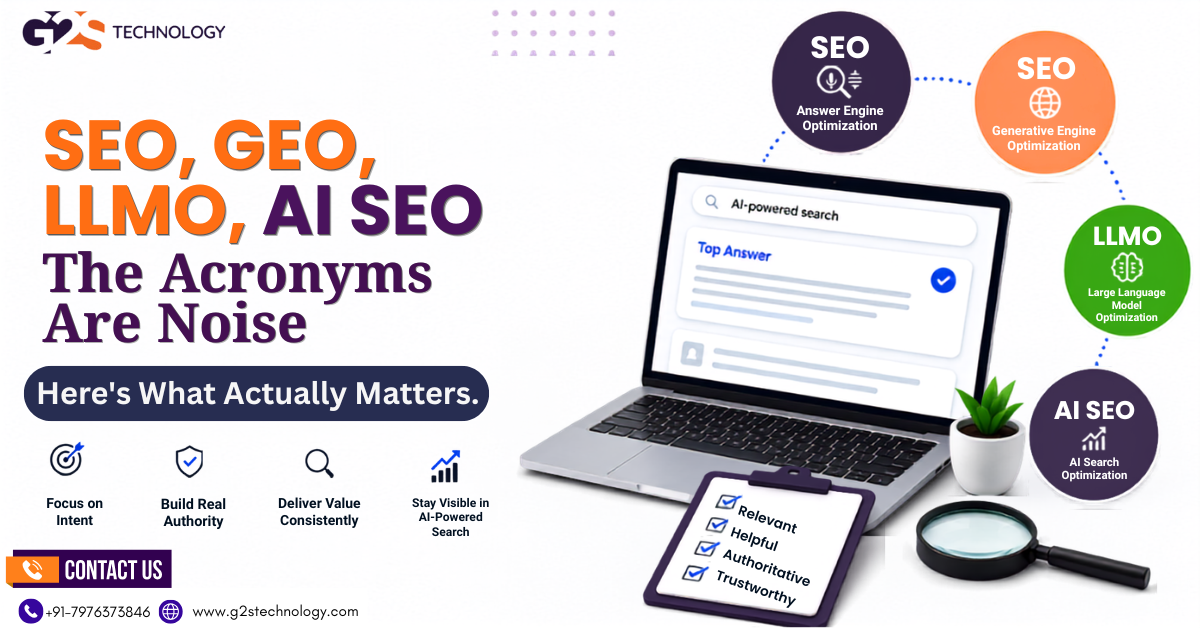
Four acronyms. One LinkedIn feed. Every few weeks a new three-letter word gets “invented,” and right behind it a founder messages me asking if their SEO is now “dead.” Sach bataaun toh, this is the most confusing marketing moment in years — not because the tech is hard, but because everyone selling you something needs a fresh label to sell it under.
This post cuts the jargon. You’ll learn what AEO, GEO, LLMO, and AI SEO actually mean, why they mostly describe the same job, and the handful of things that genuinely decide whether ChatGPT, Gemini, Perplexity, or Google’s AI Overviews mention your business — or hand that space to your competitor.
| 🔑 Key Takeaways AEO, GEO, LLMO, and AI SEO are overlapping labels for one goal: getting your content surfaced and cited by AI-driven search.There is no secret “AI SEO trick.” The work is clear answers, structured data, and real authority — the same fundamentals good SEO always rewarded.AI engines cite sources they can understand and trust. Clarity, citations, and consistent brand information matter more than keyword stuffing.Google’s AI Overviews still pull from the organic web, so strong traditional SEO is the base layer, not a separate project.The businesses winning in AI search are the ones already answering real questions better than anyone else. |
Where all these acronyms suddenly came from
Two years ago, no client had heard of GEO. Then generative AI became a real way people search, and the industry did what it always does when something new appears — it named it. Repeatedly.
GEO isn’t even a marketing invention originally. It started as academic research. A 2023 paper on Generative Engine Optimization from researchers at Princeton and Georgia Tech studied how to make content more likely to be cited inside AI-generated answers. That paper found that adding clear citations, quotations, and relevant statistics could improve a source’s visibility in generative engines by up to around 40% for some methods.
Notice what that finding is really saying: be clearer, cite sources, add data. None of that is exotic. It’s good writing. The acronyms multiplied after that — AEO, LLMO, AI SEO — mostly as marketing wrappers around the same idea.
What each acronym actually means (no fluff)
Here are the plain-English definitions, because you’ll keep hearing these words:
- AEO (Answer Engine Optimization) is the practice of structuring content so answer engines — featured snippets, voice assistants, and AI chat tools — can pull a direct answer straight from your page.
- GEO (Generative Engine Optimization) is the practice of optimizing content so generative AI engines such as ChatGPT, Gemini, and Perplexity cite or reference it in their responses.
- LLMO (Large Language Model Optimization) is the same goal framed around large language models specifically — shaping content so an LLM understands and reuses it accurately.
- AI SEO is the umbrella term. It usually just means “SEO, but for a world where AI sits between the user and your website.”
Read those four again. Different words, same job: make your content easy for a machine to understand, trust, and repeat.
Also Read This:- Complete SEO Audit Guide For 2026–27
The uncomfortable truth: they all point to the same work
In my 10+ years of working with businesses, I’ve watched this exact movie before — with “voice search optimization,” then “mobile-first,” then “E-E-A-T as a service.” Each time, a real shift got repackaged into a scary-sounding product.
Here’s what most people get wrong about this: they treat AI search as a brand-new channel that needs a brand-new team, a brand-new budget, and a brand-new acronym on the invoice. It doesn’t. Google’s AI Overviews are built on top of its regular search index. ChatGPT and Perplexity mostly cite pages that already rank, read cleanly, and answer the question directly.
So the honest version is unglamorous: AI search rewards the fundamentals, just more strictly. A weak page that scraped by on backlinks in 2019 gets quietly skipped by an AI answer in 2026.
What actually matters (the real work)
Forget the labels for a minute. If you get these four things right, you’re optimized for every engine — the ones with acronyms and the ones that haven’t been named yet.
1. Be a source AI can quote, not just crawl
What it is: writing pages that contain complete, self-contained answers a machine can lift without guessing.
Why it matters: AI engines don’t reward the cleverest page. They reward the clearest one. A paragraph that answers “What does GST registration cost for a small shop?” in two direct sentences will get cited over a 2,000-word essay that buries the answer.
How to do it: lead each section with the answer, then explain. Add a short definition sentence near the top of the topic. Use structured data (schema markup) so engines can label your content — FAQ, HowTo, Product, Local Business. Schema is a signal AI systems can parse without misreading your page.
2. Answer questions the way real people ask them
People type into ChatGPT the way they’d talk to a friend: “best way to fix a slow WordPress site,” not “WordPress performance optimization services.” Your headings and FAQs should match that natural language.
- Turn buyer questions into H2 and H3 subheadings, word-for-word where it reads naturally.
- Add a real FAQ block that answers what customers actually ask on calls.
- Keep answers tight — two to four sentences — so an engine can quote them whole.
3. Build authority an AI can verify
Google’s own guidance on creating helpful, reliable, people-first content leans hard on E-E-A-T — Experience, Expertise, Authoritativeness, Trust. AI engines lean the same way, because they’re trained to prefer sources that other credible sources trust.
Practical version for an Indian SMB:
- Put a real author with real credentials on your posts — not “Admin.”
- Get mentioned by name across the web: directories, associations, local press, genuine partner sites. Brand mentions (even without a link) help AI connect your name to your industry.
- Keep your business name, address, and phone number identical everywhere. Inconsistent details confuse both Google and AI.
4. Keep your technical house in order
None of the above works if the machine can’t read your site. Fast pages, crawlable HTML, clean structure, and correct Schema.org markup are the plumbing. Boring? Yes. But this is the layer that quietly decides whether you’re in the answer or invisible.
If you want a foundation check before touching AI-specific tactics, start with a [Link to your technical SEO / site health audit service] and your [Link to your schema markup guide].
A quick gut-check: the Jaipur sweet shop test
Picture a third-generation sweet shop in Jaipur that wants to show up when someone asks an AI, “where can I get good ghee-based mithai for Diwali gifting?”
The shop doesn’t need GEO, AEO, and LLMO as three separate projects. It needs one honest page that says:
- what it makes, in plain words a customer would use;
- prices, gifting options, and delivery areas, clearly listed;
- a real FAQ (“Is the mithai pure desi ghee?” “Do you ship across India?”);
- LocalBusiness and Product schema so the details are machine-readable;
- consistent listings and a few genuine mentions around the web.
Do that, and the shop is optimized for every acronym at once. Main yeh isliye bol raha hoon kyunki I’ve seen the fanciest “GEO strategy” decks lose to a plain, specific page that simply answered the question.
One pattern I keep seeing: the pages that get pulled into AI answers are almost never the ones written for AI. They’re the honest, slightly boring pages that answered one question completely — a real pricing breakdown, a step-by-step fix, a straight comparison. The “optimized-for-GEO” fluff gets skipped.
What to do in the next 30 days
If you want a concrete order of operations instead of another acronym, here it is:
- Pick your 10 most important pages and rewrite the openings to answer the core question in the first two lines.
- Add or fix schema markup (FAQ, LocalBusiness, Product) on those pages.
- Build a genuine FAQ section from questions customers actually ask you.
- Fix speed and mobile issues — a slow page is skipped before it’s ever cited.
- Standardise your business name, address, and phone across every listing.
- Earn three to five real mentions this month — a directory, an association, a local feature.
Notice there’s no “GEO tool” on that list. There doesn’t need to be.
Where this is actually heading in 2026
A few things are worth watching, minus the panic. Standards like llms.txt are being proposed to tell AI crawlers what your site is about. AI Overviews keep expanding into more queries. And brand mentions — how often your name shows up in trusted places — are becoming a stronger signal than raw backlink counts.
The direction is consistent, though. Every update pushes the same way: reward clear, trustworthy, well-structured content, and ignore the rest. I’ve seen this happen with startups, MSMEs, even funded companies — the ones who stayed obsessed with fundamentals kept winning while everyone else chased the next acronym.
The good news? This is fixable, and you don’t need a new department to do it. You need clarity, structure, and a bit of patience.
FAQ
Is SEO dead because of AI search?
No. AI search sits on top of traditional SEO rather than replacing it. Google’s AI Overviews still pull from the organic index, and tools like ChatGPT and Perplexity mostly cite pages that already rank and read clearly. Strong SEO is now the entry ticket to AI visibility, not an outdated one.
What is the difference between AEO and GEO?
AEO (Answer Engine Optimization) focuses on getting a direct answer pulled from your page by snippets, voice, and AI tools. GEO (Generative Engine Optimization) focuses on getting your content cited inside generative AI answers from ChatGPT, Gemini, or Perplexity. In practice they overlap heavily — both reward clear, structured, quotable content.
Do I need a separate strategy for ChatGPT and Perplexity?
Usually not. The same fundamentals — clear answers, schema markup, authority, and consistent brand information — make your content easy for every AI engine to use. It’s smarter to optimize the content well once than to build a separate playbook per tool.
What does LLMO mean?
LLMO stands for Large Language Model Optimization. It’s the practice of shaping content so large language models understand and reuse it accurately. It’s essentially the same idea as GEO, framed around LLMs specifically.
How do I get my business cited in AI Overviews or ChatGPT?
Answer real customer questions directly and completely, add structured data so engines can read your content, and build genuine authority through consistent listings and brand mentions. AI engines cite sources they can understand and trust — so clarity and credibility do most of the work.
Does schema markup help with AI search?
Yes. Schema markup labels your content — FAQ, HowTo, Product, LocalBusiness — so search and AI engines can interpret it without guessing. It doesn’t guarantee a citation, but it removes ambiguity and makes your page far easier for a machine to use correctly.
Is GEO just SEO with a new name?
Largely, yes. GEO applies familiar SEO principles — clarity, structure, authority, and helpful content — to how generative engines select and cite sources. The goal shifts from ranking a blue link to being quoted in an answer, but the underlying work is the same.