
Here’s a number that should change how you think about SEO: AI Overviews now appear in roughly 47% of all Google searches. Almost half of all searches. And in most of those results, Google is answering the user’s question before they ever click a single link.
So what does that mean for your content? It means that ranking on page one is no longer enough. The real game now is being cited inside that AI-generated answer box at the top of the page.
In my 10+ years of working with businesses — from small Indian MSMEs to funded SaaS startups — I have watched SEO evolve in waves. But this shift, from keyword ranking to AI citation, is one of the biggest changes I have seen in a long time.
In this post, I am going to break down exactly how Google’s AI Overviews decide which sources to cite, what patterns I have observed, and — most importantly — what your 2026 content strategy needs to look like if you want to show up there.
What Are AI Overviews, Exactly?
AI Overviews (AIOs) are the AI-generated summary boxes that appear at the top of Google search results. They were previously called Search Generative Experience (SGE) during testing and were officially rolled out to all U.S. users in May 2024.
Google’s AI Overviews pull information from multiple web sources, synthesize an answer, and then cite the sources they used — much like an AI research assistant would.
The critical thing to understand: Google is not just crawling your page for keywords anymore. It is reading and comprehending your content. And then it decides whether your content is trustworthy and relevant enough to quote.
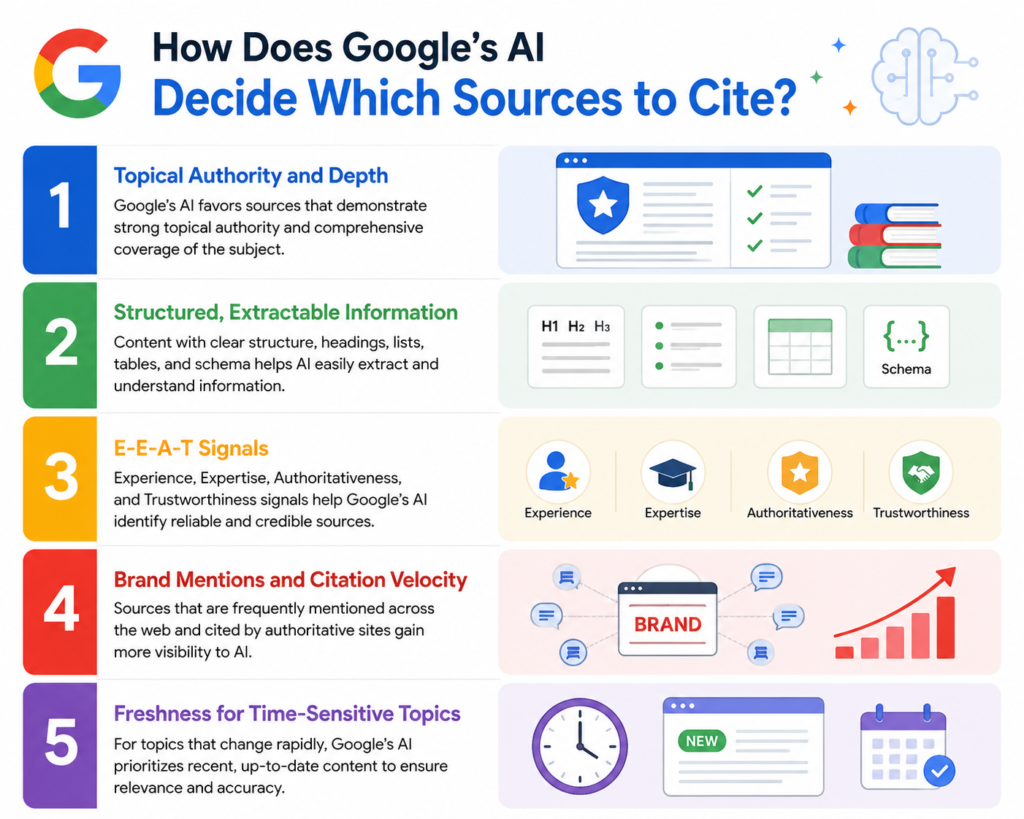
How Does Google’s AI Decide Which Sources to Cite?
This is the real question. And Sach bataaun toh — there is no single official answer from Google. But based on research, pattern analysis, and what I have observed across dozens of client sites, several clear signals emerge.
1. Topical Authority and Depth
Google’s AI heavily favors sources that demonstrate comprehensive topical authority. A page that covers a subject deeply — not just a thin 400-word article — stands a far better chance of being cited.
Agar aap seriously grow karna chahte ho in AI search, you need to build content clusters. One strong pillar page supported by related supporting articles across the same topic. That is the structure AI Overviews seem to trust most.
2. Structured, Extractable Information
Here is what most people get wrong about this: AI Overviews do not read your content the way a human does. They scan for clean, structured answers — clear definitions, numbered lists, concise explanations.
If your content is one long flowing paragraph with no hierarchy, the AI has a harder time extracting a clean, citable answer from it.
3. E-E-A-T Signals
Experience, Expertise, Authoritativeness, and Trustworthiness — Google has been talking about E-E-A-T for years, but it matters even more now for AI citations. Sites with clear author credentials, cited sources, original data, and consistent publishing histories appear more frequently in AI Overviews.
Google’s own Search Quality Evaluator Guidelines make this explicit — E-E-A-T is core to how quality is assessed.
4. Brand Mentions and Citation Velocity
If other credible sites reference or link to your content, AI Overviews are more likely to pick you up. This is not a new idea — it is traditional link authority — but it plays a larger role in AI citation selection than many people realize.
5. Freshness for Time-Sensitive Topics
For queries that are news-driven or trend-sensitive, Google’s AI strongly prefers recently updated content. An article from 2021 may still rank, but it is far less likely to appear in an AI Overview for a topic that has evolved since then.
Citation Patterns I Have Noticed Across Industries
I have been watching AI Overview citations across client industries — eCommerce, D2C, SaaS, local services — and a few patterns stand out consistently.
| Observed AI Overview Citation Patterns |
| Definition + Explanation Structure: Content that starts with a clear 1–2 sentence definition of the topic before expanding gets cited far more often. |
| FAQ and Q&A Formats: Pages with structured FAQ sections, especially those using proper schema markup, show up in AIO citations regularly. |
| Original Data and Stats: If your content contains an original stat, study, or proprietary insight, AI models actively seek it out — it becomes a citable asset. |
| Comparison Content: ‘X vs Y’ style content appears in AI Overviews often because it gives structured, decisive information. |
| Local Expertise for Regional Queries: For searches with geographic intent, Google cites local authority sources. Indian businesses can capitalize on this heavily for regional SEO Search Engine optimization |
What This Means for Your 2026 Content Strategy
Main yeh isliye bol raha hoon kyunki I see too many businesses still writing for 2018-era SEO — keyword stuffing, thin content, no structure. That approach is not just outdated; it is now actively working against you. Here is what a 2026 content strategy actually needs to look like:
Optimize for Answer Extraction, Not Just Keywords
Every piece of content you publish should have at least one clear, self-contained answer that an AI can extract without needing the rest of the page for context. Think of it as writing for a reader who only reads one paragraph.
Structure your content like this:
- Lead with the direct answer
- Then explain and expand
- Then provide examples or evidence
This ‘inverted pyramid’ structure is exactly what AI engines are looking for.
Build Topical Clusters, Not Isolated Articles
One-off articles do not build topical authority. You need a content ecosystem. Pick 5–8 core topics relevant to your business. Write a comprehensive pillar page for each. Then create 4–6 supporting articles that link back to the pillar.
This is what makes Google’s AI trust you as an authority on a subject — not a single well-optimized article, but a connected web of expertise.
Add Schema Markup — Especially FAQ and How-To
Schema markup is essentially you telling Google’s systems: ‘Here — I have already structured this for you.’ FAQ schema, HowTo schema, and Article schema all improve your chances of being picked up in AI-generated answers.
The Schema.org documentation is freely available and covers every markup type you might need. If you are on WordPress, plugins like Rank Math make implementation straightforward.
Prioritize First-Party Data and Original Insights
Here is a big one. AI models actively prefer citing original content over secondary interpretations. If your business can generate even simple original data — a survey of your customers, an analysis of your own industry metrics, a benchmark report — that becomes highly citable content.
I have seen this happen with startups, MSMEs, even funded companies. The ones producing original insights get cited. The ones republishing what everyone else says do not.
Update Your Existing Content Regularly
A 2022 article that is still ranking is a missed opportunity if it has not been refreshed. Go through your top-performing pages and update them — new data, revised sections, updated examples. A ‘Last Updated’ timestamp signals freshness to both Google and AI systems.
Build Your E-E-A-T Intentionally
This is not optional anymore. Your author bio matters. Your ‘About’ page matters. Your citations and references matter. If your content reads like it was written by no one in particular, AI systems have no reason to trust it over content from a clearly credentialed source.
The Moz Beginner’s Guide to SEO has a solid overview of E-E-A-T signals if you want to go deeper on this.
GEO: The New Skill Your Content Team Needs
Generative Engine Optimization (GEO) is the practice of optimizing content specifically for AI-driven search engines — ChatGPT, Gemini, Claude, Perplexity, and Google’s AI Overviews. It is SEO’s next evolution.
GEO focuses on: clarity of answers, structural formatting, citation-worthiness, and topical authority. If your content strategy does not include GEO thinking in 2026, you are already behind.
A good starting framework for understanding how large language models process web content is available through Google’s Search Central documentation.
A Quick Reality Check for Indian Businesses
Yeh mistake almost har client karta hai: they assume AI Overviews are a ‘foreign’ phenomenon — something that matters more for international brands than for Indian businesses targeting local customers.
That is no longer true. AI Overviews are increasingly active for Hindi and regional language queries. Google is expanding AI-generated answers for Indian search patterns, especially in categories like health, finance, local services, and education.
If you run a local service business, a D2C brand, or a startup targeting Indian consumers — the content strategy I have described above applies to you right now. Getting ahead of this early is the opportunity. Most of your competitors have not figured this out yet.
The Bottom Line
Getting cited in Google’s AI Overviews is the new page-one ranking. And the good news? This is fixable — if you start building your content the right way.
The businesses that will win in 2026 are the ones creating structured, authoritative, expert-backed content that AI systems can extract, trust, and cite. That is not complicated. But it does require intention. Stop writing content just to fill a publishing calendar. Start writing content that earns citations.
Frequently Asked Questions
Q1: What are Google AI Overviews and how do they work?
Google AI Overviews are AI-generated summaries that appear at the top of search results for many queries. They pull information from multiple credible web sources, synthesize a direct answer, and cite those sources. The AI uses Google’s large language models, combined with its Search index, to generate these responses in real time.
Q2: Can any website get cited in Google AI Overviews?
Yes — there is no exclusive list. Any website can potentially be cited, provided it demonstrates topical authority, clear structure, strong E-E-A-T signals, and content that is easy for AI systems to extract and interpret. Smaller sites and local businesses have appeared in AI Overviews when their content is well-structured and relevant.
Q3: Does traditional SEO still matter if AI Overviews are taking over?
Traditional SEO still matters — but it is no longer sufficient on its own. Rankings, backlinks, and technical SEO remain important foundations. The difference is that you now also need to optimize for AI extractability, which means structured content, clear answers, and topical depth. Think of GEO as SEO’s evolution, not its replacement.
Q4: How is GEO (Generative Engine Optimization) different from SEO?
SEO traditionally focuses on ranking pages in search results through keywords, backlinks, and technical signals. GEO focuses on making your content citable and extractable by AI search engines — including Google AI Overviews, ChatGPT, Perplexity, and others. GEO requires clear answer structures, authoritative sourcing, and schema markup in addition to standard SEO practices.
Q5: How often should I update my content to stay relevant in AI Overviews?
For evergreen topics, a review every 6–12 months is a reasonable baseline. For faster-moving topics — technology, finance, marketing, policy — quarterly updates are better. The key signal is whether the information in your article is still accurate and complete. Outdated facts significantly reduce your chances of being cited.
Q6: Does schema markup really help with AI Overview citations?
Yes, structured data markup — particularly FAQ schema, HowTo schema, and Article schema — makes it significantly easier for AI systems to identify and extract specific information from your pages. It is not a guarantee, but it is one of the clearest signals you can send to both Google’s traditional and AI-powered systems that your content is well-organized.
Q7: How does this apply to Indian businesses targeting regional audiences?
AI Overviews are increasingly active for regional and Hindi-language queries in India. Google is expanding AI-generated answers across Indian content categories including health, finance, local services, and education. Indian businesses that build structured, authoritative content now are positioning themselves ahead of competitors who are still treating content as an afterthought.