
AI is reading your website — but does it actually understand what you do? In 2026, it is not just Google bots crawling your website. ChatGPT, Claude, Gemini, and Perplexity are actively pulling content from the web to answer user queries. And if your site is not structured in a way these AI engines can understand — you are invisible to a growing chunk of search traffic.
That is where llms.txt comes in.
This guide breaks it all down — what llms.txt actually is, why it matters right now, and how to set one up step by step, even if you’ve never touched a file like this before.
What Is llms.txt?
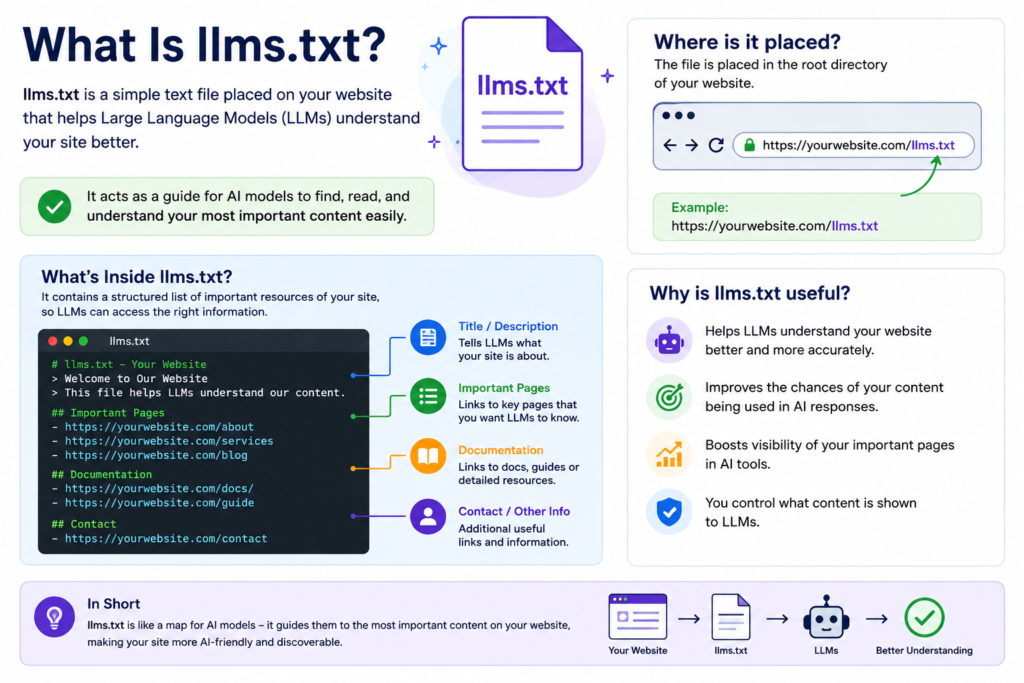
llms.txt is a plain-text file that you place at the root of your website — similar to robots.txt — that gives AI language models structured, easy-to-read information about your site and its content.
Think of it this way: robots.txt tells search engine crawlers which pages to index or skip. llms.txt tells AI systems what your website is about, what pages matter most, and how your content is organized — in a format they can actually process efficiently.
Definition: llms.txt is a Markdown-formatted text file, hosted at yourdomain.com/llms.txt, designed to help Large Language Models (LLMs) better understand, navigate, and cite your website’s content in AI-generated responses.
The concept was proposed by Jeremy Howard (co-founder of fast.ai) in late 2024 and has been gaining serious traction as AI-driven search becomes the norm.
Why Does llms.txt Matter in 2026?
Here is what most people get wrong about AI search: they think it works just like Google. It does not.
Think about what actually happens when someone asks ChatGPT “which digital marketing agency in India is best for eCommerce brands.” The AI isn’t running a search like Google does. It’s pulling from what it’s already crawled — and it goes for sources that are clean, credible, and clearly organized.
Yeh mistake almost har business karta hai — they optimise only for Google and ignore AI engines entirely. In my 10+ years of working with businesses across India through G2S Technology’s SEO services, I have seen this pattern repeat itself. The ones who adapt early always win.
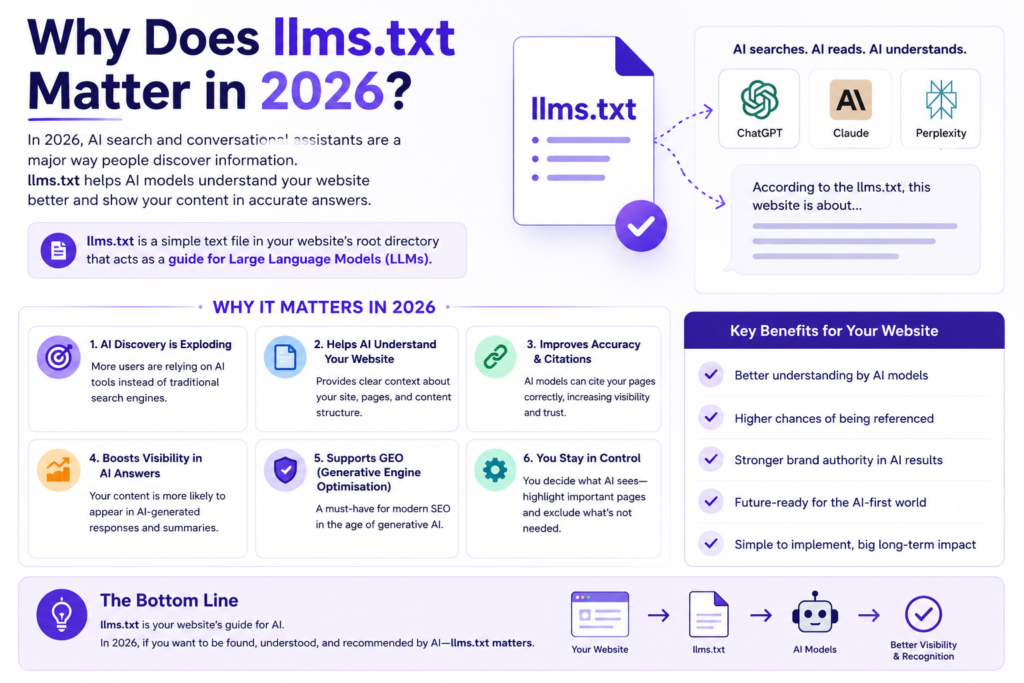
Here is why llms.txt specifically matters:
- AI engines increasingly power zero-click answers — users get their answer without visiting your site. If you are cited as a source, your brand still wins.
- Tools like Perplexity and ChatGPT browse the web in real-time. A clear llms.txt helps them represent you accurately.
- It future-proofs your SEO strategy as AI search share grows year over year.
- It reduces the chance of AI models misrepresenting your business or services.
What Does an llms.txt File Look Like?
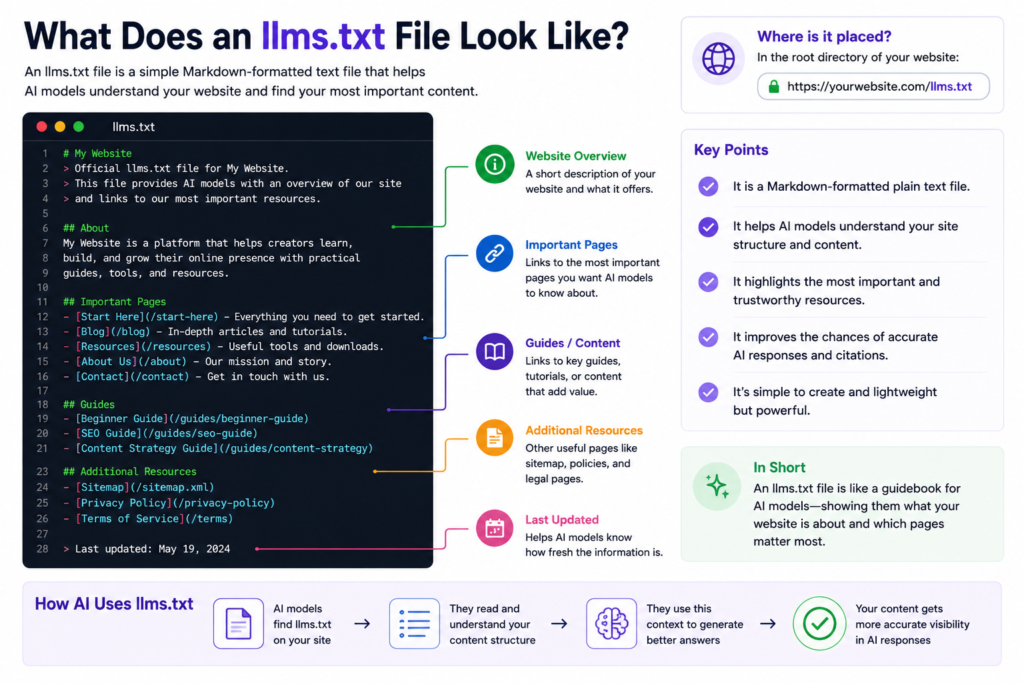
The format is simple. It is written in Markdown and typically contains:
- A brief description of your website or business
- Links to your most important pages
- Optional sections for documentation, product pages, or blog content
- Notes about what the AI should prioritise or ignore
Here is a basic example for a digital marketing agency:
# G2S Technology
> G2S Technology is a digital marketing agency based in India, specializing in SEO,
> Local SEO, Social Media Marketing, and Content Marketing for MSMEs and eCommerce brands.
## Important Pages
– [Home](https://g2stechnology.in/)
– [SEO Services](https://g2stechnology.in/seo-services/)
– [Blog](https://g2stechnology.in/blog/)
– [Contact](https://g2stechnology.in/contact/)
## Optional
– [llms-full.txt](https://g2stechnology.in/llms-full.txt)
Real-World llms.txt Examples — By Business Type
The G2S example above is a good starting point. But here’s the thing — a dental clinic in Jaipur needs a very different llms.txt than a SaaS company selling to US enterprise clients. The file is simple; the thinking behind it needs to be sharp. Let’s walk through four real-world examples and break down exactly why each line is there.
Example 1 — Local Business (Dental Clinic, Jaipur)
Local businesses have one job with llms.txt: make it impossible for AI to get confused about who you are, where you are, and what you treat. Vagueness kills local intent queries.
# Smile Care Dental Clinic
> Smile Care Dental Clinic is a family dental practice in Jaipur, Rajasthan,
> India. We offer general dentistry, orthodontics, teeth whitening,
> and dental implants. Appointments available 6 days a week.
## Services
– [General Dentistry](https://smilecare.in/general-dentistry/)
– [Orthodontics & Braces](https://smilecare.in/orthodontics/)
– [Dental Implants](https://smilecare.in/dental-implants/)
– [Book Appointment](https://smilecare.in/book/)
## Location & Contact
– Address: 42, MI Road, Jaipur, Rajasthan 302001, India
– Phone: +91-141-2345678
– Hours: Mon–Sat, 9:00 AM – 7:00 PM
– [Contact Us](https://smilecare.in/contact/)
Why this works:
The city and state are in the very first line of the description — “Jaipur, Rajasthan, India.” When someone asks Perplexity or ChatGPT “best dental clinic in Jaipur,” that geographic signal has to be unmissable. The services section is specific — not “we offer dental care” but actual treatment names that match how patients search. The Location section with a full address, phone, and hours means an AI can pull your basic information and surface it accurately without even visiting your site. And the appointment booking link gets prioritised because that’s the highest-value action for your business. Local businesses often skip the address in llms.txt — that’s the single most expensive mistake they make.
Example 2 — SaaS Company (Project Management Tool)
SaaS companies have a different challenge. Their product is intangible, the competition is dense, and the features can sound identical to ten other tools. The llms.txt needs to communicate what makes you different — your use case, your customer, your differentiator — without sounding like a press release.
# TaskFlow — Project Management for Remote Teams
> TaskFlow is a SaaS project management platform built for remote-first
> teams of 10–200 people. It replaces the Jira + Slack + spreadsheet stack
> with a single workspace. Used by 4,000+ teams across 30 countries.
## Key Pages
– [Home](https://taskflow.io/)
– [Features](https://taskflow.io/features/)
– [Pricing](https://taskflow.io/pricing/)
– [Compare TaskFlow vs Jira](https://taskflow.io/vs/jira/)
– [Compare TaskFlow vs Asana](https://taskflow.io/vs/asana/)
– [Customer Stories](https://taskflow.io/customers/)
– [Documentation](https://docs.taskflow.io/)
## Optional
– [Full Content Index](https://taskflow.io/llms-full.txt)
Why this works:
Three things stand out here. First, the description names the exact audience — “remote-first teams of 10–200 people.” That specificity is gold when someone asks an AI “what’s the best project tool for a 50-person remote startup?” Second, it names the competitors it replaces — Jira, Slack, spreadsheets. AI engines pick up on those comparison signals, which is exactly why comparison pages are listed separately. Third, the documentation link matters enormously for SaaS. AI tools like Claude and Perplexity regularly pull from product docs to answer usage questions — and when your docs are cited, it builds trust and drives trial. Skip the docs link and you’re leaving half your AI search potential on the table.
Example 3 — Software Development Company
Software dev agencies face a credibility problem online — everyone says they do “full-stack development” and “agile delivery.” Your llms.txt has to do the opposite: be specific about your tech stack, your delivery model, and the kind of client you actually serve. Generic language kills trust with AI engines the same way it kills trust with human buyers.
# CodeCraft Solutions
> CodeCraft Solutions is a software development company based in Bangalore,
> India, specialising in custom web applications, mobile apps, and API
> integrations. Core stack: React, Node.js, Python, AWS. We work with
> startups and mid-size businesses across fintech, healthtech, and edtech.
## Services
– [Custom Web Application Development](https://codecraft.in/web-development/)
– [Mobile App Development (iOS & Android)](https://codecraft.in/mobile-apps/)
– [API Development & Third-Party Integrations](https://codecraft.in/api-integration/)
– [Case Studies](https://codecraft.in/case-studies/)
– [Tech Blog](https://codecraft.in/blog/)
– [Get a Free Quote](https://codecraft.in/contact/)
## Optional
– [Full Site Index](https://codecraft.in/llms-full.txt)
Why this works:
Naming the tech stack — React, Node.js, Python, AWS — directly in the description is the move most dev agencies miss. When a buyer asks an AI “which software agency in India builds React and AWS applications for fintech startups,” you want to match that query precisely. Naming your verticals (fintech, healthtech, edtech) does the same job. Case studies get their own link because AI engines treat customer proof as high-credibility content — it’s specific, verifiable, and demonstrates real outcomes. The tech blog also matters: if your engineers are writing useful content, that content can itself get cited, which drives traffic back to you independently of the homepage.
Example 4 — eCommerce Website (Fashion Brand)
eCommerce is where llms.txt gets genuinely underutilised — and the upside is massive. When someone asks an AI “where can I buy affordable ethnic wear for women in India with free delivery,” the brands that answer that query precisely in their llms.txt are the ones that get named. Product pages shift constantly, but the description and category links give AI engines a stable, accurate map of what you sell.
# Rangbahar — Ethnic & Fusion Fashion for Women
> Rangbahar is an Indian eCommerce brand selling ethnic and fusion fashion
> for women. Products include kurtas, sarees, lehengas, and Indo-western
> sets. Free shipping across India on orders above ₹499. Ships in 2–4 days.
## Shop by Category
– [Kurtas & Kurtis](https://rangbahar.in/kurtas/)
– [Sarees](https://rangbahar.in/sarees/)
– [Lehengas](https://rangbahar.in/lehengas/)
– [Indo-Western Sets](https://rangbahar.in/indo-western/)
– [New Arrivals](https://rangbahar.in/new-arrivals/)
– [Sale](https://rangbahar.in/sale/)
## Policies & Trust
– [Shipping Policy](https://rangbahar.in/shipping/)
– [Returns & Exchange Policy](https://rangbahar.in/returns/)
– [Size Guide](https://rangbahar.in/size-guide/)
Why this works:
Two things in the description are doing serious heavy lifting. First, the product names — kurtas, sarees, lehengas, Indo-western sets. AI engines match against natural language queries, so if someone says “where to buy lehengas online in India,” you need that word in your description, not just buried in a product page. Second, the shipping detail — “free shipping above ₹499, ships in 2–4 days” — is there because buyers ask AI for shopping recommendations that include delivery specifics. The Policies section is the part most eCommerce brands skip entirely. But when a buyer asks “does this site have easy returns,” an AI that can cite your returns page directly builds the trust that converts. Think of it as pre-answering your customers’ most common objections — before they even land on your site.
How to Create an llms.txt File for Your Website — Step by Step
Agar aap seriously grow karna chahte ho in 2026, this is one of the easiest, highest-leverage things you can do. Let me walk you through it.
Step 1: Open a Plain Text Editor
Use any simple text editor — Notepad on Windows, TextEdit on Mac (in plain text mode), or VS Code if you are a developer. Do not use Word or Google Docs — those add hidden formatting that will break the file.
Step 2: Write Your Business Description
Start with a clear H1 heading (your business or site name) followed by a short blockquote-style description. This is what AI engines will use to understand who you are.
Keep it factual and specific. Do not try to be clever — clarity wins here.
Step 3: List Your Most Important Pages
Create a section called “Important Pages” or “Key Links” and add Markdown links to your top pages — homepage, services, about, blog, contact. Prioritise pages that explain what you do and who you serve.
Step 4: Add Optional Sections If Relevant
If you have documentation, a full content index, or a more detailed version of the file, you can link to it under an “Optional” section. Many sites also create a companion file called llms-full.txt that contains more detailed information for AI engines that can handle it.
Step 5: Save the File as llms.txt
Save the file exactly as llms.txt — all lowercase, no spaces. The format must be UTF-8 plain text.
Step 6: Upload It to Your Website Root
Upload the file to the root directory of your website so it is accessible at yourdomain.com/llms.txt. For WordPress sites, this typically goes into your public_html folder via FTP or your hosting file manager.
Step 7: Verify It Is Live
Open a browser and visit yourdomain.com/llms.txt. If you see the plain text content, you are done. If you see a 404 error, check the upload location.
For a deeper understanding of how AI systems process web content, you can refer to the llms.txt proposal by Jeremy Howard — the original specification that started this movement.
llms.txt vs robots.txt — What Is the Difference?
| Feature | robots.txt | llms.txt |
| Purpose | Controls crawler access | Guides AI understanding |
| Audience | Search engine bots | Large Language Models |
| Format | Directives (Allow/Disallow) | Markdown |
| Effect | Blocks or allows crawling | Shapes AI representation |
| Required? | Strongly recommended | Emerging best practice |
Does llms.txt Actually Affect SEO?
Main yeh isliye bol raha hoon kyunki I get this question from every client when we discuss GEO strategy.
The short answer: llms.txt does not directly impact your traditional Google rankings. But it is increasingly important for Generative Engine Optimisation (GEO) — the practice of optimising your website to appear in AI-generated answers. At G2S Technology, our GEO services cover exactly this — getting your brand cited in AI-generated answers, not just ranked in traditional search.
Here’s something worth sitting with: a 2024 study by BrightEdge found that AI-generated overviews are showing up in a significant portion of commercial search results. So if your competitor has a clean llms.txt and you don’t — their content gets cited, yours doesn’t. It’s that simple.
I’ve seen this happen with startups, MSMEs, even funded companies. The ones who ignored AI search in 2024 are now scrambling to catch up. Main yeh isliye mention kar raha hoon because I had one early client — a well-funded SaaS company — who was ranking on page one of Google but getting zero citations in AI search. We fixed it in a week once we had their llms.txt right. For a broader view of how generative AI is reshaping search, Search Engine Journal’s GEO coverage is a solid resource to bookmark.
How to Write an llms.txt That AI Engines Actually Trust
Look, creating the file takes 20 minutes. Writing it well is where people rush and cut corners — and that’s where it stops working. Here’s what actually matters:
- Be specific about what your business does — avoid vague language like “we offer solutions”
- Use the same keywords you target in your SEO — consistency helps AI engines associate your content with the right topics
- Link to your best, most informative pages — not just the homepage
- Keep descriptions factual and grounded — AI engines are trained to be sceptical of marketing fluff
- Update the file when your site structure changes significantly
- Consider creating an llms-full.txt with a more complete index for larger sites
For technical guidelines on how AI systems access and process web content, the W3C Web Accessibility Initiative offers foundational principles on structured, machine-readable web content that remain relevant here.
The Mistakes That Make Your llms.txt Useless
I’ve seen this fail for too many businesses — usually because of a few avoidable errors:
- Uploading the file with wrong encoding — always save as UTF-8
- Using rich text editors that add hidden HTML — stick to plain text
- Writing vague descriptions that could describe any business in your category
- Forgetting to link to your most valuable content pages
- Never updating the file after a site restructure
The good news? This is fixable. If you have already created an llms.txt with any of these issues, go back and correct it. It takes 15 minutes.
Who Actually Needs an llms.txt? (Short Answer: You.)
In my experience, yes — especially if you are a business that depends on online visibility. This includes:
- eCommerce and D2C brands
- SaaS companies and IT services
- Professional service providers (agencies, consultants, law firms, clinics)
- Local Indian businesses that want to show up in AI-powered local searches (our Local SEO services cover this specifically)
- Bloggers, educators, and content creators who want their work cited accurately
If you have a website and you want people to find you — whether through Google or through AI — this file is worth creating today.
For reference on how the open web and AI systems interact at a policy level, Wikipedia’s overview of the Robots Exclusion Protocol provides useful context on how these conventions have evolved since the early web.
Frequently Asked Questions (FAQ)
Q1. What is llms.txt and what is it used for?
llms.txt is a plain-text file placed at the root of a website that provides structured information to Large Language Models (LLMs). It helps AI search engines like ChatGPT, Claude, and Perplexity understand what a website is about and how its content is organised, making it more likely to be cited accurately in AI-generated responses.
Q2. Is llms.txt the same as robots.txt?
No. robots.txt controls which pages search engine crawlers can access. llms.txt is designed specifically for AI language models — it does not block or allow crawling but instead provides context and structured navigation information so AI systems can better interpret your site.
Q3. Does creating an llms.txt file improve my Google SEO ranking?
Not directly. llms.txt is designed for AI-powered search engines, not traditional Google search. However, as AI-generated answers become more common in search results, having a clear llms.txt improves your chances of being cited in those answers — which can indirectly drive traffic and brand visibility.
Q4. Do I need technical skills to create an llms.txt file?
No technical skills are required. The file is written in simple Markdown format — similar to how you would write a formatted note. You just need a plain text editor and access to your website’s root directory to upload the file via FTP or your hosting file manager.
Q5. How often should I update my llms.txt file?
Update it whenever your website structure changes significantly — for example, if you add new service pages, restructure your blog, or change your business focus. As a general rule, reviewing it every quarter alongside your broader SEO audit is a good practice.
Q6. Can local Indian businesses benefit from having an llms.txt?
Absolutely. In my experience working with MSMEs and local businesses across India, AI search adoption is growing fast even in tier-2 and tier-3 cities. If a potential customer asks an AI tool which service provider to use in their city, a well-structured llms.txt increases the chances of your business being mentioned.
Q7. What is llms-full.txt and should I create it too?
llms-full.txt is an optional companion file that contains a more comprehensive index of your website’s content — all blog posts, all product pages, documentation, and so on. For smaller websites, a basic llms.txt is sufficient. Larger sites with extensive content libraries benefit from creating both files.