
Ask ChatGPT or Perplexity to recommend a service in your city, and it will name three or four businesses. Someone gets mentioned. Someone doesn’t. And nobody in that second group ever finds out why.
That selection process is what Generative Engine Optimization (GEO) is about. This guide covers what GEO actually is, how generative engines choose which sources to cite, what the research says works, and a practical way to make your business one of the names that gets mentioned.
| 🔑 Key Takeaways Generative Engine Optimization (GEO) is the practice of shaping content so generative AI engines cite or reference it in their answers.GEO targets AI engines like ChatGPT, Gemini, Perplexity, and Google AI Overviews, where the goal is being quoted rather than ranked.Research on GEO found that adding clear citations, direct quotations, and relevant statistics measurably improved source visibility in generative answers.Generative engines rely heavily on retrieval, so pages must be crawlable, clear, and self-contained to be pulled into an answer.Brand mentions across trusted sources help AI engines associate your business with your category — links alone are no longer the whole story. |
What is Generative Engine Optimization (GEO)?
Generative Engine Optimization (GEO) is the practice of creating, structuring, and promoting content so that generative AI engines — such as ChatGPT, Google Gemini, Perplexity, and Google’s AI Overviews — understand it, trust it, and cite it inside the answers they generate for users.
A generative engine doesn’t hand you a list of links. It reads across many sources and writes one composed answer, usually with a handful of citations attached. GEO is the work of becoming one of those citations.
The term isn’t agency jargon, by the way. It came out of academic work — a 2023 research paper on Generative Engine Optimization from researchers at Princeton, Georgia Tech, and collaborators, which tested which content changes actually increased a source’s visibility inside AI-generated answers.
What the GEO research actually found
That study is worth knowing because it replaces guesswork with tested signals. Across their experiments, the methods that improved visibility in generative answers most reliably were:
- Adding citations. Referencing credible sources inside your content.
- Adding quotations. Including direct quotes from relevant experts or sources.
- Adding statistics. Supporting claims with concrete, sourced numbers.
The researchers reported visibility improvements of up to roughly 40% for some of these methods. Notably, keyword stuffing did not perform well — the tactics that helped were the ones that made content more credible, not more optimized-looking.
Read that list again and you’ll notice something uncomfortable: it’s just good, well-sourced writing. Sach bataaun toh, that’s the whole trick most GEO “services” are quietly selling.
How do generative engines choose which sources to cite?
Different tools work differently, but the broad mechanics are similar enough to plan around. Most generative answers involve some version of these steps:
- The engine interprets the user’s question and breaks it into what it needs to know.
- It retrieves candidate sources — often through live search, an index, or its training data.
- It reads those sources and judges which ones actually answer the question clearly.
- It composes one answer and attaches citations to the sources it used.
That second step matters most. Many AI tools use retrieval — commonly called retrieval-augmented generation — which means they fetch real pages before answering. If your page can’t be crawled, read, or understood quickly, you’re out of the running before the answer is even written.
GEO vs SEO vs AEO: how they fit together
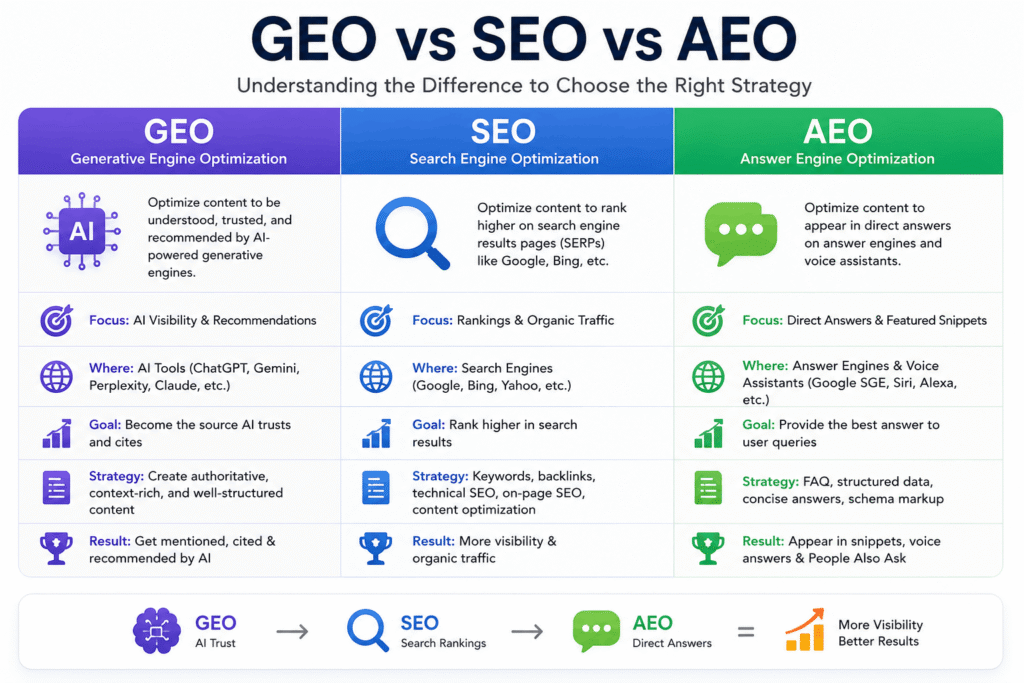
These three get treated as rivals. They’re layers.
- SEO gets your page indexed, trusted, and ranked. It’s the foundation everything else stands on.
- AEO gets a direct answer extracted from your page — snippets, voice, answer boxes.
- GEO gets your content cited inside a generated answer, with your brand named as a source.
Skip the foundation and the rest collapses. Google’s AI Overviews are built on top of its regular index, so a page that can’t rank normally rarely shows up in an AI summary either. For the extraction layer, see our Answer Engine Optimization (AEO)]; for why the acronyms matter less than the work, read on AEO, GEO, LLMO and what actually matters .
How to do GEO: a practical framework
Here’s the order I’d work in with any business, from a funded startup to a single-location shop.
1. Make your pages retrievable
Start boring. Fast-loading pages, content in real HTML rather than locked behind scripts, clean internal linking, and a crawlable site. If your robots settings block AI crawlers, decide that deliberately — not by accident.
2. Write self-contained, quotable answers
Generative engines lift passages, not whole pages. Each section should make sense on its own, without the reader needing the three paragraphs above it. State the point, then support it.
3. Add citations, quotes, and real numbers
This is the research-backed part. Reference credible sources by name, quote genuine experts, and use sourced statistics instead of vague claims like “most businesses.” Every verifiable detail gives an engine a reason to trust you.
4. Use structured data so machines read you correctly
Mark content up with Schema.org types — Organization, Product, FAQ Page, Local Business. Schema removes ambiguity about who you are and what you offer, which reduces the chance an engine misattributes or skips your content.
5. Build brand mentions, not just backlinks
Generative engines learn associations from text across the web. When your business name repeatedly appears alongside your category and city in trusted places — directories, associations, local media, industry roundups — the model connects those dots. Unlinked mentions count here in a way they never quite did for classic SEO.
6. Keep your entity information consistent
Same business name, same address, same phone, same description everywhere. Contradictory details across the web make you a low-confidence source, and low-confidence sources don’t get cited.
7. Demonstrate real experience
Google’s helpful, reliable, people-first content guidance leans on E-E-A-T — Experience, Expertise, Authoritativeness, Trust. Named authors with real credentials, original observations, and first-hand detail separate you from the endless generic content AI engines are already drowning in.
What does GEO look like for a normal business?
Take a plumber in Jaipur. Someone asks an AI assistant, “what should I do about a leaking overhead tank, and who fixes it?”
The plumber gets named not through some AI hack, but because their site has:
- a clear page explaining common overhead tank problems and realistic repair costs;
- step-by-step content written from actual jobs, not copied boilerplate;
- service areas, timings, and emergency availability stated plainly;
- LocalBusiness schema and consistent listings across directories;
- a few genuine mentions on local platforms and association pages.
The engine now has a specific, verifiable, well-described source for that question. Yeh koi jaadu nahi hai — it’s just being the most useful, most legible option available.
Something I keep running into: businesses obsess over whether AI “likes” them, while their own website still can’t answer a basic pricing question in plain words. Every time I’ve seen a brand start getting cited, the change wasn’t clever — they finally wrote down the things they’d been explaining on the phone for years.
Are you accidentally blocking the AI engines?
This one catches people out, so check it before anything else. AI companies use their own crawlers to fetch pages, and many sites block them — sometimes on purpose, often because a developer copied a robots.txt file from somewhere else.
Your robots.txt file controls which crawlers may access your site. If AI crawlers are disallowed, your content can be excluded from the live retrieval those tools depend on — and no amount of good writing fixes that.
There’s also a newer proposal called llms.txt, a simple file that points AI systems to your most useful content in plain text. Adoption is still early and it is not an official standard, so treat it as a low-cost experiment rather than a requirement. Get crawl access right first.
Common GEO mistakes to avoid
- Treating GEO as separate from SEO. It sits on the same foundation. Broken basics sink both.
- Publishing AI-written filler. Generic content gives an engine no reason to pick you over a hundred identical pages.
- Vague claims with no sources. “Industry-leading results” is unciteable. A sourced number is not.
- Buying tools that promise guaranteed AI citations. No one controls what a model outputs. Be sceptical of anyone claiming otherwise.
How do you measure GEO results?
Honest answer first: GEO measurement is immature, and anyone selling you precision here is overselling. What you can reasonably track:
- Referral traffic from AI tools in your analytics — sources like ChatGPT and Perplexity show up as referrers.
- Manual spot checks: ask the engines your top buyer questions monthly and note who gets cited.
- Branded and direct search growth, which often rises when AI answers start naming you.
- Google Search Console visibility for question-shaped queries.
Accept the limitation: AI answers vary between users and change without notice, so treat this as a trend line, not a dashboard number.
Your Questions, Answered
What is Generative Engine Optimization (GEO)?
Generative Engine Optimization (GEO) is the practice of creating and structuring content so generative AI engines like ChatGPT, Gemini, Perplexity, and Google AI Overviews cite it in their answers. Instead of aiming for a ranked link, GEO aims for your brand to be named as a source inside an AI-generated response.
What is the difference between GEO and SEO?
SEO focuses on ranking pages in traditional search results, while GEO focuses on being cited within AI-generated answers. GEO depends on SEO rather than replacing it, because most AI engines retrieve from the same indexed, crawlable web that SEO serves.
Is GEO the same as AEO?
They overlap but differ in scope. AEO covers answer engines broadly, including featured snippets and voice results, while GEO focuses specifically on generative AI engines that compose answers and attach citations. The underlying work — clear, structured, credible content — serves both.
How do I get my business cited by ChatGPT or Perplexity?
Make your pages crawlable and fast, write self-contained answers to real customer questions, support claims with citations and sourced statistics, and add schema markup. Then build consistent brand mentions across trusted sites so engines associate your name with your category.
Does GEO work for small businesses and local brands?
Yes. Local and niche businesses often have specific, first-hand knowledge that generative engines struggle to find elsewhere. Writing that knowledge down clearly, adding Local Business schema, and keeping listings consistent can make a small brand a highly citeable source.
Do backlinks still matter for GEO?
Backlinks still matter because they support the rankings and trust signals AI engines draw on. But brand mentions carry more weight in GEO than in classic SEO, since language models learn associations from how often your name appears alongside your topic in credible text.
Can I guarantee that AI engines will cite my content?
No, and any tool or agency promising guaranteed AI citations is overstating what is possible. Model outputs vary between users and change without warning. What you can do is improve your odds consistently by being clear, credible, well-structured, and widely mentioned.